



| HEADLINE |

|

Edn minister plans to scrap admission lottery from 2027
Published : Tuesday, 17 March, 2026 at 12:00 AM
Staff Correspondent


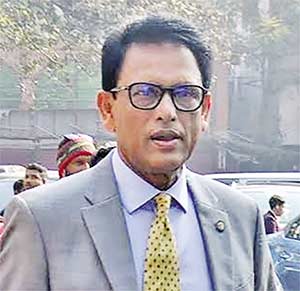 Education Minister ANM Ehsanul Haque Milon on Monday announced that the government has decided to abolish the lottery-based admission system for classes I to IX in both government and private schools, replacing it with a simple admission test from the 2027 academic year.
The announcement came during a briefing at the meeting room of the Secondary and Higher Education Division under the Ministry of Education.
Addressing the briefing, the minister said the government has taken a policy decision to replace the current lottery system with an assessment-based admission process.
"We have decided that from the 2027 academic year we will conduct admission tests for all classes," he said.
However, Milon emphasised that the proposed assessment would be simple and not academically burdensome for young students.
"It will not be a complicated test. We will not make them neurosurgeons in class one. Admission will be conducted through a simple test," he said.
Responding to concerns that admission tests might encourage coaching businesses and lobbying practices, the minister dismissed the possibility, saying the process would remain straightforward and transparent.
"There will be no opportunity for coaching here. It will be a simple test conducted in a general manner. There is no reason for parents to worry," he said.
He also questioned the sustainability of the lottery system in an organised education structure.
"I believe admission through lottery cannot continue in any education system," the minister remarked.
During the briefing, Milon also announced another policy decision regarding the leadership of managing committees and governing bodies of educational institutions. He said the government has withdrawn an earlier move to relax the educational qualification requirement for presidents or chairpersons of these bodies.
"Our baseline requirement for becoming chairman or president of the governing body will be a graduate degree," he said.
However, he added that academic qualifications alone would not determine eligibility.
"Other factors will also be considered based on qualifications and skills. We want to bring qualified and capable people to leadership positions in these institutions," he said.
Referring to earlier provisions, Milon noted that previous regulations had limited such leadership roles mainly to senior teachers or headmasters, restricting wider participation and sometimes giving rise to allegations of nepotism and favouritism.
"We want to move away from that trend and create opportunities for everyone. A fair and effective system must be developed based on qualifications and transparency," the minister added.
Loading...
Loading...
Also read



Editor : Iqbal Sobhan Chowdhury
Published by the Editor on behalf of the Observer Ltd. from Globe Printers, 24/A, New Eskaton Road, Ramna, Dhaka.
Editorial, News and Commercial Offices : Aziz Bhaban (2nd floor), 93, Motijheel C/A, Dhaka-1000.
Phone: PABX- 41053001-06; Advertisement: 41053012; 01793317829, 01550707291, E-mail: [email protected], [email protected] Online: email: [email protected] 41053014; 01550707297 Advertisement: 01550707296
Published by the Editor on behalf of the Observer Ltd. from Globe Printers, 24/A, New Eskaton Road, Ramna, Dhaka.
Editorial, News and Commercial Offices : Aziz Bhaban (2nd floor), 93, Motijheel C/A, Dhaka-1000.
Phone: PABX- 41053001-06; Advertisement: 41053012; 01793317829, 01550707291, E-mail: [email protected], [email protected] Online: email: [email protected] 41053014; 01550707297 Advertisement: 01550707296


