



| HEADLINE |

|
Trauma centers must be equipped to treat injured patients


 Major trauma is an injury or combination of injuries that are life threatening or could be life changing because it may result in permanentorlongtermdisability. Among common major traumatic injuries arehead injury& spinal injuries,multiple bone fractures,severe chest trauma, major internal organ damageor combination of these injuries. These are high energy trauma resulting commonly from road traffic accidents,collapse of building& bridges, gunshot injuries.Disasters such as earthquake,cyclones, industrial accidents, massive train,aeroplane and water transportaccidents alsocauses major traumatic injury but involves a large number of people at a time.Road traffic accidentis a rapidly increasing critical and widespreadglobal public health problem.
 Worldwide road traffic accident causes approximately 1.2-1.35 milliondeaths and 20-50 million of injuriesannually.It is one of the leadingcausesof death of young individual and nearly 70% of reported road traffic accident death involve people under the age of 45 with the 5- 29 age group being at most risk.It now ranks8th among the 50 major cause of death and forecasted tobe the 5th major cause of death by 2030 which reveals the gradually increasing trends of fatality from RTA globally.
Incidence of road traffic accident in Bangladesh is comparatively high and it is also a critical public health issue of our country.Statistically it was shown thatin 2024there were 8543 fatalities and total number of injured were 12608, and in2025 there were 9111 fatalities and 14812 total injuries (BangladeshJatri Kalyan Samity),which revealsthathere is 5.79% increase in fatality from RTA in 2025 in comparison to 2024 and this sequences of annually increasing trends from RTA have also been observed in our country before 2024.
 ECONOMIC AND SOCIAL IMPACT: Beyond deaths RTA is a leading cause of long term morbidity and permanent disability.It has been noted from scientific analysisthat when there is death of one persondue to road traffic crashes there are another three persons who had suffer from long term morbidity or permanent disability.The victims are often within the most economically productive age group. Economic loss resulting from road traffic accidentnot only involve the persons or their families but it has also impact on national economy.The economic losses are immense including high treatment cost, loss of productivity and in a large scale has impact on economic growth of country. According to world bank estimation the cost related to traffic crashes of a country can be as high as 5% of GDP.
Both mortality and morbidity and the economic loss as a percentage of gross domesticproduct (GDP) in Bangladesh is comparatively higher than in countries with similar socioeconomic condition.In Bangladeshroad traffic accident cost roughly 2% of annual GDP.Overall mortality rate from road traffic accidents has a co-relation with economics status ofa country. Death rate including prehospital and in hospital death is about 35% in high-income nations.Mortality rate rises to 55% in middle incomeeconomics and upto 63%in low- incomeeconomics countries.
There is a stark contrast in mortality rate between a high -income country's urban hospitalwhich canbe as low as 6% and rural area of a low-income countrywhere death raterises up to 36%.While high- income countries have made significant progress in reducing deaths, low and middle- income countries are still facing higherand insomecasesworsening fatality rates (research gate). If we consider RTA regionally, there is also regional variations.Regional picture reveals that the European region has the lowest average death rate 9.3 per 100,000 population,the African region has highest average road traffic accident death rate about 26.6 per 100,000 population and among African nations fatality rate of Dominican Republic is 67 per100,000 and Guinea is 37 per100,000.
Prevention of Road traffic accident is absolutely essential to reduce the prevalence of accident in a country but to reduce the preventable death and disability health sector needs an efficient and time bound management strategy of road traffic accident patients. Management of major trauma is highly specialized, skilled category of management with a goal to immediate life savings and prevention of dread complications.It follows a systemicteam-based approachprioritizing life threatening injuries.
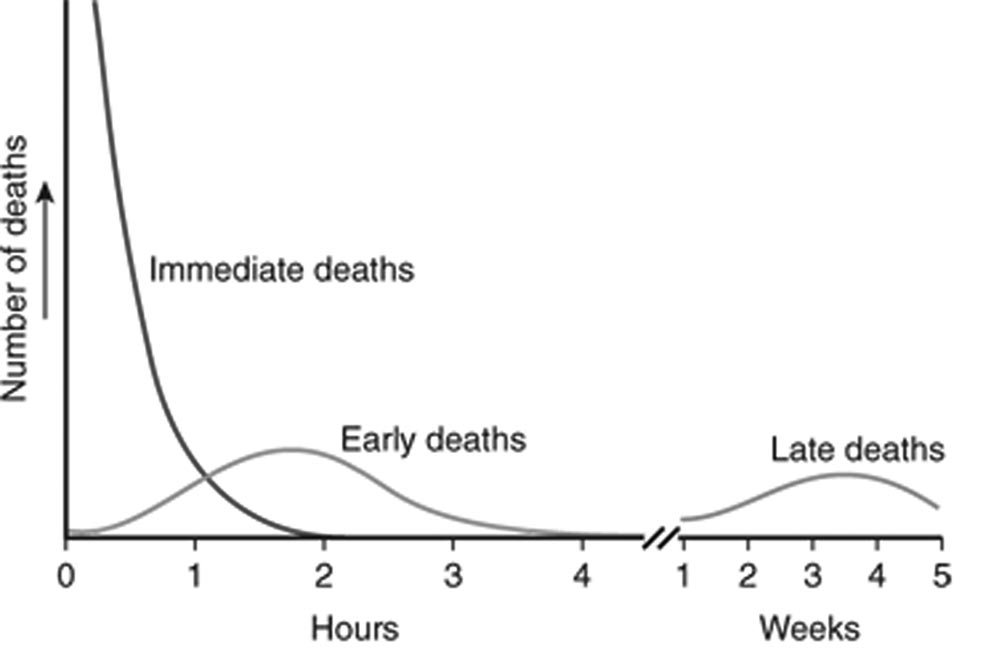
Death as a result of major trauma classically follow trimodalpattern, that is it occur in 3 waves or peak. The 1st peak of death is unavoidable but a significant number of 2nd and 3rd peak deathsalong with reduction in complication rate can be done by early and efficient medical management. Approximately 50 percent of severely injured patient die immediately or within minutes of accident and these deaths are not preventable due to nature of injuries which are due to non-survival injuries like- Central nervous system injuries (head injury and spinal injury), cardiovascular disruption.Another 30 percent of the injured survived the initial trauma but may die within 1-3 hours without proper and adequate management. A significant proportion of these death can be avoided with efficient emergency medical service(EMS) that must beinitiatedwithin 1st hour andthisfirst hourafter major trauma is the most crucial period that determine the subsequent outcome.
The patient might not die within hours but there be some changes to be happened that is irreparable and might lead to death later on. This 1st 60 minutes period for major trauma patient is termed as "GOLDEN HOUR" of trauma management.This peak of death is mostly due tohypoxia(low oxygen) and hypovolemic (low blood volume) shock, which needs very urgent management,unless that these can lead to irreversible shock and multiorgan failure. This concept ofdefinitive resuscitative trauma care initiated within this golden hour that has been practiced for more than four decades with success.The remaining 20% death occur due to complication at the late stage during the 6 weeks which is mentioned as 3rdpeak of trauma death and these can be also reduced by early and effective treatment.
Trauma center is a specialized hospital unit equipped and staffed withto provide comprehensive and immediate and 24/7 hours, care to patients with major trauma from road traffic accident, gunshot injuries, industrial accidents,earthquakes, cyclone, other catastrophes. These centersneed to be enriched with dedicated surgeons, specialist and equipment available immediatelyto treat critical injuries during the golden hour.These are the satellite clinics.
Bangladesh has comparatively higher rate of road traffic accidents and almost 44% of RTA occur on National Highways.Major trauma victim needs urgent transfer to nearest hospital having adequate lifesaving facilities, initiation of definitive care within golden hour. It should be done with accurate planning, providing necessary equipment and expertise in these centers. With continued monitoring, surveillance andensuring accountability, injured patient will get high quality life saving treatment at these centers and can regain their trust upon these centers.
The writer is Professor(Ortho-Surgery) & Ex-Project Director GOB
Loading...
Loading...
Also read



Editor : Iqbal Sobhan Chowdhury
Published by the Editor on behalf of the Observer Ltd. from Globe Printers, 24/A, New Eskaton Road, Ramna, Dhaka.
Editorial, News and Commercial Offices : Aziz Bhaban (2nd floor), 93, Motijheel C/A, Dhaka-1000.
Phone: PABX- 41053001-06; Advertisement: 41053012; 01793317829, 01550707291, E-mail: [email protected], [email protected] Online: email: [email protected] 41053014; 01550707297 Advertisement: 01550707296
Published by the Editor on behalf of the Observer Ltd. from Globe Printers, 24/A, New Eskaton Road, Ramna, Dhaka.
Editorial, News and Commercial Offices : Aziz Bhaban (2nd floor), 93, Motijheel C/A, Dhaka-1000.
Phone: PABX- 41053001-06; Advertisement: 41053012; 01793317829, 01550707291, E-mail: [email protected], [email protected] Online: email: [email protected] 41053014; 01550707297 Advertisement: 01550707296


