



| HEADLINE |

|

Onion-potato farmers count losses despite bumper harvest



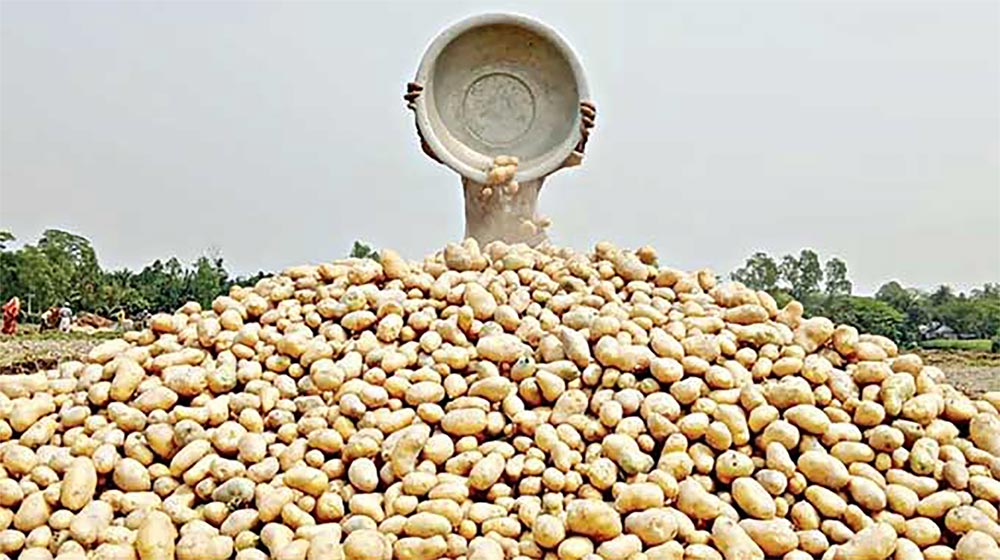 RAJSHAHI, Apr 3: Despite bumper harvests of potatoes and onions this season, growers across Rajshahi and other northern districts are counting losses as market prices have plunged far below production costs.
 At the farm level, potatoes are selling for Tk 8-10 per kg, while production costs-including irrigation, fertiliser, seed, labour, wastage, and transport-amount to at least Tk 14 per kg. That means growers are losing Tk 4-6 on every kilogram.
The situation is even worse for onions. Production costs this season are estimated at Tk 38 per kg. But in Pabna, the country's largest onion producing district, wholesale prices on March 30 were Tk 18-19 per kg-barely half the cost. Farmers say their dreams have been turned into nightmares, as losses mount year after year.
Reports from Rajshahi, Naogaon, Joypurhat, and Natore suggest prices have fallen further, with onions selling for as little as Tk 10 per kg. Growers there are facing severe financial distress.
According to the Department of Agricultural Marketing (DAM), potato production costs average Tk 14 per kg, while the Bangladesh Cold Storage Association estimates Tk 16. DAM puts onion costs at Tk 38 per kg, based on last year's figures.
Farmers confirm the numbers. Mobarak Hossain of Mougachhi in Mohanpur Upazila, Rajshahi, cultivated potatoes on 50 bighas of leased land, paying Tk 10 lakh to landowners. With seed, land preparation, irrigation, pesticides, and labour, his costs reached Tk 40-42,000 per bigha. Yields were 82 maunds per bigha, but he is earning only Tk 20-22,000-half the cost. "Potatoes have become a thorn in my throat," he said. "I can neither swallow nor spit them out. Last year I lost money too. Two years of losses have left me sleepless."
In Pabna, onions are selling for Tk 700-800 per maund (42 kg), with the best quality fetching Tk 900. But farmers say production costs are Tk 1,200-1,500 per maund. "We lost money last year, and this year is the same," said Yasin Ali of Kolchuri Village. "Unless prices reach Tk 2,000 per maund, we cannot cover costs. Farmers will perish if this continues."
Continuous losses are forcing growers into debt and raising concerns about food security. Experts warn that if farmers are discouraged from planting, future shortages could follow. In past years, some potato farmers unable to bear losses even took their own lives.
Md Ahsanuzzaman, President of the Bangladesh Agricultural Economists Association, said low food prices may comfort consumers temporarily but discourage production. He recommended direct procurement of surplus crops, export diversification, reduced transport costs, expanded cold storage, and incentives for affected farmers.
Bangladesh produced 11.2 million tonnes of potatoes in 2025, about 2.2 million tonnes above demand. Annual demand is around 9 million tonnes. This year's output is expected to be similar. Onion demand and production are roughly balanced, but spoilage forces imports from India. In FY 2024 25, total onion output was 4.25 million tonnes. This year's target is 4.26 million tonnes from 286,300 hectares, against demand of 3.5-4 million tonnes.
Last year, farmers also failed to get fair prices for potatoes, while onion imports depressed local markets. The interim government had promised relief: Tk 110 crore in subsidies for potato growers and procurement of 50,000 tonnes through the Trading Corporation of Bangladesh (TCB). But farmers say neither pledge was fulfilled. Cold storages still hold unsold potatoes from last season.
Agriculture Secretary Rafiqul E Mohammad said the issue of fair prices was raised in a meeting with the prime minister. "We are looking at ways to reduce farmers' losses," he said.
The DAM, tasked with ensuring fair crop prices, has failed to intervene effectively. Director Mohammad Monsur Alam Khan admitted last year's minimum price at cold storages did not work. "I am not aware of any similar steps this year," he said.
Farmers also demand a halt to onion imports during peak harvest, saying Indian onions undercut local produce. They call for a permanent policy to prevent unnecessary imports, lower fertilizer and pesticide costs, and special support for those hit by adverse weather.
In Rajshahi this season, potatoes were cultivated on 34,109 hectares and onions on 21,300 hectares, including 8,344 hectares of early harvest crops.
For now, farmers remain trapped between bumper harvests and collapsing prices-celebrating production but crying over their losses.
Loading...
Loading...
Also read



Editor : Iqbal Sobhan Chowdhury
Published by the Editor on behalf of the Observer Ltd. from Globe Printers, 24/A, New Eskaton Road, Ramna, Dhaka.
Editorial, News and Commercial Offices : Aziz Bhaban (2nd floor), 93, Motijheel C/A, Dhaka-1000.
Phone: PABX- 41053001-06; Advertisement: 41053012; 01793317829, 01550707291, E-mail: [email protected], [email protected] Online: email: [email protected] 41053014; 01550707297 Advertisement: 01550707296
Published by the Editor on behalf of the Observer Ltd. from Globe Printers, 24/A, New Eskaton Road, Ramna, Dhaka.
Editorial, News and Commercial Offices : Aziz Bhaban (2nd floor), 93, Motijheel C/A, Dhaka-1000.
Phone: PABX- 41053001-06; Advertisement: 41053012; 01793317829, 01550707291, E-mail: [email protected], [email protected] Online: email: [email protected] 41053014; 01550707297 Advertisement: 01550707296


