



| HEADLINE |

|
Hilsa production hits 8-year low
Published : Tuesday, 7 April, 2026 at 12:00 AM
Staff Correspondent


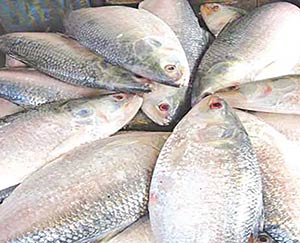 The lowest hilsa production in the last eight years was recorded in the 2024-25 fiscal year. Last year, Bangladesh produced 5 lakh tons of hilsa, which is the lowest since the 2016-17 fiscal year.
The 'Jatka Conservation Week 2026' will be celebrated across the country from today to April 13.
Fisheries and Livestock Minister Mohammad Amin Ur Rashid said that increasing hilsa production in the current situation is a big challenge. He shared this at a press conference on Monday (April 6) at the Secretariat for Jatka Conservation Week-2026.
He explained that maintaining hilsa production is becoming difficult due to river filling, climate change, river pollution, and continuous pressure on fish resources. The ministry plans to work together with everyone to deal with these challenges.
Amin Ur Rashid talked about the government's efforts to protect hilsa fish. He said the government has already taken several important steps for the sustainable development of hilsa resources.
One of the steps is a ban on all types of fishing in the Bay of Bengal from April 15 to June 11 (58 days). There is also a 22-day ban on hilsa fishing during the breeding season. Catching, transporting, and selling jatka (young hilsa) is completely banned from November 1 to June 30. The government has set up six hilsa sanctuaries and stopped fishing in those areas during specific times. It has also declared a marine protected area of 3,188 square kilometers.
In addition, the government is providing VGF food support and creating alternative jobs for fishermen.
The minister also said that projects like 'Sustainable Coastal and Marine Fisheries' and 'Hilsa Resource Development' are being implemented. He added that laws are being updated and strictly enforced to protect hilsa resources.
Earlier, a press conference on September 29 said that, according to the ARIMA model of the Bangladesh Fisheries Research Institute, hilsa production in 2024-25 could be between 538,000 and 545,000 tons. However, it was also warned that if the decline continues, the actual production could be even lower.
Officials said that in 2016-17, production was 496,000 tons, which was below 500,000 tons. After that, production stayed above 500,000 tons until 2023-24, but last year it dropped again to 500,000 tons.
According to the Fisheries Department, production was 529,000 tons in 2023-24, 571,000 tons in 2022-23, 566,000 tons in 2021-22, 565,000 tons in 2020-21, 550,000 tons in 2019-20, 532,000 tons in 2018-19, and 517,000 tons in 2017-18. This confirms that last year had the lowest production in eight years.
The minister said hilsa is very important for nutrition, jobs, fishermen's livelihoods, the rural economy, and overall socio-economic development. Hilsa contributes about 9.79% of total fish production and about 1% to the national GDP. More than 80% of the world's hilsa comes from Bangladesh.
He added that Bangladesh ranks first among 11 hilsa-producing countries, and its hilsa has GI recognition. About 600,000 people are directly involved in catching hilsa, while 20-25 million people are connected to related work like transport, selling, and processing. When asked about fuel shortages, the minister said there is no major problem with fuel supply. He also said the government will investigate if there are other reasons for high hilsa prices and is working to stop smuggling.
He further said that hilsa fishing is also being controlled in Indian waters along with Bangladesh.
In response to another question, he said hilsa production has decreased due to sandbars (char) in rivers. The government has taken plans to dredge rivers and canals so hilsa can move easily.
Loading...
Loading...
Also read



Editor : Iqbal Sobhan Chowdhury
Published by the Editor on behalf of the Observer Ltd. from Globe Printers, 24/A, New Eskaton Road, Ramna, Dhaka.
Editorial, News and Commercial Offices : Aziz Bhaban (2nd floor), 93, Motijheel C/A, Dhaka-1000.
Phone: PABX- 41053001-06; Advertisement: 41053012; 01793317829, 01550707291, E-mail: [email protected], [email protected] Online: email: [email protected] 41053014; 01550707297 Advertisement: 01550707296
Published by the Editor on behalf of the Observer Ltd. from Globe Printers, 24/A, New Eskaton Road, Ramna, Dhaka.
Editorial, News and Commercial Offices : Aziz Bhaban (2nd floor), 93, Motijheel C/A, Dhaka-1000.
Phone: PABX- 41053001-06; Advertisement: 41053012; 01793317829, 01550707291, E-mail: [email protected], [email protected] Online: email: [email protected] 41053014; 01550707297 Advertisement: 01550707296


