



| HEADLINE |

|

Farmers cry as potato prices fall below cost
Dumping rotten potatoes on roadsides
Published : Sunday, 10 May, 2026 at 12:00 AM
Laboni Yeasmin from Rangpur


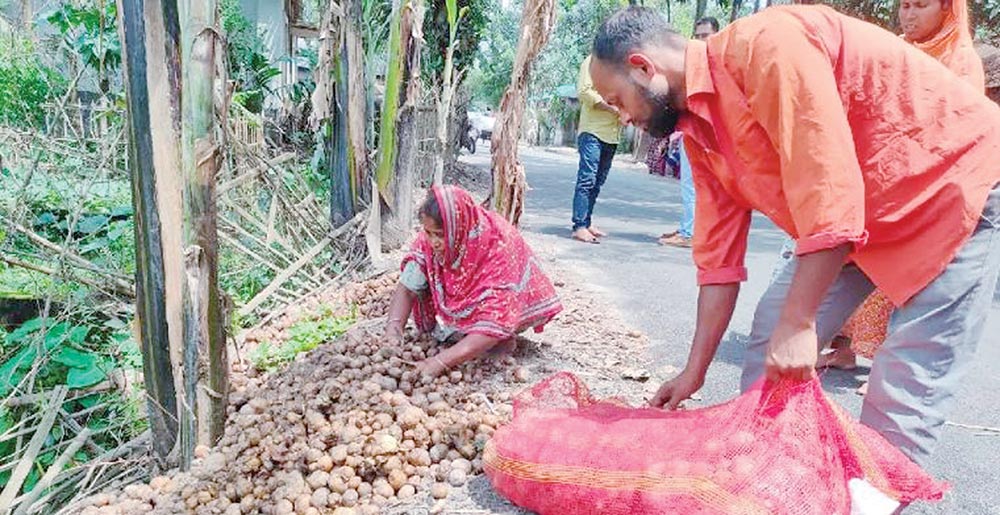 A bumper potato harvest in Rangpur, one of Bangladesh's key producing regions, has turned into a season of heavy financial distress for farmers, with prices collapsing far below production costs and storage limitations forcing widespread losses.
Many growers say they are now dumping rotten potatoes along roadsides after failing to sell or preserve their produce, as market prices remain significantly lower than production costs.
Mizanur Rahman, a farmer from Chengmari in Gangachara, cultivated potatoes on around 300 decimals of land and stored his harvest at home in hopes of better prices. Instead, poor storage conditions led to severe spoilage. "Eventually, I had to throw away nearly 50 sacks," he said.
Abdul Majid from Kutubpur in Badarganj faced a similar outcome after storing 500 sacks in cold storage last year. With prices remaining low, he chose not to withdraw them. "This year again, potato cultivation has pushed us toward ruin," he said.
Farmers across Kaunia, Mithapukur, Pirgachha, Pirganj, Badarganj, Gangachara and Rangpur Sadar reported seeing piles of decomposed potatoes along roadsides, with foul smells spreading from open dumping sites.
According to farmers, production costs this year ranged between Tk 13 and Tk 15 per kilogram, while market prices fell to Tk 7-9 per kg, and in some cases as low as Tk 3-4 during peak harvest.
The Department of Agricultural Extension (DAE) estimates Rangpur produced around 1.605 million metric tons of potatoes this season, exceeding its target. However, the price crash has resulted in an estimated loss of around Tk 963 crore in the region, with stakeholders suggesting total losses-including spoilage and storage costs-could reach Tk 1,300 crore.
The crisis has been intensified by rainfall and high humidity during harvesting, damaging potatoes stored in homes and making preservation difficult. Many farmers say they cannot even recover transportation and storage expenses.
Parveen Akter from Chengmari said she invested heavily, including selling cattle worth Tk 150,000 and taking inputs on credit, but failed to sell her produce in time. Nearly 200 sacks stored at home were damaged by rain.
In Pirgachha's Bogurapara village, farmers described similar struggles, saying many had to take loans from NGOs to continue cultivation but are now unable to recover costs after harvesting thousands of kilograms.
Farmers say inadequate cold storage facilities are a major cause of the crisis. Existing capacity covers only about 22 percent of total production in the region, forcing most farmers to sell during peak season when prices collapse.
Cold storage operators also report losses due to high electricity and fuel costs, with some stock from last year still unsold because of low demand.
Farmers and traders are now urging government intervention, including increased exports and direct procurement to stabilise prices. Some have alleged market syndicates are worsening the situation.
Agriculture officials acknowledge the price crash despite good production conditions. Stakeholders, including farmers' groups, are calling for a support price above production costs to prevent repeated losses in the sector.
Loading...
Loading...
Also read



Editor : Iqbal Sobhan Chowdhury
Published by the Editor on behalf of the Observer Ltd. from Globe Printers, 24/A, New Eskaton Road, Ramna, Dhaka.
Editorial, News and Commercial Offices : Aziz Bhaban (2nd floor), 93, Motijheel C/A, Dhaka-1000.
Phone: PABX- 41053001-06; Advertisement: 41053012; 01793317829, 01550707291, E-mail: [email protected], [email protected] Online: email: [email protected] 41053014; 01550707297 Advertisement: 01550707296
Published by the Editor on behalf of the Observer Ltd. from Globe Printers, 24/A, New Eskaton Road, Ramna, Dhaka.
Editorial, News and Commercial Offices : Aziz Bhaban (2nd floor), 93, Motijheel C/A, Dhaka-1000.
Phone: PABX- 41053001-06; Advertisement: 41053012; 01793317829, 01550707291, E-mail: [email protected], [email protected] Online: email: [email protected] 41053014; 01550707297 Advertisement: 01550707296


