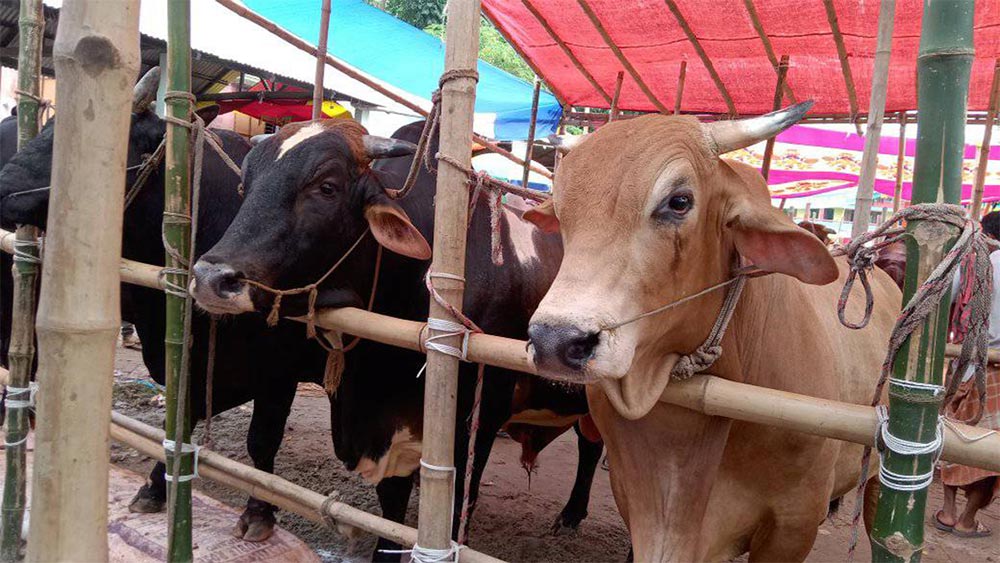
SIRAJGANJ, May 13: As Eid-ul-Azha approaches, cattle farmers in Sirajganj are passing busy days preparing sacrificial animals for the upcoming festival, with the district expecting livestock sales worth more than Tk 350 crore this season.
Officials of the Department of Livestock Services said the district has reared a significantly higher number of cattle, goats, sheep and buffaloes than the local demand, ensuring there will be no shortage of sacrificial animals in local markets. A large number of animals are also expected to be supplied to other districts, including Dhaka and Chattogram.
Once heavily dependent on cattle entering from India through border routes, Sirajganj's sacrificial animal market has gradually shifted towards local production in recent years due to tighter border controls, creating new opportunities for local farmers and cattle rearers.
Farmers across all nine upazilas of the district, including Shahjadpur, Ullapara, Sirajganj Sadar, Belkuchi and Raiganj, are fattening cattle and goats using natural feed such as wheat bran, rice husk, soybean meal, mustard oilcake, maize, lentil husk, straw and rice fragments.
Various breeds of cattle, including indigenous, Indian, Sahiwal, Fighter, Rajasthani, Western, Friesian, Brahman and Australian varieties, are being raised for Eid markets. Farmers are also rearing improved goat breeds such as Totapuri, Haryana and Beetal.
According to the District Livestock office, Sirajganj's demand for sacrificial animals this year stands at 217,850, while a total of 624,928 animals have been prepared across the district. After meeting local demand, more than 407,000 animals are expected to be transported to different parts of the country.
The district currently has around 17,068 farms and privately reared livestock units. Of the prepared animals, there are 173,110 bulls, 33,605 oxen, 15,717 cows, 3,681 buffaloes, 338,235 goats and 60,580 sheep.
Ali Hossain, a cattle farmer from Hatpangashi Village in Raiganj Upazila, said he had prepared 12 bulls for sale this Eid. He said each bull was purchased around six months ago at an average price of Tk 70,000 and additional expenses for feed and care pushed the total cost of rearing each animal to over Tk 130,000.
"Feed prices have increased sharply, but if cattle from India do not enter the market, we hope to get fair prices and make a profit," he said.
Rafiqul Islam Khan, owner of Khan Agro Farm in Sirajganj Sadar, also said the rising cost of cattle feed had increased production expenses this year. However, he expressed hope that farmers would still benefit if imported cattle did not flood the market.
Goat farmer Altaf Hossain from Rajibpur Village said he had prepared 15 goats of improved breeds, including Haryana Totapuri and Beetal, for Eid sales. He claimed some Haryana goats could fetch prices of up to Tk 3 lakh each.
District Livestock Officer Dr AKM Anwarul Haque said Sirajganj is widely known for its livestock production and naturally raised animals are in demand across the country.
He said livestock officials were regularly monitoring farms and raising awareness against the use of harmful medicines for artificial fattening.
"Although rearing costs have increased somewhat, animal prices have also gone up. We believe farmers will make profits this Eid season," he added.





