



| HEADLINE |

|
What causes rising road fatalities?
Published : Monday, 18 May, 2026 at 12:00 AM
MD Al Amin Rony


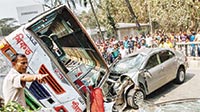 Road accidents have now become one of the most alarming public safety crises in Bangladesh. Almost every day, news of deaths and serious injuries caused by traffic collisions appears across the country. People are dying in bus overturns, head-on collisions, reckless overtaking incidents, and accidents involving motorcycles, trucks, and private vehicles. The frequency of these incidents has created a growing sense of fear among ordinary citizens. For many families, leaving home for work, school, or travel has become associated with uncertainty and risk. The roads, which should symbolize mobility and development, are increasingly becoming places of insecurity and tragedy.
One of the most significant causes behind road accidents is reckless and uncontrolled speeding. Many drivers operate vehicles at dangerously high speeds without considering road conditions, passenger safety, or traffic regulations. Excessive speed reduces reaction time and increases the severity of accidents when collisions occur. In densely populated areas or on poorly maintained highways, reckless speed becomes even more dangerous. The culture of fast driving, often encouraged by competition for passengers or profits, continues to contribute to countless preventable deaths and injuries every year.
Driver incompetence is another major factor contributing to the country's road safety crisis. Many drivers operate heavy vehicles without receiving proper training or professional certification. In some cases, individuals lacking sufficient driving skills are entrusted with transporting large numbers of passengers. This situation becomes particularly dangerous during adverse weather conditions, nighttime driving, or heavy traffic congestion. The absence of adequate training and professional accountability weakens overall road discipline and significantly increases accident risks.
In many instances, unqualified helpers or assistants are found operating buses and other public vehicles. This dangerous practice exposes passengers and pedestrians to severe risks. Helpers often lack the training, experience, and legal authorization required to drive safely on busy roads. Allowing unqualified individuals to control public transport vehicles reflects weak monitoring systems and inadequate enforcement of transportation regulations. Such negligence continues to place countless lives in danger every day.
Non-compliance with traffic laws remains a persistent challenge across the country. Traffic signals, lane rules, pedestrian crossings, and speed limits are frequently ignored by drivers and vehicle operators. This widespread disregard for traffic discipline creates chaotic road conditions that increase the likelihood of accidents. Without strict enforcement of road regulations, even well-designed transportation systems cannot function safely or efficiently. Ensuring compliance with traffic laws is therefore essential for reducing road fatalities.
Dangerous competition among transport operators is another significant contributor to accidents. Public buses and other commercial vehicles often engage in reckless overtaking and aggressive driving in attempts to reach destinations faster or collect more passengers. This competitive behavior transforms roads into hazardous spaces where safety becomes secondary to financial gain. Such practices are particularly common on highways and urban routes where transport operators compete intensely for passengers.
Irregularities and corruption in the process of issuing driving licenses further weaken road safety standards. In some cases, licenses are obtained without proper examinations or verification of driving competence. This allows unqualified individuals to legally operate vehicles despite lacking the necessary skills and knowledge. Weak regulatory oversight and corruption within licensing systems undermine public safety and contribute directly to the increasing number of accidents on the roads.
Poorly maintained roads, insufficient street lighting, lack of footpaths, damaged highways, and inadequate traffic management systems contribute significantly to accidents. In many areas, roads are not designed to accommodate the rapidly increasing number of vehicles. Improving transportation infrastructure and ensuring proper maintenance are therefore crucial for enhancing road safety and reducing fatalities.
The role of government institutions and law enforcement agencies is critical in addressing this crisis effectively. Strong monitoring systems, strict punishment for traffic violations, improved driver training, and transparent licensing procedures are necessary to reduce accidents. At the same time, coordinated efforts involving transport authorities, traffic police, educational institutions, and civil society organizations are required to promote a culture of road discipline and public responsibility.
The growing number of road accidents in Bangladesh reflects deeper problems related to governance, infrastructure, public awareness, and enforcement failures. Without comprehensive reforms, the situation is likely to worsen as urbanization and vehicle numbers continue to rise. Road safety must therefore be treated as a national priority rather than a routine transportation issue. Through stronger regulations, responsible driving practices, public awareness, and improved infrastructure, Bangladesh can move toward creating safer roads and protecting countless lives from preventable tragedies.
The writer is a student, Department of Law, World University of Bangladesh
Loading...
Loading...
Also read



Editor : Iqbal Sobhan Chowdhury
Published by the Editor on behalf of the Observer Ltd. from Globe Printers, 24/A, New Eskaton Road, Ramna, Dhaka.
Editorial, News and Commercial Offices : Aziz Bhaban (2nd floor), 93, Motijheel C/A, Dhaka-1000.
Phone: PABX- 41053001-06; Advertisement: 41053012; 01793317829, 01550707291, E-mail: [email protected], [email protected] Online: email: [email protected] 41053014; 01550707297 Advertisement: 01550707296
Published by the Editor on behalf of the Observer Ltd. from Globe Printers, 24/A, New Eskaton Road, Ramna, Dhaka.
Editorial, News and Commercial Offices : Aziz Bhaban (2nd floor), 93, Motijheel C/A, Dhaka-1000.
Phone: PABX- 41053001-06; Advertisement: 41053012; 01793317829, 01550707291, E-mail: [email protected], [email protected] Online: email: [email protected] 41053014; 01550707297 Advertisement: 01550707296


