



| HEADLINE |

|

A new hope for harvesting water from dry air
Published : Thursday, 21 May, 2026 at 12:00 AM
M Zahidul Islam


 Recently a Nobel laureate Prof Omar Yaghi of the University of California, has invented a machine that harvests water from dry air using ambient thermal energy which can generate up to 1000 litres of clean water every day. He used a type of science called reticular chemistry to create molecularly engineered materials, which can extract moisture from the air and harvest water even in arid and desert conditions. This environmentally friendly invention that provides clean water if regular supplies are blocked by an unexpected disaster such as a hurricane or drought, could be a life saver for vulnerable areas.
 One unit of this machine could be in size like a 20ft shipping container and powered entirely by ultra-low-grade thermal energy, may be installed in local communities to generate up to 1,000 litres of clean water per day.Yaghi, who won the 2025 Nobel Prize award in Chemistry, said the invention would change the world and benefit islands, which are prone to drought and it could be a solution for countries needing to get water to marooned communities after hurricanes, floods etc. which left thousands without fresh water. Describing the invention as "a science capable of reimagining matter" he urged leaders to "remove barriers, protect academic freedom" and "welcome global talent." The science is here - what we need now is courage - courage scaled to the enormity of the task, so we may gift the next generation not only carbon capture, but a planet worthy of their hopes," he said.
We must appreciate this innovation as the culmination of achievements through a longtime effort of generating water from the atmosphere.It has been evolving from ancient, passive methods such as collecting dew and fog using stone piles or nets - to advanced, energy-efficient modern systems. Modern technologies include utilization of sorbent materials like Metal-Organic Frameworks (MOFs) and solar energy to extract moisture from arid air, offering sustainable, off-grid drinking water solutions, particularly with the innovations developed at MIT in the 2020s. Historical review gives us an insight into the efficiency, evolution and relevance of ancient Atmospheric Water Harvesting (AWH) techniques from 5000 B.C. to the 1900s, alongside modern techniques.
Some of the studies reveal that the development of advanced AWH system has been difficult because of the challenging material properties required for the air filters, which must be able to absorb large amounts of water and readily expel it when needed. They have to function in low humidity, and, ideally, they should be usable off-grid. This is where California-based start-up Atoco comes in.
Atoco is a climate technology company founded in 2021 by Nobel laureate Professor Omar Yaghi that develops advanced materials, specifically Metal-Organic Frameworks (MOFs) - for AWH and carbon capture. It uses molecularly engineered, reticular solid-state materials to provide sustainable solutions for water scarcity and CO? reduction.Since then, Atoco has developed sophisticated nanoengineered reticular materials such as metal-organic frameworks (MOFs) - porous crystalline metallic and organic structures with extremely high internal surface areas, which are capable of adsorbing and expelling water and carbon dioxide. The company has produced on-grid AWH systems, as well as off-grid models that can harvest water using ambient thermal energy.
Atoco is currently planning field tests of its containerized industrial prototype AWH units, which it hopes will lead to commercialization in late 2026.
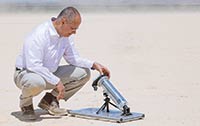
Prof. Omar Yaghi is seen with his device. Atoco's off-grid AWH systems are capable of harvesting water even in arid environments like Death Valley, as shown here. Image source: Atoco.
According to the Atoco's Vice President of Business Development, Magnus Bach, the properties of the core technology are just incredibly interesting and mind-boggling. He said: "Take, for instance, a "sugar-cube" of our MOF material. From the outside, this 1 g MOF cube would have a surface area of around 1 m2/g. Due to the extreme nanoscale porosity of the material, however, the internal surface area would be more than 7,000 m2/g - that corresponds roughly to a soccer field per gram. The fact that the material contains so much surface area is the key to understanding its exciting properties, because the more surface area you have, the more "molecular parking lots" are available for molecules to be adsorbed. Interestingly enough, the technology itself is considered solid-state, so even if the materials are saturated with water at a molecular level, it still looks dry to the naked eye."
In Bangladesh the AWH technologies mainly limited to rainwater harvestings and some ancient indigenous methods used in Hilly areas and some isolated Islands. This invention has opened up an opportunity to think, study and put our talents together to address all the challenges involved in the development of reticular materials, sustainable costs, easy utilization, and affordable for vulnerable areas around the world.
The writer is former Editor, Journal of the Institution of Engineers, Bangladesh

Loading...
Loading...
Also read



Editor : Iqbal Sobhan Chowdhury
Published by the Editor on behalf of the Observer Ltd. from Globe Printers, 24/A, New Eskaton Road, Ramna, Dhaka.
Editorial, News and Commercial Offices : Aziz Bhaban (2nd floor), 93, Motijheel C/A, Dhaka-1000.
Phone: PABX- 41053001-06; Advertisement: 41053012; 01793317829, 01550707291, E-mail: [email protected], [email protected] Online: email: [email protected] 41053014; 01550707297 Advertisement: 01550707296
Published by the Editor on behalf of the Observer Ltd. from Globe Printers, 24/A, New Eskaton Road, Ramna, Dhaka.
Editorial, News and Commercial Offices : Aziz Bhaban (2nd floor), 93, Motijheel C/A, Dhaka-1000.
Phone: PABX- 41053001-06; Advertisement: 41053012; 01793317829, 01550707291, E-mail: [email protected], [email protected] Online: email: [email protected] 41053014; 01550707297 Advertisement: 01550707296


