



| HEADLINE |

|

Smugglers put hurt cattle on sale
Published : Friday, 22 May, 2026 at 12:00 AM
Khandoker Azizur Rahman


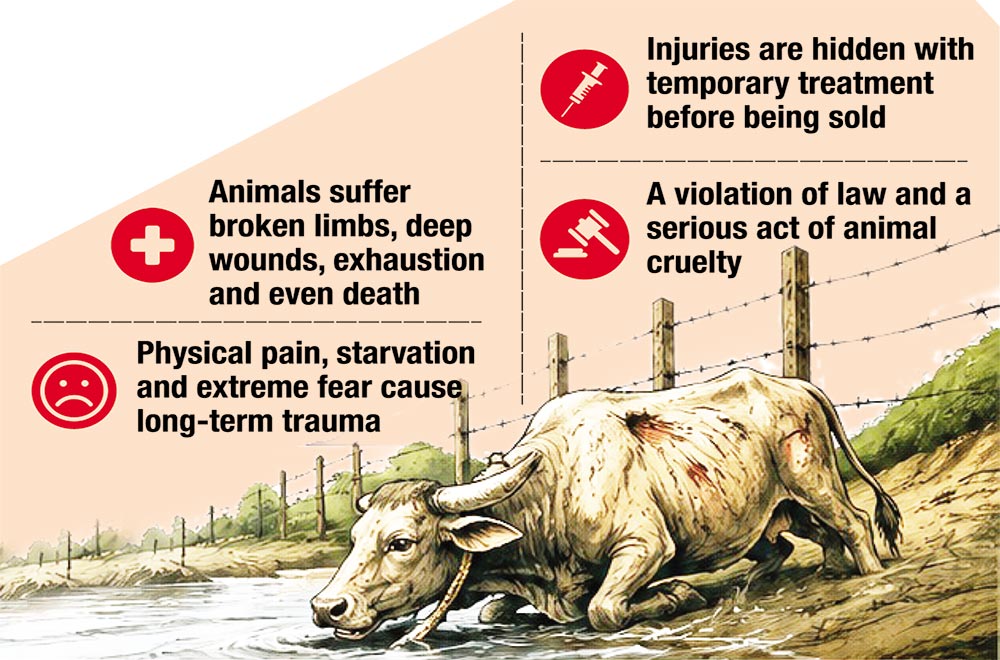 As Eid-ul-Azha approaches, Bangladesh's border regions are witnessing a sharp rise in illegal cattle smuggling, with disturbing allegations of severe animal cruelty during cross-border transportation from India through unauthorized routes.
Sources and traders say smuggled cattle and buffaloes are being brought into the country through dangerous and often violent methods, including forcing animals to swim across rivers, pushing them under or over barbed-wire fences, and, in some hilly border areas of Sylhet, Chapainawabganj and Dinajpur, reportedly rolling tied animals down steep slopes into Bangladeshi territory.
These practices frequently leave the animals critically injured, with reports of broken limbs, deep wounds, exhaustion and, in some cases, death during transit. Traders allegedly attempt to conceal injuries using temporary medication before selling the animals in Eid markets.
A trader at Dhaka's Gabtoli cattle market, speaking anonymously, said several Murrah buffaloes recently brought in through the Sylhet border showed visible injuries, including wounds on the back, neck, knees, waist and near the horns, along with signs of severe fatigue and distress.
According to him, animals are often tightly bound before being pushed downhill. "Many break their legs, some die. If an animal dies, payment may be avoided, but if it survives injured, the buyer still has to pay," he said, adding that traders attempt to keep them alive through basic treatment to ensure market sales.
Relevant sources say such smuggling typically intensifies before Eid, but continues year-round across border districts including Sylhet, Chapainawabganj, Cumilla and Mymensingh. Allegations of political protection and bribery facilitating smuggling networks have also surfaced.
Experts warn that beyond legal violations, the practice inflicts severe physical and psychological harm on animals, with long-term trauma even after visible wounds heal. They argue that the trade also undermines local livestock farmers by distorting market prices.
Calls have been made for stricter border monitoring, coordinated enforcement, and stronger action against those involved in animal abuse and illegal import operations. Specialists have also urged investment in domestic livestock production to reduce dependence on smuggled cattle.
Islamic scholars have noted that severely injured or disabled animals may not meet the requirements for Qurbani, raising additional ethical concerns ahead of the festival.
Fisheries and Livestock Adviser Mohammad Aminur Rashid said the country is self-sufficient in sacrificial animal production and urged people to avoid purchasing illegally smuggled cattle to protect local farmers and national interests.
State Minister for Fisheries and Livestock Sultan Salahuddin Tuku called for greater awareness and coordinated action to discourage illegal livestock trade and support domestic producers during the Eid season.
Officials from Border Guard Bangladesh were not available for comment despite repeated attempts.

Loading...
Loading...
Also read



Editor : Iqbal Sobhan Chowdhury
Published by the Editor on behalf of the Observer Ltd. from Globe Printers, 24/A, New Eskaton Road, Ramna, Dhaka.
Editorial, News and Commercial Offices : Aziz Bhaban (2nd floor), 93, Motijheel C/A, Dhaka-1000.
Phone: PABX- 41053001-06; Advertisement: 41053012; 01793317829, 01550707291, E-mail: [email protected], [email protected] Online: email: [email protected] 41053014; 01550707297 Advertisement: 01550707296
Published by the Editor on behalf of the Observer Ltd. from Globe Printers, 24/A, New Eskaton Road, Ramna, Dhaka.
Editorial, News and Commercial Offices : Aziz Bhaban (2nd floor), 93, Motijheel C/A, Dhaka-1000.
Phone: PABX- 41053001-06; Advertisement: 41053012; 01793317829, 01550707291, E-mail: [email protected], [email protected] Online: email: [email protected] 41053014; 01550707297 Advertisement: 01550707296


