



| HEADLINE |

|

Bangladesh medicine exports eye first-ever $250m mark as earnings climb
Published : Wednesday, 3 June, 2026 at 12:00 AM


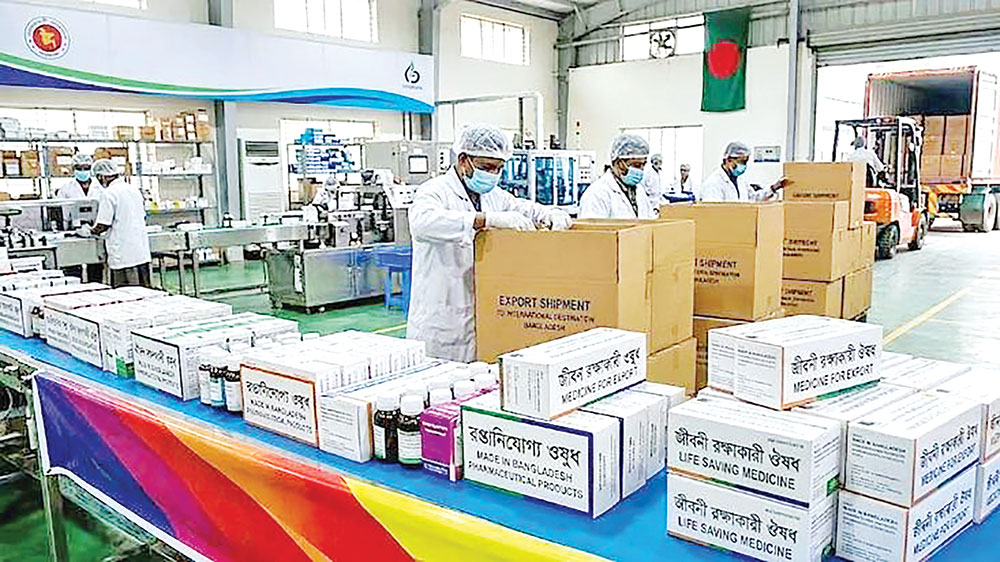 Bangladesh has continued to earn more foreign currency from pharmaceutical exports, with receipts approaching $195 million in the first 10 months of the ongoing fiscal year.
The industry, long viewed as one of the country's most promising export sectors, has maintained its upward trajectory, while growing global demand has helped lift earnings.
Over the past 15 years, export income from pharmaceuticals has increased more than fivefold.
Industry leaders say the sector's progress has come despite weaknesses in raw material supply.
They believe improvements in that area could pave the way for pharmaceuticals to become Bangladesh's second-largest export industry after ready-made garments.
An analysis of Export Promotion Bureau (EPB) data shows Bangladesh earned $44.2 million from pharmaceutical exports in FY2011.
The figure rose steadily over the next 15 years, reaching $213.16 million in FY25, more than five times higher.
Export earnings increased every fiscal year from 2010-11 to 2021-22.
Although income dipped slightly in FY23, growth resumed the following year and has continued since.
Maintaining that momentum, pharmaceutical exports generated $194.63 million during the July-April period of FY26, up 9.7 percent from $177.42 million recorded in the corresponding period a year earlier.
On a monthly basis, April delivered particularly strong growth.
Pharmaceutical exports rose 100.67 percent year-on-year to $23.96 million, compared with $11.94 million in April last year.
If export earnings in May and June match April's performance, total pharmaceutical export revenue could approach $250 million by the end of the fiscal year.
Exporters are optimistic about reaching that milestone for the first time.
Abdul Muktadir, chairman and managing director of Incepta Pharmaceuticals and president of the Bangladesh Association of Pharmaceutical Industries, believes earnings could hit $5 billion within five years if domestic raw material production is scaled up.
He told bdnews24.com that Bangladesh is rapidly emerging as a global hub for high-quality, low-cost generic medicines, partly because many countries lack the facilities needed to produce them efficiently.
"Most importantly, Bangladesh is the only country among the 48 least developed countries that is nearly self-sufficient in pharmaceutical manufacturing," he said.
"Ten Bangladeshi drug manufacturers have already secured approvals from the United States, the European Union, Australia and the World Health Organization."
Muktadir identified raw materials as the industry's biggest challenge.
He said the Active Pharmaceutical Ingredient (API) Park being developed in Gajaria Upazila of Munshiganj could significantly strengthen local supply once it becomes fully operational.
Plots have already been allocated to various companies, while several manufacturers have begun building factories there.
Local production of raw materials, he said, would help take the industry much further.
The API park, however, has yet to fully materialise more than 15 years after the project began.
Much of the allocated land remains unused. Although Bangladesh produces 95 percent of its pharmaceutical needs domestically, nearly all raw materials are imported, resulting in an annual outflow of around $1.5 billion.
The government allocated land for the industrial park in Gajaria 17 years ago.
So far, only two companies have started producing raw materials there, while two others have begun preliminary work.
Land allocated to 23 companies remains vacant.
Medicines typically contain two types of ingredients: the API, which serves as the core raw material, and auxiliary inactive components known as excipients.
For instance, the API in a paracetamol tablet is called "para-acetylaminophenol", which acts on the human body to cure illnesses.
Conversely, components like cellulose and talc in the tablet are excipients that help shape the API into a tablet and ensure quick dissolution without causing side effects.
Industry insiders say local pharmaceutical companies import at least Tk 100 billion worth of APIs each year.
They warn that costs will rise further after Bangladesh graduates from least developed country status in November. �"bdnews24.com

Loading...
Loading...
Also read



Editor : Iqbal Sobhan Chowdhury
Published by the Editor on behalf of the Observer Ltd. from Globe Printers, 24/A, New Eskaton Road, Ramna, Dhaka.
Editorial, News and Commercial Offices : Aziz Bhaban (2nd floor), 93, Motijheel C/A, Dhaka-1000.
Phone: PABX- 41053001-06; Advertisement: 41053012; 01793317829, 01550707291, E-mail: [email protected], [email protected] Online: email: [email protected] 41053014; 01550707297 Advertisement: 01550707296
Published by the Editor on behalf of the Observer Ltd. from Globe Printers, 24/A, New Eskaton Road, Ramna, Dhaka.
Editorial, News and Commercial Offices : Aziz Bhaban (2nd floor), 93, Motijheel C/A, Dhaka-1000.
Phone: PABX- 41053001-06; Advertisement: 41053012; 01793317829, 01550707291, E-mail: [email protected], [email protected] Online: email: [email protected] 41053014; 01550707297 Advertisement: 01550707296


