



| HEADLINE |

|

Fuel price hike raises cost of living
Inflation, liquidity support to banks add to people's sufferings
Published : Wednesday, 3 June, 2026 at 12:00 AM
Business Correspondent


 The cost of living in Bangladesh continues to rise as repeated fuel price hikes, persistent inflationary pressures and liquidity support extended to commercial banks by the central bank combine to push up the prices of essential commodities.
Economists warn that the simultaneous increase in fuel costs and expansion of money supply could further intensify inflationary pressures, placing additional burdens on millions of low-and middle-income households already struggling to make ends meet.
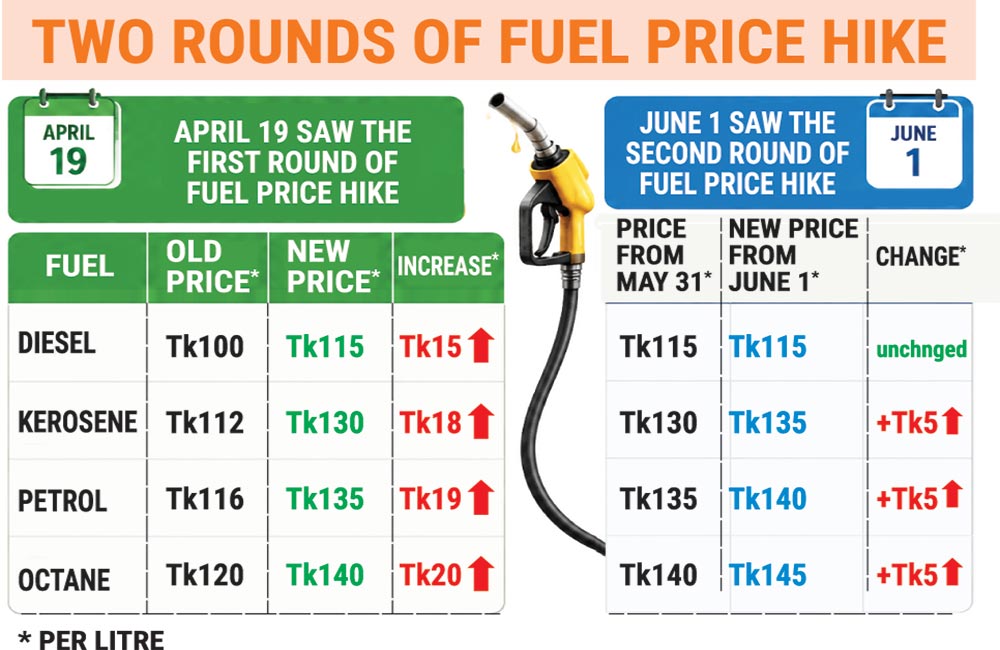
Over the past one and a half months, the government has increased fuel prices twice. In the first round, a notification issued on April 18 and effective from April 19 raised the prices of all major petroleum products. Diesel prices increased from Tk100 to Tk115 per litre, kerosene from Tk112 to Tk130, petrol from Tk116 to Tk135, and octane from Tk120 to Tk140 per litre.
In a second round, another notification issued on May 31, effective from June 1, increased the prices of petrol, octane and kerosene by an additional Tk5 per litre. Under the revised rates, petrol now sells at Tk140 per litre, octane at Tk145 and kerosene at Tk135, while diesel remains unchanged at Tk115 per litre.
Meanwhile, the price of liquefied petroleum gas (LPG) has increased by about Tk 50 per kg in two phases this month. With this, the price of a 12 kg LPG cylinder, which is most commonly used in homes, has increased to Tk 1,940. That is, the price per cylinder has increased by Tk 600. However, gas cylinders have to be bought at a higher price in the market.
The government has justified the increases by citing higher costs in the international energy market and adjustments under the country's fuel pricing mechanism. However, the impact has quickly spread across the economy, particularly in the market for essential goods.
Traders and transport operators say higher fuel prices have significantly increased transportation costs, which are now being passed on to consumers. As a result, prices of rice, lentils, edible oil, vegetables, fish, poultry and eggs have risen in recent weeks.
Market surveys in different parts of the capital indicate that coarse rice prices have increased by Tk4 to Tk6 per kilogram, medium-quality rice by Tk3 to Tk5 and premium rice by Tk5 to Tk8. Lentil prices have risen by Tk8 to Tk12 per kilogram, while a five-litre bottle of soybean oil now costs Tk20 to Tk30 more than before. Broiler chicken prices have increased by Tk10 to Tk20 per kilogram, and egg prices have gone up by Tk10 to Tk15 per dozen. Prices of various vegetables have also increased by Tk5 to Tk20 per kilogram.
Meanwhile, the vegetable market continues to witness significant price volatility, with no vegetable available for less than Tk 80 per kilogram. Several commonly consumed vegetables are selling at over Tk 100 per kg, adding to consumers' concerns.
On Friday, long brinjal was sold at Tk 100 per kg, while round brinjal fetched Tk 120 per kg. Cucumber and ridge gourd (jhinga) were selling at Tk 100-110 per kg, while bitter gourd was priced at Tk 100 per kg. Yardlong beans (barbati) and taro stolons (kachur lati) were being sold at Tk 80 per kg each.
Papaya was available at Tk 90-100 per kg, while pointed gourd (patol) was selling at Tk 80 per kg. Snake gourd (chichinga) was priced at Tk 100-110 per kg, and teasel gourd (kankarol) at Tk 120 per kg. Okra (dherosh) was selling at Tk 60 per kg.
Bottle gourd was priced at Tk 100 per kg, sponge gourd (dhundul) at Tk 100 per kg, green chillies at Tk 160 per kg, and carrots at Tk 120 per kg.
In last month, the price of eggs in the market has increased by about Tk 30 per dozen. A dozen eggs are being sold for Tk 150-160. Retailers said that wholesalers have increased the price of eggs by increasing the rent of vehicles.
Rickshaw puller Abdul Karim sighed as he entered Nayabazar on Tuesday morning, a holiday. He said that the Tk 500 note in his hand was worthless now. He spent the day buying one kilogram of rice, half a kilogram of pulses, a few eggs and a few vegetables.
"I used to buy groceries for a week with a certain amount of money. Now the same amount hardly lasts five days," said Abdul Malek, a rickshaw puller in Mirpur. "Whenever fuel prices go up, everything else becomes more expensive. But our income remains the same."
Nasrin Akter, a private-sector employee, echoed similar concerns. "My salary has not increased, but transportation costs, house rent and grocery expenses continue to rise. It is becoming increasingly difficult to manage a family budget, and saving money is almost impossible," she said.
At Karwan Bazar, shopper Ayesha Begum expressed frustration over the rising cost of essential commodities. She told the Daily Observer, "My husband is a rickshaw puller, and I work as a domestic helper. The combined income we earn supports our six-member family. But with the current prices of food and other essentials, we can no longer manage our household expenses with our earnings."
At the same time, Bangladesh Bank has been providing liquidity support to commercial banks facing cash shortages. While policymakers view such measures as necessary to maintain financial stability, economists caution that expanding liquidity without corresponding increases in production and supply may fuel inflation.
Economist Dr Zahid Hussain said fuel price hikes have a direct impact on transportation costs and consequently affect the prices of almost all goods and services.
"Fuel is a key input in the economy. Any increase in fuel prices raises production and transportation costs. If money supply also expands significantly, inflationary pressures may become more pronounced," he observed.
Economist Dr Debapriya Bhattacharya has repeatedly stressed the need for fiscal and monetary discipline to contain inflation. "Inflation tends to persist when excess liquidity in the financial system coincides with supply-side constraints," he said.
Loading...
Loading...
Also read



Editor : Iqbal Sobhan Chowdhury
Published by the Editor on behalf of the Observer Ltd. from Globe Printers, 24/A, New Eskaton Road, Ramna, Dhaka.
Editorial, News and Commercial Offices : Aziz Bhaban (2nd floor), 93, Motijheel C/A, Dhaka-1000.
Phone: PABX- 41053001-06; Advertisement: 41053012; 01793317829, 01550707291, E-mail: [email protected], [email protected] Online: email: [email protected] 41053014; 01550707297 Advertisement: 01550707296
Published by the Editor on behalf of the Observer Ltd. from Globe Printers, 24/A, New Eskaton Road, Ramna, Dhaka.
Editorial, News and Commercial Offices : Aziz Bhaban (2nd floor), 93, Motijheel C/A, Dhaka-1000.
Phone: PABX- 41053001-06; Advertisement: 41053012; 01793317829, 01550707291, E-mail: [email protected], [email protected] Online: email: [email protected] 41053014; 01550707297 Advertisement: 01550707296


