



| HEADLINE |

|

Sundarbans Under Siege (Part - III)
The forest at a crossroads of survival and change
Published : Monday, 8 June, 2026 at 12:00 AM
Mizanur Rahman


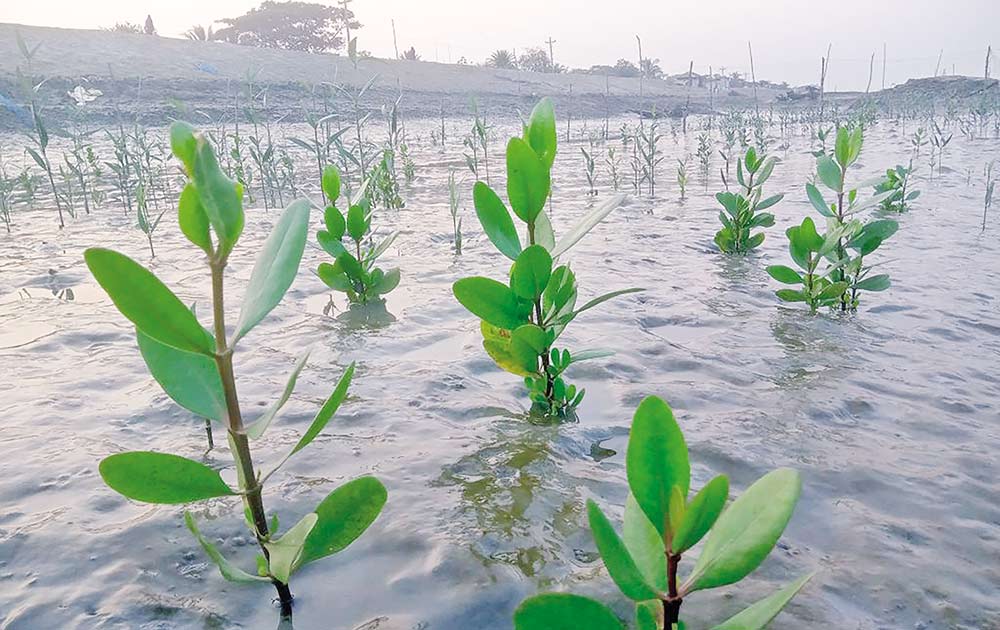 On the banks of the Kholpetua River, the Sundarbans is no longer just a forest. For thousands of people living along Bangladesh's vulnerable coastline, it has become a lifeline.
As cyclones become more frequent and salinity spreads across once-fertile land, many families are finding it increasingly difficult to survive through farming alone. For them, the vast mangrove forest offers fish, crabs, honey and firewood �" resources that have become essential in an era of climate uncertainty. Yet the growing dependence on the Sundarbans is also placing the forest under unprecedented pressure, raising concerns about whether both people and nature can continue to coexist as they have for generations.
Mohammad Sabud Ali has spent his entire life in Gabura, a village near the entrance to the Sundarbans. He has watched cyclones batter the coast, embankments collapse and saltwater invade farmland.
The forest, he said, has never seemed more important.
"We now depend on this river and the forest for survival. Everyone now goes to the forest for honey, fish and crabs," he said.
In Gabura, the effects of climate change are visible everywhere. Cyclone-damaged embankments have left large areas exposed to tidal surges. Saltwater intrusion has made agricultural land increasingly difficult to cultivate, forcing many residents to seek alternative sources of income.
Those who can afford to leave are moving elsewhere. Those who remain often work as day labourers, boatmen or forest resource collectors. For many families, the Sundarbans has become the last available source of livelihood.
Yet even as dependence on the forest increases, access to it is becoming more complicated.
Local residents say government licensing regulations designed to protect forest resources have created difficulties for many traditional users.
Ali said only a limited number of permits are available despite growing demand.
"Maybe 100 licences can be obtained at a time. But 10,000 people are trying to enter the forest. They are putting our lives at risk in the name of saving the environment," he said.
Researchers say the relationship between local communities and the Sundarbans has changed significantly over recent decades.
Biswajit Mallick, a researcher at Dresden University of Technology who grew up in the region, said dependence on the forest has increased over time. At the same time, improved transport and communication networks have attracted larger commercial interests to the area.
According to Mallick, local villagers traditionally harvested limited quantities of fish, crabs and golpata using small boats and maintained a relatively balanced relationship with the forest.
"They knew that they should not bring everything," he said.
However, he believes the expansion of tourism and larger commercial activities has altered that balance. Small-scale resource collectors are increasingly competing with bigger businesses, while some parts of the forest are showing signs of depletion.
"The Sundarbans still produces many resources. But if you enter the forest, you will see that many places have become empty," he said.
For local communities, dependence on the forest is accompanied by fear.
Residents continue to face threats from wildlife and criminal activity. Royal Bengal Tigers occasionally enter nearby localities, while stories of bandit attacks remain part of life in remote riverine areas.
Abdul Hakim, a 61-year-old retired teacher, said his family has experienced both the dangers and the benefits of living beside the forest.
"My elder brother was taken away by a tiger. Since then, I have been afraid of this forest," he said.
"Over the past 20 years, my family has become increasingly dependent on the Sundarbans. They come here for everything. They come here to catch crabs, collect honey and collect firewood. We are completely dependent on the Sundarbans. We live and die because of this forest."
Scientists are also warning about the deteriorating health of the ecosystem.
Dr ASM Helal Uddin Ahmed Siddiqui, a divisional officer at the Bangladesh Forest Research Institute, said findings from multiple studies indicate that around 40 per cent of Sundarbans trees are affected by top-dying disease. He added that approximately half of the trees suffer from heart rot, a condition that causes the inner portions of trees to decay.
According to him, older trees in areas with higher salinity are particularly vulnerable, highlighting the growing impact of environmental stress on the forest.
Meanwhile, illegal activities continue to threaten biodiversity.
Residents and fishermen allege that poison fishing remains widespread in some rivers and canals. They say the practice kills fish fry, crabs, snakes and other aquatic species, damaging entire ecosystems.
Forest Department and police sources said at least 40 poachers were arrested over the past year. Authorities recovered 512 kilograms of deer meat, one slaughtered deer and several skins and heads from different areas adjacent to the Sundarbans.
Officials also reported the seizure of 293 boats and 3,660 kilograms of fish caught using poison during operations conducted over the last two years. A total of 216 cases were filed and 224 fishermen arrested.
Tourism, promoted as a tool for economic development, is creating another challenge.
According to Forest Department sources, seven tourist centres currently operate in the Sundarbans, attracting between 200,000 and 250,000 visitors annually. New ecotourism facilities are also being developed in several locations.
However, recent visits to some of these sites revealed evidence of tree cutting during construction activities. Plastic waste, food packaging and disposable items were also found in forest areas and waterways. Local residents reported noise pollution from tourist boats and visitors.
For many living around the Sundarbans, these developments raise difficult questions about the future.
The forest continues to protect coastal communities from storms, provide livelihoods for thousands of families and sustain one of the world's most important ecosystems. Yet climate change, poverty, commercial exploitation and growing human activity are placing increasing pressure on its resources.
For generations, people have depended on the Sundarbans for survival. Whether the forest can continue to support them may depend on how successfully Bangladesh balances conservation with the growing demands being placed upon it.
Loading...
Loading...
Also read



Editor : Iqbal Sobhan Chowdhury
Published by the Editor on behalf of the Observer Ltd. from Globe Printers, 24/A, New Eskaton Road, Ramna, Dhaka.
Editorial, News and Commercial Offices : Aziz Bhaban (2nd floor), 93, Motijheel C/A, Dhaka-1000.
Phone: PABX- 41053001-06; Advertisement: 41053012; 01793317829, 01550707291, E-mail: [email protected], [email protected] Online: email: [email protected] 41053014; 01550707297 Advertisement: 01550707296
Published by the Editor on behalf of the Observer Ltd. from Globe Printers, 24/A, New Eskaton Road, Ramna, Dhaka.
Editorial, News and Commercial Offices : Aziz Bhaban (2nd floor), 93, Motijheel C/A, Dhaka-1000.
Phone: PABX- 41053001-06; Advertisement: 41053012; 01793317829, 01550707291, E-mail: [email protected], [email protected] Online: email: [email protected] 41053014; 01550707297 Advertisement: 01550707296


