



| HEADLINE |

|
Dhaka’s water paradox: Drowning above, drying below
Published : Friday, 12 June, 2026 at 12:00 AM
Joy Halder; Sanzida Khan


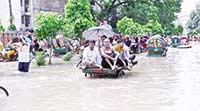 Dhaka receives approximately 2,000 mm of rain every year-almost three times the amount London gets. People protest for safe water every dry season and the government has dispatched troops to protect the pumping stations from the frustrated masses. Every monsoon, these same streets are inundated just a few hours after the rain begins to fall. These two crises are seemingly contradictory. They are not; they are two related symptoms of the same disease-a city that was built to work against water, not with it.
The mechanism isn't complicated. Rain on concrete, asphalt and sealed pavement has nowhere to go except into the drains, and out to the rivers. Nothing gets into the ground. Simultaneously, approximately 82% of Dhaka’s piped water is pumped from underground aquifers. WASA supplies 3.3 million cubic meters of water from this source to a population of 23 million each day. Pumping is relentless; the replenishment has effectively ceased. The result is a rapidly falling water table. In 1996 it was 25 meters below mean sea level. By 2005, it had fallen to 45 meters, 60 meters by 2010, 75 meters by 2023 and it's estimated that it will fall to 120 meters by 2050. Dhaka is not running out of rain. It is running out of earth deep enough to contain the rain it has already lost.
The flooding half of the paradox works in the same fashion, but in reverse. Bodies of water that used to constitute a fifth of the city now cover about three percent; green space has declined from 22% at independence to 9% today. Over three-quarters of Dhaka’s wetlands disappeared between 1978 and 2020 through land-grabbing and urban development-but wetlands aren't empty bogs-they are a city’s flood defense and aquifer recharge system, a service they perform for free that no engineered drainage system could match. Without wetlands, even a light rain can inundate the system. Heavy rain for a few hours flooded major streets on July 17; a two hour deluge caused hospitals and schools to close on August 13, 2022. Neither was an exceptional weather event; both are predictable outcomes of a walled-off city.
The economic costs are vast, and incalculable. The 1998 flood-which affected 40% of the city-reportedly cost the ready-made garment industry, the backbone of the Bangladesh economy, $10.3 billion. The costs of water supply are themselves steadily increasing with falling water levels; pumping from lower depths requires more power, pumps that are more powerful, and more expensive maintenance for an increasingly scarce resource. Geoscientists are warning that if current extraction rates continue and water tables fall to the projected 120 meters, the resulting vacuum in the aquifer could cause the land itself to collapse, threatening buildings and infrastructure in one of the world's most densely built cities. At the policy level, a $92.7 million drainage project, implemented in 2014 with financing from the World Bank, has failed to improve flooding because the engineering has targeted the symptoms rather than the cause, and the money has been spent on the wrong thing.
The paradox has a simple graphic. Imagine two identical cities experiencing identical rain falls. In one, every surface is built of concrete or asphalt; water washes off rooftops and streets immediately, flows rapidly through the drainage system and rushes out of the city within hours. Nothing enters the aquifer below. In the other city, buildings have vegetation on their rooftops, roads are constructed from porous materials and tree canopies delay rain and allow it to gently drench the ground where root systems create permeable soil. Water enters the aquifer and remains there. The rainfall is the same, the sky is the same. The two cities are only distinguished by the building materials and land cover between them and a complete difference in flooding and drought is achieved by spreading these two simple variations over millions of buildings and kilometers of roads.
Nature already figured this out. Trees and wetlands don't allow rainwater to be wasted- they collect, slow down, filter and release it gradually back to the earth. Leaf litter acts like a sponge. Root systems create channels that help carry water down. Wetlands absorb floodwaters and release them slowly. Nature has adapted over millions of years to maximize retention of water in the landscape. We in the built environment should embrace this function, not deny it. Green roofs, permeable pavements, urban wetlands, medians with planted bioswales, mandate collection of rainwater; these are not experiments or too expensive; Dhaka can look at Singapore, Rotterdam and Medellin who are already doing this at the city level and making it work. According to experts, nearly 80% of Dhaka's flooding problems could be solved by re-digging only 15 of the 40 canals in Dhaka, which would be vastly cheaper than the concrete drainage infrastructure that has already been implemented and proven ineffective.
What stands in the way of this not the lack of know-how, but politics and money. Land values drive wetlands to be developed. Enforcement of building codes that mandate permeable surfaces or rainwater harvesting is inconsistent, encroachment continues unabated and the drainage master plan that was drawn up in 2016 still has not been implemented nearly ten years later. Citizens of Dhaka have among the lowest water rates on the planet so there is absolutely no financial incentive for water conservation and consequently WASA is left with no capital to make the indispensable infrastructural improvements that the city needs so badly. The true costs of mismanagement are being deferred onto other areas - the collapsing aquifer, flooded streets, and the city's long-term prospects.
The answer to the question posed in the title of this article is not geology or meteorology; it is architectural. Dhaka is experiencing a water shortage because its buildings, roads, and sidewalks have disconnected rain from the ground-capturing it on their surfaces and draining it away before it can serve the city’s most essential function: seeping into the earth. Each monsoon brings in the water Dhaka needs for the long, dry months; the city now has no mechanism to hold onto it. That is not a drainage problem, that is a design problem, and the design problem must begin with architects, planners, and policymakers recognizing that in a city situated in one of the world’s rainiest climates on a flood plain, water are not the enemy; the real enemy does not understand it.
The writers are students, Department of Economics, Southeast University
Loading...
Loading...
Also read



Editor : Iqbal Sobhan Chowdhury
Published by the Editor on behalf of the Observer Ltd. from Globe Printers, 24/A, New Eskaton Road, Ramna, Dhaka.
Editorial, News and Commercial Offices : Aziz Bhaban (2nd floor), 93, Motijheel C/A, Dhaka-1000.
Phone: PABX- 41053001-06; Advertisement: 41053012; 01793317829, 01550707291, E-mail: [email protected], [email protected] Online: email: [email protected] 41053014; 01550707297 Advertisement: 01550707296
Published by the Editor on behalf of the Observer Ltd. from Globe Printers, 24/A, New Eskaton Road, Ramna, Dhaka.
Editorial, News and Commercial Offices : Aziz Bhaban (2nd floor), 93, Motijheel C/A, Dhaka-1000.
Phone: PABX- 41053001-06; Advertisement: 41053012; 01793317829, 01550707291, E-mail: [email protected], [email protected] Online: email: [email protected] 41053014; 01550707297 Advertisement: 01550707296


