



| HEADLINE |

|
Save rivers surrounding Dhaka
Published : Sunday, 14 June, 2026 at 12:00 AM
Joy Halder and Sanzida Khan


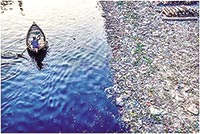 Once a completely water-driven city, Dhaka emerged amid four large rivers �" Buriganga, Turag, Balu, and Shitalakshya �" that gave trade, transport, and life to this bustling delta city for many years, but currently, these four rivers are suffering from the deadly effects of industrial runoff, illegal construction, and rapid urbanization caused by a growing population of more than twenty-two million and are some of the most polluted and contested waterways in South Asia.
 This is such an extensive problem in Dhaka that, according to the Bangladesh Inland Water Transport Authority’s report in 2023, the navigable width of the Turag River alone was reduced by 37 percent over two decades. Satellite imagery shows floodplains, which previously received annual monsoons, now cluttered with brick kilns, garment factories, and informal settlements kilometers long from the center of Dhaka, while the Buriganga River, which runs along the southern part of Old Dhaka, was referred to as a ‘dead zone’ by water experts due to dangerously low levels of dissolved oxygen that have become too toxic for marine life to survive.
It is not difficult to identify the culprits. Dhaka is one of the fastest urbanising mega cities on earth. Between 2000 and 2025, its urban footprint is expected to expand by a staggering 300 percent. This will see it absorb surrounding districts while agricultural and wetland buffers are converted into dense built-up zones. Every year an estimated half a million migrants arrive from flood-prone and climate-stressed rural areas. Many settle on low-lying riverbanks where land is cheapest and tenure most precarious. Infrastructure has failed catastrophically to keep pace. Only a fraction of Dhaka’s households are connected to the formal sewerage network. This means that domestic waste, along with industrial discharge, flows largely untreated into the river system.
The Supreme Court ruling in 2019 recognizing the Turag River as a living being and giving the same rights as a citizen, as well as legal guardianship powers to the National River Conservation Commission to manage the river, was hailed across the globe as a historic event in the field of environmental law, but this has enabled the demolition of numerous illegal constructions on the Turag and Buriganga.
Nevertheless, the fight has been anything but straightforward, as reconstructed buildings have often stayed around for weeks on end, border markers have disappeared or gotten damaged, and locals say that the environmental authorities have rarely made any inspections at all: “it is impossible to litigate a river back to good health,” says Dr. Ainun Nishat, a leading water resources expert, “because the rivers did not die all at once; they died gradually.”
Not only that, but this is an ongoing trend since many of the effects are already felt by riverside inhabitants, such as fish catch rates by fishers of the Buriganga dropping by over 70% within one generation, boat operators discovering areas of the riverbed which were navigable throughout the year three decades ago but are now dried up in March and April, as well as women having to travel greater distances for clean drinking water because of the contamination of riverside wells..
So, in terms of a solution, there have been ambitious, often inspired, blueprints developed: a proposed Dhaka River Corridor plan envisions a green riverbank buffer around the Buriganga and Turag, provision for planned settlements for informal riverside dwellers with basic services, and the transformation of the banks into parks and ecological zones, while the successful examples of urban river regeneration such as Seoul's Cheonggyecheon stream and Singapore's sustainable transformation of the Singapore River have been widely presented as evidence that long-term political commitment can bring rivers back to life.
The question now is whether Dhaka can do the same, and the answer depends on factors beyond mere engineering. It relies on a governance structure that can truly hold the industrial sector to account, no matter how politically connected or economically important it is, an effective land tenure policy that stops the riverbank being perceived as a resource that can be captured by all and sundry and a commitment to urban development and infrastructure investment that benefits all citizens but particularly the poorest in the informal river settlements who suffer most when the rivers die.
As summer’s heat intensifies over Dhaka and the Buriganga appears like a sickly, dark ribbon flowing through the old city, the fate of the country’s rivers is still an open question. The court orders, the demolition drives, and the fleeting attention of the outside world haven’t yet made the water clean, but the rivers continue to flow, however meagerly. This alone is a start, and how Dhaka builds on that start may prove instrumental in determining the future face and the liveability of the city.
The writers are students, Department of Economics, Southeast University
Loading...
Loading...
Also read



Editor : Iqbal Sobhan Chowdhury
Published by the Editor on behalf of the Observer Ltd. from Globe Printers, 24/A, New Eskaton Road, Ramna, Dhaka.
Editorial, News and Commercial Offices : Aziz Bhaban (2nd floor), 93, Motijheel C/A, Dhaka-1000.
Phone: PABX- 41053001-06; Advertisement: 41053012; 01793317829, 01550707291, E-mail: [email protected], [email protected] Online: email: [email protected] 41053014; 01550707297 Advertisement: 01550707296
Published by the Editor on behalf of the Observer Ltd. from Globe Printers, 24/A, New Eskaton Road, Ramna, Dhaka.
Editorial, News and Commercial Offices : Aziz Bhaban (2nd floor), 93, Motijheel C/A, Dhaka-1000.
Phone: PABX- 41053001-06; Advertisement: 41053012; 01793317829, 01550707291, E-mail: [email protected], [email protected] Online: email: [email protected] 41053014; 01550707297 Advertisement: 01550707296


