



| HEADLINE |

|
Rooppur testing anomaly not a cause for concern: NPCBL
Published : Tuesday, 16 June, 2026 at 12:00 AM
Special Correspondent


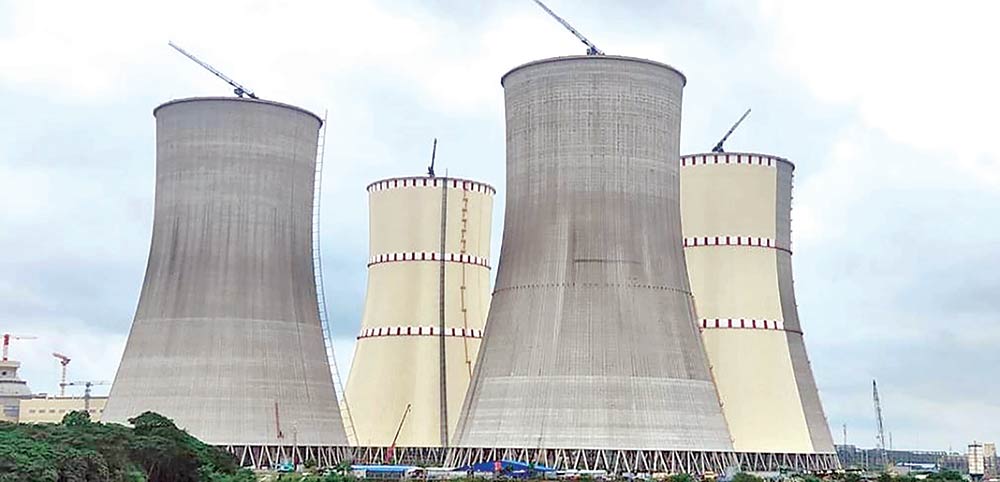 Nuclear Power Company Bangladesh Limited (NPCBL) on Monday said a technical anomaly detected during commissioning tests at Unit-1 of the Rooppur Nuclear Power Plant is a routine issue and poses no safety risk, stressing that the plant's safety systems are functioning as intended.
The anomaly was detected on Friday during a mandatory leak-tightness test in the plant's secondary circuit at a pressure of 8.1 megapascals (MPa), prompting a temporary suspension of commissioning activities.
"There is no room for compromise on safety," NPCBL Managing Director Dr Zahedul Hasan said in a statement.
According to NPCBL, the deviation exceeded pre-established acceptance criteria and was therefore flagged for further evaluation and corrective action. Engineers are now working to address the issue before testing resumes.
Dr Hasan said identifying irregularities before commercial operation is a normal and essential part of the commissioning process. He noted that nuclear power plants worldwide undergo extensive safety and performance tests under international standards before entering service, with oversight from the International Atomic Energy Agency (IAEA) and the Bangladesh Atomic Energy Regulatory Authority.
"The identification of even a minor deviation demonstrates that the plant's safety and quality assurance systems are functioning as intended," he said.
NPCBL said no approval would be granted to proceed until all corrective measures are completed and verified.
The Rooppur Nuclear Power Plant in Pabna comprises two reactors with a combined generation capacity of 2,400 megawatts.
Nuclear fuel was loaded into the first unit on April 28, after which commissioning activities began.
Saikat Ahmed, media focal point officer of the project, said the fault had led to a temporary halt in operations, while a representative of Russian state nuclear corporation Rosatom said such issues are common during the commissioning stage.
"Many minor issues emerge during commissioning. These are identified and resolved before the plant moves into production," the representative said.
Saikat said a series of tests is being conducted following fuel loading to identify and resolve any problems before the plant enters the next phase. Once all systems perform as required, the power generation process will begin.
Earlier, a fault in a Reactor Cooling Pump detected before fuel loading also delayed the project's timeline by several weeks after testing was temporarily halted.
Officials said around $1 billion has been invested in safety and security systems designed to withstand major natural disasters, including earthquakes of up to magnitude 8 and tsunami-related impacts.
Loading...
Loading...



Editor : Iqbal Sobhan Chowdhury
Published by the Editor on behalf of the Observer Ltd. from Globe Printers, 24/A, New Eskaton Road, Ramna, Dhaka.
Editorial, News and Commercial Offices : Aziz Bhaban (2nd floor), 93, Motijheel C/A, Dhaka-1000.
Phone: PABX- 41053001-06; Advertisement: 41053012; 01793317829, 01550707291, E-mail: [email protected], [email protected] Online: email: [email protected] 41053014; 01550707297 Advertisement: 01550707296
Published by the Editor on behalf of the Observer Ltd. from Globe Printers, 24/A, New Eskaton Road, Ramna, Dhaka.
Editorial, News and Commercial Offices : Aziz Bhaban (2nd floor), 93, Motijheel C/A, Dhaka-1000.
Phone: PABX- 41053001-06; Advertisement: 41053012; 01793317829, 01550707291, E-mail: [email protected], [email protected] Online: email: [email protected] 41053014; 01550707297 Advertisement: 01550707296


