



| HEADLINE |

|
Are women only partners in movement or they should be symbol of empowerment?
Published : Monday, 3 August, 2026 at 8:08 PM
Observer Special


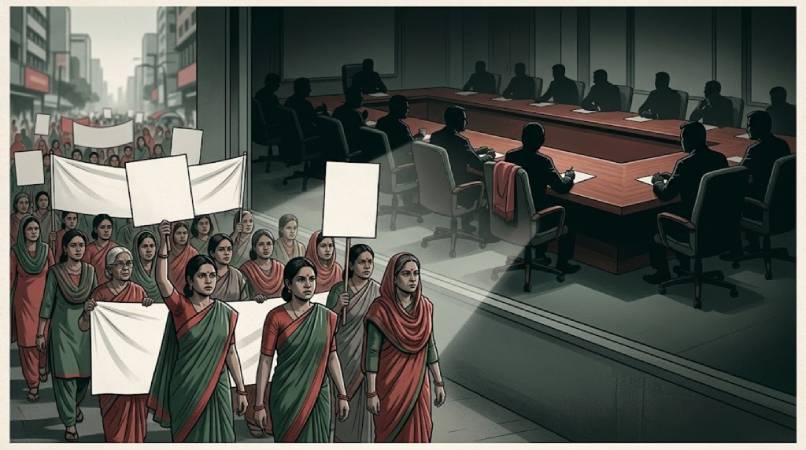
Symbolic Photo
Women are highly visible in Bangladesh's politics. They lead protest marches, fill public rallies, campaign during elections and often stand at the forefront of political movements. To an outside observer, it might appear that women's political participation has expanded significantly over the years. Yet visibility is not the same as influence. The true measure of political participation lies not on the streets but in the rooms where decisions are made. Who shapes policy? Who allocates power? Who determines the political agenda? Those questions reveal far more about women's place in politics than their prominence in public demonstrations.
This has long been one of the central paradoxes of Bangladeshi politics. Women are indispensable when political movements seek legitimacy. Their participation conveys moral authority, broad public support and democratic energy. Once a movement succeeds or enters the phase of political negotiation, however, women often become less visible in leadership, policy-making and institutional decision-making. Their presence is celebrated during mobilization, but their role in governing is frequently far more limited.
The 2024 quota reform movement brought this contradiction into sharper focus. Women students were among the movement's most recognizable faces. They organized protests, articulated demands and argued that they did not require a separate quota in public employment. Many insisted that they wanted to compete on equal terms with men.
That confidence deserves respect. But confidence cannot eliminate structural inequality.
Men and women in Bangladesh do not begin from identical social circumstances. For many women, preparing for a competitive examination is only one part of a much larger struggle. Personal safety, family expectations, domestic responsibilities, marriage, motherhood and social restrictions continue to shape educational and professional opportunities in ways that men often do not experience. Legal equality, therefore, does not automatically produce equality of opportunity.
This is precisely why many democracies retain affirmative action policies for women and other historically disadvantaged communities. Such measures are not intended to undermine merit. They seek to reduce the effects of long-standing structural inequalities so that merit can be assessed under fairer conditions.
Bangladesh's women's quota in public recruitment emerged from the same logic. Following the quota reforms of 2024, however, that provision was removed from direct government recruitment. The political debate surrounding the reform has been extensive. Its long-term social consequences have received far less attention.
The results of the 47th Bangladesh Civil Service (BCS) examination have added a new dimension to this discussion. Of the 1,334 candidates recommended for appointment across various cadres, only about 22 per cent are women. A single recruitment cycle cannot establish a long-term trend, and several factors may have influenced the outcome. Even so, the figures raise an important question: is women's representation in Bangladesh's higher civil service beginning to decline?
The question matters because the civil service is not merely a source of employment. It produces future secretaries, district commissioners, diplomats, senior police officers and public administrators. A sustained reduction in women's representation at this level would inevitably affect the diversity of perspectives within the institutions that govern the country.
At the same time, public discussion on women's rights appears to have lost momentum. Progress on implementing recommendations made by the Women's Affairs Reform Commission has remained limited. Women's representation in the higher decision-making bodies of political parties also continues to be modest. This stands in sharp contrast to the prominent role women played during political mobilization.
Another development deserves careful attention. Since 2024, Bangladesh has witnessed a number of incidents involving violence against women, disruptions of women's sporting events and attacks on cultural activities. Human rights organizations have also documented continuing violence against women and girls. According to Ain o Salish Kendra (ASK), reported rape cases increased in 2025 compared with the previous year. The Human Rights Support Society (HRSS) likewise recorded significant levels of violence against women and children during the first half of 2026.
It would be inaccurate to attribute each of these developments directly to the political changes of 2024. Violence against women is shaped by multiple factors, including weaknesses in law enforcement, impunity, social attitudes and political conditions. Yet the broader concern remains valid. Have women become more secure, more confident and more empowered in public life over the past two years? Or has the political transition coincided with a narrowing of their social space?
These questions deserve serious examination.
A decline in women's representation carries consequences far beyond public employment. When fewer women enter public institutions, fewer women participate in shaping policy and administering the state. Public institutions inevitably reflect the experiences of the people who lead them. Reduced diversity at the top often results in narrower perspectives within governance itself.
The implications extend into society as well. If families begin to believe that higher education no longer offers comparable opportunities for daughters, investment in girls' education may gradually decline. Over time, this can contribute to higher dropout rates, child marriage and greater economic dependence. These changes are rarely immediate, but they often reshape societies over the long term.
Women's empowerment, therefore, cannot be understood solely through the lens of employment or quotas. It is inseparable from education, economic development, public health, democratic inclusion and social progress.
For the same reason, the legacy of the 2024 movement should not be assessed only in terms of political victory or defeat. Its impact on women's access to education, employment, public institutions and political influence deserves independent and evidence-based research. Political transitions should be evaluated not only by the governments they replace but also by the societies they leave behind.
The central question, ultimately, is a simple one.
Has politics learned to treat women as equal partners in power?
This question is relevant to every major political party in Bangladesh. Women are routinely valued as participants in political mobilization. They are far less visible where authority is exercised and decisions are made.
A democracy cannot realize its full potential while half its population remains underrepresented in the institutions that shape public life. Women belong not only in political movements but also in the structures of governance. Until that becomes a reality, Bangladesh will continue to confront an uncomfortable question: are women genuine partners in power, or do they remain political symbols?
-/SA
Loading...
Loading...
Also read






Editor : Iqbal Sobhan Chowdhury
Published by the Editor on behalf of the Observer Ltd. from Globe Printers, 24/A, New Eskaton Road, Ramna, Dhaka.
Editorial, News and Commercial Offices : Aziz Bhaban (2nd floor), 93, Motijheel C/A, Dhaka-1000.
Phone: PABX- 41053001-06; Advertisement: 41053012; 01793317829, 01550707291, E-mail: [email protected], [email protected] Online: email: [email protected] 41053014; 01550707297 Advertisement: 01550707296
Published by the Editor on behalf of the Observer Ltd. from Globe Printers, 24/A, New Eskaton Road, Ramna, Dhaka.
Editorial, News and Commercial Offices : Aziz Bhaban (2nd floor), 93, Motijheel C/A, Dhaka-1000.
Phone: PABX- 41053001-06; Advertisement: 41053012; 01793317829, 01550707291, E-mail: [email protected], [email protected] Online: email: [email protected] 41053014; 01550707297 Advertisement: 01550707296


