



| HEADLINE |

|
Battery-run rickshaws rule the roost in Dhaka


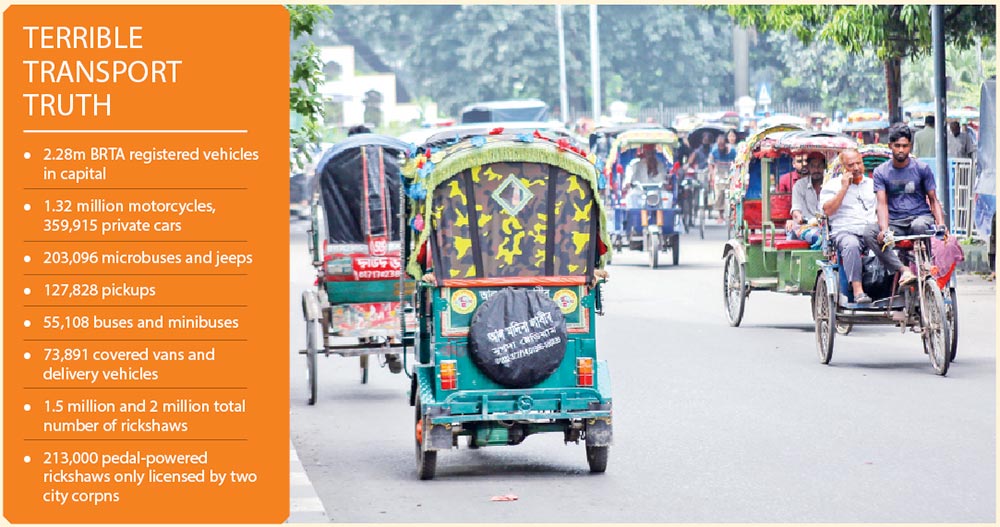 Dhaka, once widely known as the “city of rickshaws,” has undergone a dramatic transformation in its urban transport landscape. Pedal-powered rickshaws that once dominated its streets are increasingly being replaced by battery-operated three-wheelers.
While these vehicles have gained popularity among city dwellers for their speed, affordability, and convenience, their rapid and largely unregulated expansion has now emerged as a major challenge for the capital’s traffic management system.
Urban planners, traffic authorities, and transport experts argue that battery-run rickshaws have become both a vital source of livelihood for millions and a significant contributor to traffic congestion, road safety risks, and urban disorder.
According to the Bangladesh Road Transport Authority (BRTA), more than 2.28 million vehicles are registered in the Dhaka metropolitan area as of May 2026. This includes 1.32 million motorcycles, 359,915 private cars, 203,096 microbuses and jeeps, 127,828 pickups, 55,108 buses and minibuses, and 73,891 covered vans and delivery vehicles. However, there is no official government data on battery-powered rickshaws.
Various research organizations estimate that between 1.5 million and 2 million rickshaws are currently operating in the capital. The Bangladesh Institute of Labour Studies (BILS) places the figure at around 1.5 million, while the Centre for Policy Dialogue (CPD) estimates it at nearly 2 million. In contrast, the Dhaka North and South City Corporations have issued licenses for only about 213,000 pedal-powered rickshaws.
A 2026 survey by Innovision Consulting revealed that more than 90 percent of rickshaw-based vehicles in Dhaka operate without formal registration. Meanwhile, data from BUET’s Accident Research Institute and JICA’s strategic transport planning indicate that an additional 400,000 to 500,000 unregistered vehicles operate daily in the city, a large share of which are battery-run rickshaws and easy bikes.
Experts identify Dhaka’s extremely limited road infrastructure as a key driver of the crisis. International urban standards suggest that at least 25 per cent of a city’s total land area should be allocated to roads. In Dhaka, however, road coverage stands at only 6 to 7 per cent. This severe mismatch has resulted in intense pressure on the transport system, with more than 4 million registered and unregistered vehicles competing for limited road space.
Traffic authorities report that areas such as Mirpur, Badda, Mohammadpur, Jatrabari, Khilgaon, Uttara, and Old Dhaka regularly experience severe congestion caused by battery-run rickshaws. Traffic flow in these zones often becomes nearly stagnant during school and office rush hours.
Deputy Police Commissioner (Traffic) of Dhaka Metropolitan Police, Md. Anisur Rahman, described battery-run rickshaws as one of the biggest challenges for traffic management. He noted that these vehicles frequently violate traffic rules, move against traffic flow, and disrupt overall vehicular movement, significantly increasing accident risks and disorder on the roads.
On the other hand, rickshaw workers’ leaders argue that the lack of adequate public transport has fuelled the rapid growth of battery-run rickshaws. They claim that the sector directly and indirectly supports the livelihoods of around 7 million people, while serving the mobility needs of more than 35 million urban residents.
Some rickshaw owners, speaking on condition of anonymity, said that the expansion of battery-run rickshaws continues unchecked due to weak enforcement and unclear legal frameworks. They argued that without strong legislation and implementation, controlling the sector would be extremely difficult.
Although an initiative to ban battery-run rickshaws in Dhaka was launched in 2024, it was not implemented due to protests by drivers and legal complications. The High Court’s directive was later suspended, leaving the issue unresolved and in a state of policy uncertainty.
Meanwhile, Dhaka’s two city corporations have initiated efforts to bring battery-run rickshaws under registration, licensing, and designated route systems. Plans are also underway, through collaboration among the Local Government Division, city corporations, BUET, and development partners, to introduce driver training programs, biometric registration, and QR-code-based licensing.
Urban planner and architect Iqbal Habib said that the absence of fitness certification and licensing for thousands of rickshaws has led to the breakdown of Dhaka’s traffic system. In contrast, economist MM Akash described battery-run rickshaws as a market-driven transport solution arising from real urban demand, arguing that regulated management, not outright bans, would be a more practical approach.
Recently, Home Minister Salahuddin Ahmed told the media that the government is considering relocating battery-run rickshaws outside metropolitan areas in phases. He acknowledged that thousands of such vehicles have appeared on roads overnight and stressed that immediate eviction would not be feasible due to humanitarian and economic concerns.
He further added that the livelihoods of a large number of people depend on this sector, and sudden displacement without rehabilitation could create serious social instability. The government, therefore, is exploring a balanced solution that ensures both employment protection for drivers and improved traffic management in urban areas.
Experts emphasize that without proper registration, training, designated routes, licensing, and strict enforcement, restoring order on Dhaka’s roads will remain extremely difficult. Otherwise, the growing pressure of unregulated battery-run rickshaws may continue to worsen traffic congestion and urban chaos in the capital.
Loading...
Loading...
Also read


Editor : Iqbal Sobhan Chowdhury
Published by the Editor on behalf of the Observer Ltd. from Globe Printers, 24/A, New Eskaton Road, Ramna, Dhaka.
Editorial, News and Commercial Offices : Aziz Bhaban (2nd floor), 93, Motijheel C/A, Dhaka-1000.
Phone: PABX- 41053001-06; Advertisement: 41053012; 01793317829, 01550707291, E-mail: [email protected], [email protected] Online: email: [email protected] 41053014; 01550707297 Advertisement: 01550707296
Published by the Editor on behalf of the Observer Ltd. from Globe Printers, 24/A, New Eskaton Road, Ramna, Dhaka.
Editorial, News and Commercial Offices : Aziz Bhaban (2nd floor), 93, Motijheel C/A, Dhaka-1000.
Phone: PABX- 41053001-06; Advertisement: 41053012; 01793317829, 01550707291, E-mail: [email protected], [email protected] Online: email: [email protected] 41053014; 01550707297 Advertisement: 01550707296


