



| HEADLINE |

|

BARVIDA Warns Budget Tax Hike Could Price Reconditioned Cars Out of Reach
Published : Sunday, 21 June, 2026 at 12:00 AM
Business Correspondent


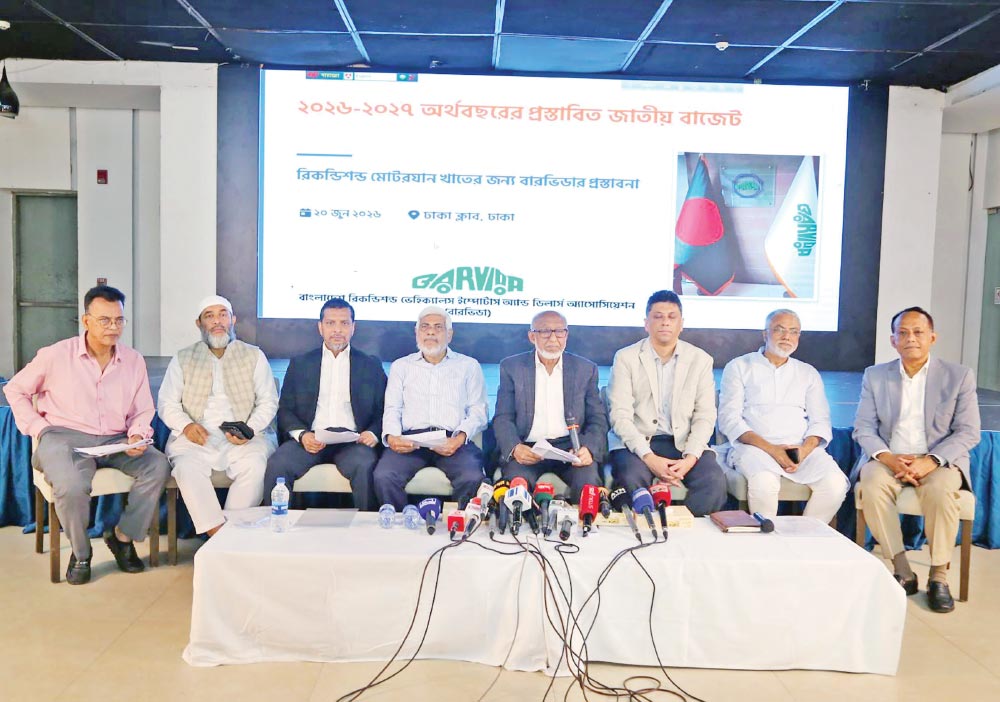 Reconditioned vehicle importers on Saturday urged the government to rethink the proposed restructuring of engine-capacity (CC) tax slabs in the FY2026-27 budget, warning that the move could make reconditioned vehicles more expensive than brand-new cars and severely disrupt the country's automobile market.
Speaking at a press conference in the capital, Bangladesh Reconditioned Vehicles Importers and Dealers Association (BARVIDA) President Abdul Haque said the proposed tax measures would push up vehicle prices, threaten thousands of businesses and place car ownership beyond the reach of middle-income families.
"If these higher taxes are imposed, the prices of reconditioned vehicles will rise sharply. Importers will suffer and more than one lakh people connected to the sector could lose their livelihoods," he said.
He warned that the proposed fiscal measures would undermine a sector that has long provided affordable transport solutions for Bangladesh's growing middle class.
According to BARVIDA, the new duty structure could create a market anomaly in which reconditioned vehicles become costlier than new ones in several engine-capacity categories, eroding the competitiveness of the industry and discouraging consumers.
Abdul Haque argued that higher taxes on reconditioned vehicles would not only reduce affordability but could also hurt government revenues by depressing sales and imports.
The BARVIDA chief noted that annual vehicle registrations had already fallen sharply, from around 21,000 units to 9,400 units, and warned that registrations could decline further if the proposed tax regime is implemented.
CC slabs refer to engine-capacity categories, measured in cubic centimetres (cc), which determine the level of duties and taxes imposed on imported vehicles.
Drawing comparisons with international practices, Abdul Haque said countries such as Britain and Singapore have adopted policies that encourage the use of reconditioned and environmentally friendly vehicles while maintaining market balance.
He urged the government to formulate a comprehensive policy framework that supports both reconditioned and electric vehicles instead of favouring one segment at the expense of another.
"It is unreasonable to increase taxes on reconditioned vehicles while reducing duties on electric vehicles," he said. "Electric cars remain far beyond the purchasing power of most middle-class consumers."
Although the proposed budget offers tax incentives for electric vehicles, their prices remain too high for the average buyer, he argued. He added that even tax concessions on electric buses would have limited impact on consumers because of the high acquisition costs involved.
To boost government revenue, BARVIDA proposed bringing electric rickshaws under a formal registration and taxation framework. The association also called for a uniform tax structure for plug-in hybrid and reconditioned hybrid vehicles.
Abdul Haque further criticised what he described as an uneven fiscal regime, saying the budget provides tax advantages for new vehicles while maintaining a 5 per cent regulatory duty on reconditioned plug-in hybrid cars.
"The proposed budget creates a discriminatory tax structure that favours new vehicles over reconditioned ones," he said, urging policymakers to revise the measures before the budget is finalised.
Industry leaders warned that unless the proposed tax structure is reconsidered, the country's largest source of affordable private vehicles could face a significant slowdown, with repercussions for employment, government revenue and consumer access to personal transport.

Loading...
Loading...
Also read



Editor : Iqbal Sobhan Chowdhury
Published by the Editor on behalf of the Observer Ltd. from Globe Printers, 24/A, New Eskaton Road, Ramna, Dhaka.
Editorial, News and Commercial Offices : Aziz Bhaban (2nd floor), 93, Motijheel C/A, Dhaka-1000.
Phone: PABX- 41053001-06; Advertisement: 41053012; 01793317829, 01550707291, E-mail: [email protected], [email protected] Online: email: [email protected] 41053014; 01550707297 Advertisement: 01550707296
Published by the Editor on behalf of the Observer Ltd. from Globe Printers, 24/A, New Eskaton Road, Ramna, Dhaka.
Editorial, News and Commercial Offices : Aziz Bhaban (2nd floor), 93, Motijheel C/A, Dhaka-1000.
Phone: PABX- 41053001-06; Advertisement: 41053012; 01793317829, 01550707291, E-mail: [email protected], [email protected] Online: email: [email protected] 41053014; 01550707297 Advertisement: 01550707296


