The Bangladesh Textile Mills Association (BTMA) has issued a stark warning that a proposed budget measure allowing 18 industrial sectors to import raw materials duty-free without obtaining bonded warehouse licences could push the country’s primary textile industry towards collapse by exposing local manufacturers to unfair competition from foreign suppliers.
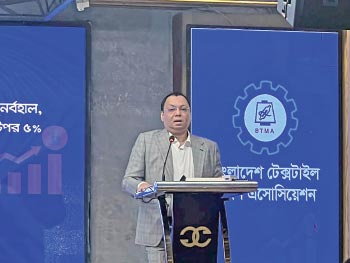
Expressing deep concern over the proposed national budget for FY2026-27 at a press conference in the capital on Saturday, BTMA President Showkat Aziz Russell said the removal of existing safeguards would open the floodgates to widespread misuse of bonded facilities, undermine domestic production and severely distort market competition.
“The withdrawal of the 30 per cent value-addition requirement will place the domestic textile industry on a path to destruction,” BTMA leaders warned, stressing that the provision remains critical to protecting local industries and sustaining Bangladesh’s export competitiveness as the country prepares for graduation from Least Developed Country (LDC) status.
To help the embattled primary textile sector weather what it described as a multi-dimensional crisis, the association placed a four-point charter of demands before the government.
Foremost among these is the retention of the 30 per cent value-addition condition. BTMA argued that Bangladesh must eventually raise local value addition to between 40 and 50 per cent to continue enjoying international trade benefits in the post-LDC era.
Maintaining the existing threshold, it said, is indispensable for safeguarding domestic yarn and fabric production and preventing irregularities in bonded warehouse operations. The association also criticised the current tax regime as “highly discriminatory”.
While apparel exporters enjoy a corporate tax rate of 12 per cent, primary textile manufacturers face an effective income tax burden of 27.5 per cent. BTMA called for the corporate tax rate for textile mills to be reduced to 12 per cent and maintained until June 2030.
Another key demand was the withdrawal of the proposed 5 per cent import duty on polyester staple fibre, the principal raw material used in producing man-made fibre (MMF) yarn and fabrics.
BTMA leaders noted that although MMF-based products account for nearly 70 per cent of global apparel demand, Bangladesh’s export basket remains heavily dependent on cotton. They cautioned that imposing the duty would significantly increase production costs for spinners, weaken the competitiveness of local manufacturers and hamper efforts to diversify exports into higher-growth global markets.
While welcoming the proposal to reduce source tax on export cash incentives from 10 per cent to 5 per cent, the association urged the government to grant a temporary zero-rate source tax facility to ease the acute liquidity crisis facing exporters.
Russell also questioned the lack of transparency surrounding the government’s recently announced Tk 60,000 crore economic stimulus package.
“We have yet to see a clear roadmap outlining who will receive the funds, on what basis, and through what mechanism. Supporting sectors with stagnant demand will produce little benefit and could result in a significant waste of public resources,” he said.
Highlighting the sector’s growing distress, Russell revealed that Bangladesh imported yarn worth Tk 26,000 crore during FY2024-25 alone �" demand that, he argued, could largely have been met by domestic producers.
He further disclosed that at least 234 textile mills have shut down since 2019, while many surviving factories are operating at only 60 to 70 per cent of capacity. “In view of these realities, the textile sector has one of the strongest claims to support from the stimulus package,” he added.
The press conference was also addressed by former BTMA director Rajeev Haider and former vice-president Abdullah Al Mamun. President of the Bangladesh Garments Accessories and Packaging Manufacturers and Exporters Association (BGAPEA), Md Shahriar, was also present.





