



| HEADLINE |

|

Tk 2.29bn hilsa project falls short of targets
Published : Monday, 22 June, 2026 at 12:00 AM
Our Correspondent


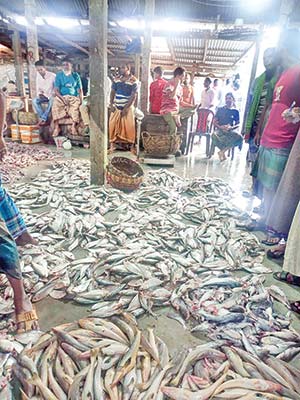 BARISHAL, June 21: Government project worth Tk 2.29 billion, launched with the goal of increasing annual hilsa production by 53,000 tonnes, has failed to achieve key targets as the project nears completion on upcoming Jun 30.
Instead of rising, hilsa production has declined by about 67,000 tonnes over the six-year period. At the same time, the average hilsa size available in the market has also fallen, raising concerns over the long-term sustainability of the project.
The Department of Fisheries (DoF) launched the Hilsa Resource Development and Management Project on July 1, 2020, aiming not only to increase production but also to ensure larger fish reach the market, thereby improving supply and helping stabilise prices.
However, according to DoF statistics, Hilsa production initially increased during the first two years of the project.
The country recorded a historic high of 571,000 tonnes in fiscal year (FY) 2022-23. The upward trend, however, was short-lived. Production dropped to 529,000 tonnes in FY 2023-24 and 500,000 tonnes in FY 2024-25, marking a decline of 29,000 tonnes within just two years. Although official figures for FY 2025-26 have yet to be published, senior fisheries officials say production is unlikely to exceed 500,000 tonnes.
Meanwhile, the average hilsa weighed between 500 and 550 grams when the project began, but most fish now weigh only 300 to 400 grams. Project officials argue that the decline in production, measured by weight, does not necessarily indicate fewer fish.
Deputy Project Director Md Nasir Uddin said the hilsa catch has actually increased, but the fish are significantly smaller. A hilsa reaches its first spawning stage at 8 to 9 months, when it weighs between 300 and 400 grams. By the second year, it grows to about 800 to 900 grams, he said.
Due to excessive fishing, many hilsa are being caught before they can reach maturity. As a result, the number of fish may be higher, but the total weight is lower. Fisheries experts, however, dispute that explanation.
Mir Mohammad Ali, Assistant Professor at the Faculty of Fisheries and Marine Science at Sher-e-Bangla Agricultural University, said, “Overfishing is not the only problem. Industrial pollution around estuaries and hilsa sanctuaries, thermal pollution from power plants, contaminated river water, siltation, and declining navigability are major factors. Simply controlling fishing will not be enough. Without protecting the ecosystem where hilsa breed and migrate, production cannot be sustained.”
Echoing those concerns, Dr Anisur Rahman, former chief scientific officer of the Bangladesh Fisheries Research Institute, said, “Excessive harvesting, climate change, environmental degradation, and a lack of long-term scientific research have collectively contributed to the decline in hilsa production.”
Even before the current project officially ends on June 30, the DoF has begun preparing for another initiative. Project Director Molla Emdadullah said a feasibility study is currently underway, adding that implementation would take at least another year if the proposed project receives approval.
Reflecting on the shortcomings of the outgoing project, he acknowledged that while conservation efforts have shown some success in rivers, protecting Hilsa in the Bay of Bengal remains a major challenge. “We have had relative success in rivers, but we could not adequately protect Hilsa in the sea. The next project will place greater emphasis on monitoring and conservation in the sea,” he added.
Loading...
Loading...
Also read



Editor : Iqbal Sobhan Chowdhury
Published by the Editor on behalf of the Observer Ltd. from Globe Printers, 24/A, New Eskaton Road, Ramna, Dhaka.
Editorial, News and Commercial Offices : Aziz Bhaban (2nd floor), 93, Motijheel C/A, Dhaka-1000.
Phone: PABX- 41053001-06; Advertisement: 41053012; 01793317829, 01550707291, E-mail: [email protected], [email protected] Online: email: [email protected] 41053014; 01550707297 Advertisement: 01550707296
Published by the Editor on behalf of the Observer Ltd. from Globe Printers, 24/A, New Eskaton Road, Ramna, Dhaka.
Editorial, News and Commercial Offices : Aziz Bhaban (2nd floor), 93, Motijheel C/A, Dhaka-1000.
Phone: PABX- 41053001-06; Advertisement: 41053012; 01793317829, 01550707291, E-mail: [email protected], [email protected] Online: email: [email protected] 41053014; 01550707297 Advertisement: 01550707296


