



| HEADLINE |

|
Dhaka, Beijing agree to deepen co-op over Teesta project
Published : Friday, 26 June, 2026 at 12:00 AM
Jahid Biplob from Beijing


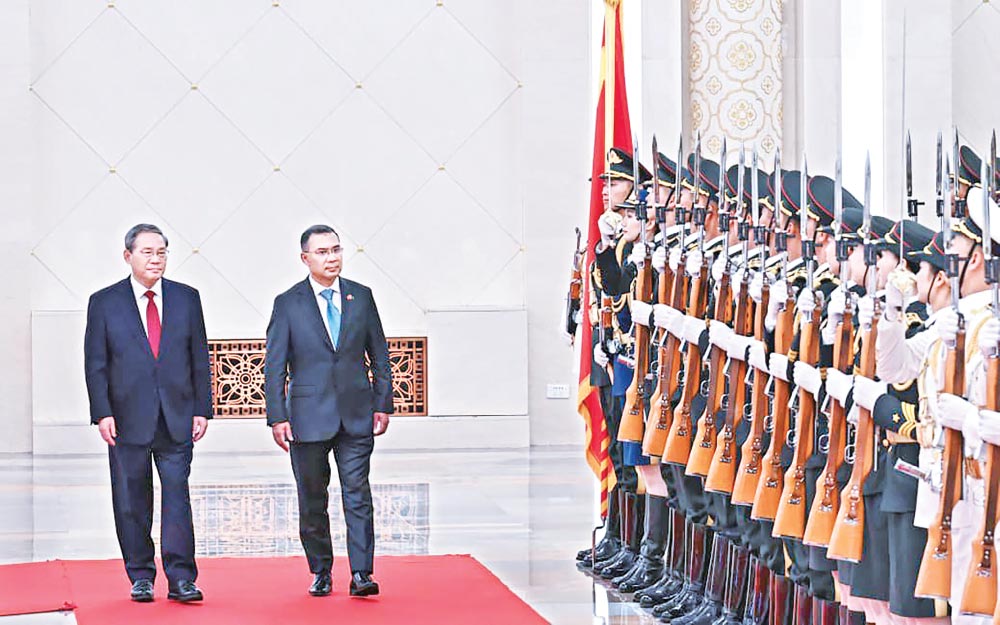 Bangladesh and China have signed 13 Memorandums of Understanding (MoUs) covering investment, trade, education, media cooperation, human resource development, and infrastructure, marking a major milestone in bilateral relations during Prime Minister Tarique Rahman’s first official visit to China.
The agreements were signed on Thursday at Beijing’s Great Hall of the People in the presence of Prime Minister Tarique Rahman and Chinese Premier Li Qiang. The signing ceremony was held followed by ay high-level bilateral talks aimed at deepening economic, strategic, and people-to-people cooperation between the two countries.
Speaking at a press conference in Beijing, Prime Minister’s Adviser and government spokesperson Mahdi Amin described the visit as a significant step toward elevating Bangladesh-China relations. He said the agreements include cooperation on green development, investment promotion, a joint action plan for development cooperation, enhancement of Bangladesh’s export capacity, and discussions on reducing interest rates and extending grace periods on Chinese concessional loans.
* Tarique to meet Chinese President Xi Jinping today
* 13 MoUs signed covering investment, trade, education, media
* BNP, CPC ink MoU to strengthen communication
Under China’s Global Development Initiative, both sides also agreed to strengthen collaboration in health, education, skills development, and human resource capacity building. Additional MoUs were signed on the export of Bangladesh's national fruit, jackfruit, to China, the introduction of Mandarin language education in Bangladesh, and cooperation in technical and vocational education.
Four separate agreements were signed to expand cooperation among state-owned television channels, newspapers, media organizations, and think tanks. Separate investment-related agreements were also concluded involving the Bangladesh Investment Development Authority (BIDA), with a focus on attracting Chinese investment to economic zones in Anwara and Mongla, establishing new industrial facilities, and generating employment opportunities.
Earlier in the day, the Bangladesh Nationalist Party (BNP) and the Communist Party of China (CPC) signed a separate memorandum of understanding at the Diaoyutai State Guesthouse. The agreement was signed by BNP Joint Secretary General (International Affairs) Humayun Kabir and Liu Haixing, Minister of the International Department of the CPC. Both sides expressed optimism that the agreement would strengthen cooperation in media, think tanks, people-to-people exchanges, and development initiatives.
Prime Minister Rahman also held a meeting with Chinese Minister of Water Resources Li Guoying, during which the two sides agreed to expand cooperation on the Teesta Master Plan, river management, flood mitigation, river dredging, erosion control, irrigation, and inland navigation development. China also expressed interest in supporting research, training, and institutional capacity building in Bangladesh's water resources sector.
The Prime Minister emphasised Bangladesh's need for technical assistance in river management and climate resilience projects, particularly regarding the Teesta basin and nationwide dredging initiatives. The Chinese minister reaffirmed Beijing's willingness to support Bangladesh in these areas.
During the visit, Prime Minister Rahman also met senior executives of several major Chinese corporations and investment groups. Discussions focused on expanding Chinese investment in Bangladesh's manufacturing, infrastructure, transportation, and industrial sectors.
Addressing the "Invest Bangladesh" conference jointly organized by BIDA and the China Council for the Promotion of International Trade (CCPIT), Rahman invited Chinese businesses to increase investment in Bangladesh. The event was attended by representatives of around 80 leading Chinese companies.
The Prime Minister highlighted ongoing economic and administrative reforms, describing Bangladesh as an emerging destination for manufacturing and industrial development. He announced that the government is implementing a special 180-day action plan to improve the investment climate, accelerate licensing procedures, establish Bangladesh's first investment office in China, and develop economic zones in Anwara and Mongla.
Rahman's four-day China visit, which began on June 23 following his participation in the World Economic Forum's Annual Meeting of the New Champions in Dalian, is being viewed as a major diplomatic and economic engagement. Prior to arriving in China, he completed his first state visit to Malaysia.
The Prime Minister received full state honours during his Beijing visit, including a red-carpet reception and guard of honour at the Great Hall of the People. Chinese and Bangladeshi national flags lined the venue and surrounding areas during the official welcome ceremony.
On Friday morning, Prime Minister Rahman is scheduled to hold talks with Chinese President Xi Jinping and meet Zhao Leji. Discussions are expected to focus on expanding strategic cooperation, trade, investment, development financing, and regional issues of mutual interest.
Rahman, accompanied by a compact 25-member delegation, is expected to depart Beijing for Dhaka on Friday afternoon. Officials expressed confidence that the visit would open a new chapter in Bangladesh-China relations and lead to greater cooperation in trade, investment, infrastructure, education, technology, and people-to-people connectivity.
Loading...
Loading...
Also read



Editor : Iqbal Sobhan Chowdhury
Published by the Editor on behalf of the Observer Ltd. from Globe Printers, 24/A, New Eskaton Road, Ramna, Dhaka.
Editorial, News and Commercial Offices : Aziz Bhaban (2nd floor), 93, Motijheel C/A, Dhaka-1000.
Phone: PABX- 41053001-06; Advertisement: 41053012; 01793317829, 01550707291, E-mail: [email protected], [email protected] Online: email: [email protected] 41053014; 01550707297 Advertisement: 01550707296
Published by the Editor on behalf of the Observer Ltd. from Globe Printers, 24/A, New Eskaton Road, Ramna, Dhaka.
Editorial, News and Commercial Offices : Aziz Bhaban (2nd floor), 93, Motijheel C/A, Dhaka-1000.
Phone: PABX- 41053001-06; Advertisement: 41053012; 01793317829, 01550707291, E-mail: [email protected], [email protected] Online: email: [email protected] 41053014; 01550707297 Advertisement: 01550707296


