



| HEADLINE |

|

Banking Sector Crisis Puts Trillion-Dollar Goal at Risk
Published : Tuesday, 7 July, 2026 at 12:00 AM
Faruk Ahmed


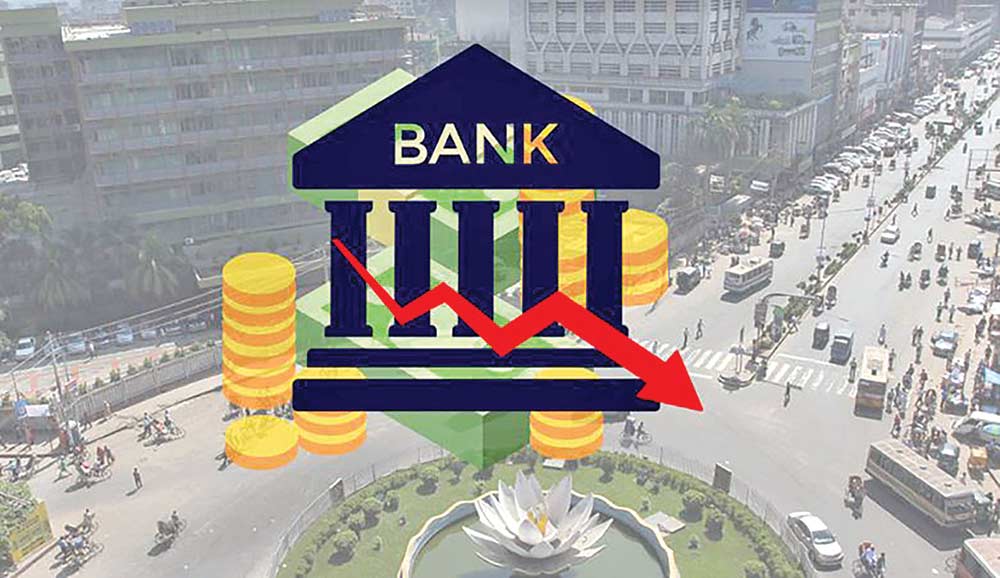 Bangladesh's banking sector has plunged into its deepest crisis in decades, with soaring bad loans, a crippling capital deficit and acute liquidity shortages. The situation is threatening financial stability and casting a long shadow over the country's ambition to become a trillion-dollar economy by 2034.
The World Bank and leading economists have identified the distressed banking sector as the single biggest structural obstacle to Bangladesh's long-term economic transformation, warning that without urgent and far-reaching reforms, the financial system could become the greatest drag on investment, employment and sustainable growth.
The banking industry, which holds assets worth more than US$212 billion�"equivalent to around half of the country's GDP and nearly 88 per cent of total financial sector assets�"is under unprecedented strain from record non-performing loans (NPLs), deteriorating capital adequacy, weak governance and years of regulatory shortcomings.
Official data show the NPL ratio climbed to 32.6 per cent at the end of March 2026, more than four times the South Asian average of 7.9 per cent.
Once written-off and repeatedly rescheduled loans are included, nearly 60 per cent of total outstanding credit is classified as distressed, exposing the true scale of financial fragility that has built up over years of poor lending practices and weak oversight.
The sector's financial health has deteriorated further, with the capital-to-risk-weighted assets ratio falling to negative 2.6 per cent at the end of 2025, leaving many banks with little capacity to absorb additional losses and raising concerns over the resilience of the country's financial system.
The crisis has deepened as Bangladesh Bank keeps its policy (repo) rate at 10 per cent to curb stubborn inflation. While the tight monetary stance has strengthened macroeconomic stability, it has also driven up banks' funding costs, squeezed lending margins and made credit more expensive, further straining businesses already grappling with weak demand, rising production costs and subdued investment.
Nearly 20 commercial banks have reportedly curtailed or virtually suspended fresh lending because of severe funding shortages, while anxious depositors have shifted savings to stronger institutions amid declining confidence. Several banks have sought emergency liquidity support from Bangladesh Bank, prompting the central bank to roll out a US$3.2 billion support package alongside an 18-month reform roadmap to stabilise the sector.
The World Bank warned that the crisis is no longer confined to the banking industry. It is increasingly spilling over into the broader economy by restricting credit to productive sectors, discouraging private investment, slowing industrial expansion and undermining employment creation.
The lender attributed the sector's deterioration to years of weak governance, regulatory forbearance and politically influenced lending.
Loopholes in legal definitions enabled complex related-party lending arrangements, allowing influential business groups to conceal ownership links, obtain fraudulent loans, wilfully default and siphon billions of dollars from the banking system.
"The lack of proper enforcement and regulatory forbearance has exacerbated the problems, encouraged risky behaviour, undermined market discipline and delayed necessary reforms," the World Bank said.
To help reverse the decline, the World Bank has approved a US$450 million programme to strengthen banking regulation, improve corporate governance, modernise Bangladesh Bank's digital infrastructure, enhance cybersecurity and reinforce risk-based supervision across the financial sector.
Economists say liquidity support alone will not restore confidence. They argue that sustainable recovery will require comprehensive structural reforms, including stricter loan classification standards, transparent disclosure of actual bad loans, an end to repeated loan restructuring, stronger corporate governance, enhanced operational independence for Bangladesh Bank and decisive action to eliminate political interference in lending decisions.
With banks accounting for the overwhelming majority of Bangladesh's financial system, analysts warn that failure to implement meaningful reforms could choke private investment, weaken industrial growth, slow job creation and jeopardise the country's aspiration of joining the ranks of trillion-dollar economies.

Loading...
Loading...
Also read



Editor : Iqbal Sobhan Chowdhury
Published by the Editor on behalf of the Observer Ltd. from Globe Printers, 24/A, New Eskaton Road, Ramna, Dhaka.
Editorial, News and Commercial Offices : Aziz Bhaban (2nd floor), 93, Motijheel C/A, Dhaka-1000.
Phone: PABX- 41053001-06; Advertisement: 41053012; 01793317829, 01550707291, E-mail: [email protected], [email protected] Online: email: [email protected] 41053014; 01550707297 Advertisement: 01550707296
Published by the Editor on behalf of the Observer Ltd. from Globe Printers, 24/A, New Eskaton Road, Ramna, Dhaka.
Editorial, News and Commercial Offices : Aziz Bhaban (2nd floor), 93, Motijheel C/A, Dhaka-1000.
Phone: PABX- 41053001-06; Advertisement: 41053012; 01793317829, 01550707291, E-mail: [email protected], [email protected] Online: email: [email protected] 41053014; 01550707297 Advertisement: 01550707296


