



| HEADLINE |

|
BGCCI hosts seminar on FY27 budget's impact on business, trade and investment
German diplomat calls for stable, business-friendly fiscal environment
Published : Tuesday, 7 July, 2026 at 12:00 AM
Business Desk


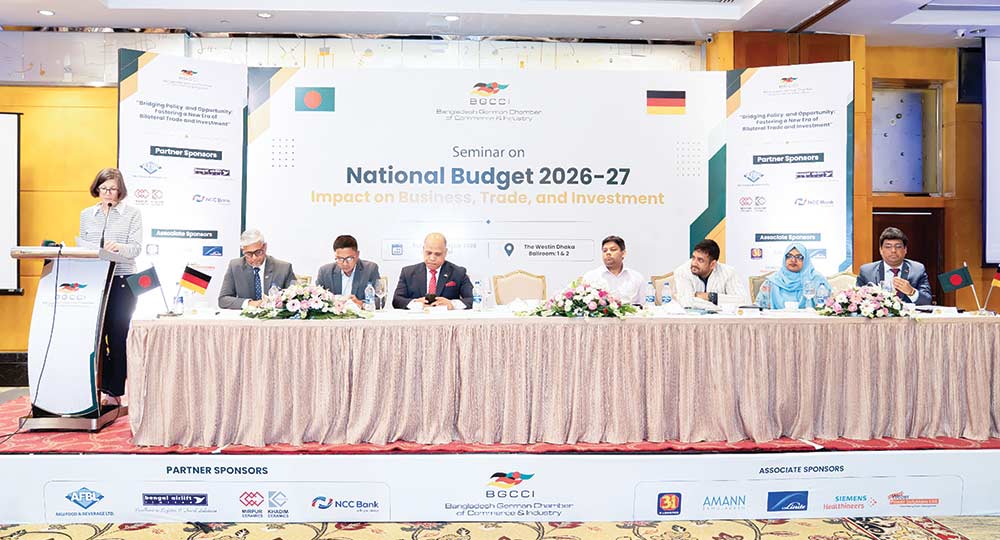 The Bangladesh-German Chamber of Commerce and Industry (BGCCI) successfully organised a high-level seminar titled "National Budget 2026�"27: Impact on Business, Trade, and Investment" held at The Westin Dhaka on Sunday.
The seminar brought together policymakers, business leaders, tax experts, entrepreneurs, and representatives from the public and private sectors to discuss the implications of the newly announced national budget on Bangladesh's business and investment landscape.
The seminar was graced by Anja Kersten, Chargé d’Affaires a.i. of the Embassy of the Federal Republic of Germany in Bangladesh, as the Chief Guest. In her address, she emphasized the importance of a stable, transparent, and business-friendly fiscal environment in fostering sustainable economic growth and strengthening Bangladesh-Germany trade and investment relations.
The event was further enriched by the presence of the following distinguished Special Guests: Md Tariq Hassan, First Secretary (Customs: Policy and ICT), National Board of Revenue (NBR), Bangladesh; Md Mashiur Rahman, First Secretary (VAT Policy); Additional Charge: First Secretary (VAT Exemption), National Board of Revenue (NBR), Bangladesh; and Nusrat Farzana, Deputy Commission of Taxes, National Board of Revenue (NBR), Bangladesh.
The keynote presentation was delivered by Snehasish Barua, (ICAEW), Partner, Snehasish Mahmud and Co., who provided an in-depth analysis of the National Budget 2026�"27, highlighting its key fiscal measures, tax reforms, customs policies, VAT provisions, and their anticipated impact on businesses, trade, and investment.
The seminar commenced with opening remarks and moderation by Md Farooque Khan, Senior Vice President of BGCCI, who underscored the significance of constructive dialogue between the government and the business community to promote economic resilience and sustainable growth.
Md. Rokonuzzaman, President of BGCCI, welcomed the participants and reaffirmed the chamber's commitment to strengthening Bangladesh-Germany trade and investment through policy dialogue, stakeholder engagement, and advocacy for a competitive business environment.
Loading...
Loading...
Also read



Editor : Iqbal Sobhan Chowdhury
Published by the Editor on behalf of the Observer Ltd. from Globe Printers, 24/A, New Eskaton Road, Ramna, Dhaka.
Editorial, News and Commercial Offices : Aziz Bhaban (2nd floor), 93, Motijheel C/A, Dhaka-1000.
Phone: PABX- 41053001-06; Advertisement: 41053012; 01793317829, 01550707291, E-mail: [email protected], [email protected] Online: email: [email protected] 41053014; 01550707297 Advertisement: 01550707296
Published by the Editor on behalf of the Observer Ltd. from Globe Printers, 24/A, New Eskaton Road, Ramna, Dhaka.
Editorial, News and Commercial Offices : Aziz Bhaban (2nd floor), 93, Motijheel C/A, Dhaka-1000.
Phone: PABX- 41053001-06; Advertisement: 41053012; 01793317829, 01550707291, E-mail: [email protected], [email protected] Online: email: [email protected] 41053014; 01550707297 Advertisement: 01550707296


