



| HEADLINE |

|
Why Bangladesh's defence budget needs a 21st-century upgrade
Published : Friday, 10 July, 2026 at 12:00 AM
Major Md Shazid Hossain Shohan, PSC, Infantry


 In early 2026, as Iranian drones crossed Middle Eastern skies toward US and Israeli positions, American-made Patriot and THAAD systems lit up the night attempting to intercept them. The Iranian drones cost around USD 20000, whereas the interceptors fired to destroy them cost between USD 4 million and USD 12 million each. The message was clear that modern warfare has changed dramatically. The conflict has demonstrated how relatively cheap technologies can force even the world’s most advanced militaries into costly wars of attrition.
Close to home, the India-Pakistan conflict of May 2025 has shown another important feature of modern warfare. Pakistan's Chinese-supplied J-10C fighters, armed with PL-15 beyond-visual-range missiles, engaged Indian aircraft in one of the most intense aerial encounters of the decade. Pakistan's military claimed six Indian aircraft were downed �" including multiple Rafale jets �" with French intelligence sources acknowledging the same to CNN. The Rafale, valued at approximately USD 100 million per aircraft, was reportedly struck from nearly 200 kilometres away �" a range Indian planners had not anticipated the PL-15 to possess. It took one cheap missile and one intelligence failure to turn a hundred-million-dollar aircraft into debris.Hence, technology has determined the outcome,definitely notthe numbers. These are not isolated events. They are the new grammar of warfare: precision over mass, algorithms over armies, bandwidth over battalions. Consequently, the state with smarter and cheaper technology can exhaust its opponent’s resourceseven without matching its spending.
Now, when people think about Bangladesh’s armed forces, what images usually come to mind? Most citizens think of Bangladesh's armed forces as soldiers on parade, ships guarding the Bay of Bengal, jets flying above, and troops supporting civilians in times of disaster. All of these represent the visible face of the Bangladesh armed forces. Importantly, the 1971 war won armed forces over the decades have built disciplined and capable armed forces that have played vital roles not only in national defence, but also in disaster response, UN peacekeeping, and internal stability. However, this made sense in an earlier era, but this is no longer the 20th century. The question that must follow, urgently, is whether Bangladesh's defence budget is written as per the needs of the 21st century. The evidence suggests it is not, and the gap is widening. Bangladesh, located in an increasingly strategic Indo-Pacific region and a nation with limited defence resources that cannot afford to be on the expensive side of the equation. Moreover, we cannot afford to face adversaries who have understood this lesson if we have not.
Bangladesh's Defence Budget: A Decade of Declining Real Investment
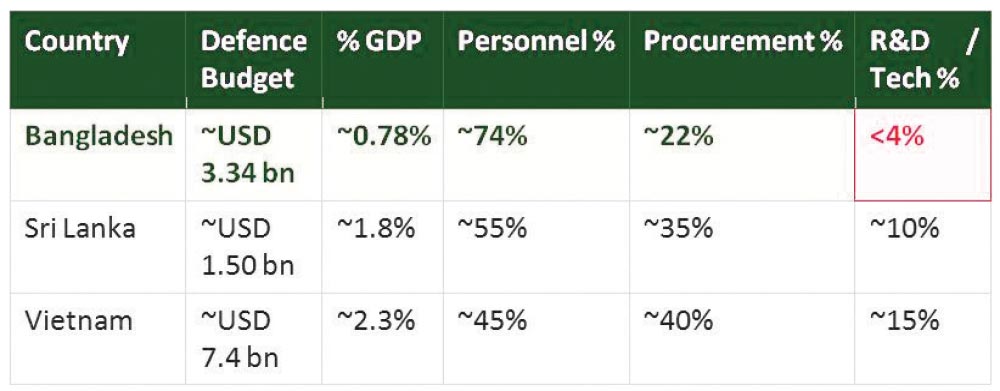
In June 2025, the interim government presented the national budget for fiscal year 2025-26. For the first time in recent memory, the defence allocation was cut from BDT 42,014 crore in FY2024-25 to BDT 40,698 crore (approximately USD 3.34 billion), a nominal decline of 3.2 percent. When adjusted for Bangladesh's persistent inflation, the real-terms reduction is much deeper. The share of GDP devoted to defence has fallen from 1.30 percent in 2021-22 to approximately 0.78 percent in 2025-26 �" the lowest in years. Interestingly, below the 1.8 to 2.5 percent range that Stockholm International Peace Research Institute(SIPRI) considers typical for countries in a peaceful security environment.
As per the document from Ministry of Finance, out of the total amount allocated for FY25-26, only BDT 91.6 billion is allocated for development and procurement and the remaining BDT 300.35 billion is utilized mainly for salaries and maintenance. Research, technology and cyber capability spending is not separately itemized in officially released budget papers, and it indicates that such allocations are likely absorbed within broader expenditure categories. So, if you look at it from a simple perspective, about 74 taka in every 100 taka of Bangladesh Defence budget is being spent while not considering a single piece of modern equipment. Hence, the remaining 26 taka will be used to purchase, set up infrastructure, invest in technology, and research & development.
How the World's Strongest Military Allocates Its Defence Budget
This is not an argument that Bangladesh should plan as the defence budget of the United States.The United States maintains a defence budget of approximately USD 850 billion which is more than 250 times larger than that of Bangladesh. Personnel expenditure within the US defence budget is roughly 21�"22 percent. Research, development, testing, and evaluation (RDT&E) receives nearly 17 percent,which is about USD 143 billion annually, funding cutting-edge work on artificial intelligence, hypersonic weapons, cyber warfare, and space systems. Procurement accounts for roughly 20 percent, totalling about USD 168 billion. The remaining 40 percent covers the operations and maintenance. On the contrary, Bangladesh spends less than 26 percent on procurement and technology combined; whereas the world's most effective military spends 37 percent on R&D and procurement alone. However, nobody expects Bangladesh to match these proportions.
Comparative Defence Spending Priorities Among Similar Economies
Bangladesh is a lower-middle-income country with significant development priorities. But several nations with comparable economies have managed to allocate meaningfully more of their defence budgets toward technology and procurement �" not because they are wealthier, but because they have chosen differently.
Sri Lanka, still recovering from its worst economic crisis in decades, has committed to allocating resources toward naval and air modernisation. The Diplomat (March 2025) reported that Sri Lanka's Army, Navy, and Air Force procurement budgets rose 3, 12, and 4 percent, respectively. President Anura Kumara Dissanayake has made technology-driven military restructuring a stated strategic priority, aiming to build a technologically advanced force by 2030.
Vietnam �" similarly positioned to Bangladesh in terms of income level and no stranger to a complex border security environment �" allocates around 15 percent of its defence budget to research, development, and technology. It has methodically built up its naval capability in the South China Sea with the helpof Russian, Israeli, and domestically developed platforms. It has not waited to become wealthy before becoming capable.
Two Neighbours, Two Rising Curves: Why Bangladesh Must Rethink Its Defence Budget
Smart defence planning is about being honest about capabilities of neighbouring armies because capabilities take years to build. On that basis, both of Bangladesh's major neighbours demand serious attention.
India's defence budget for 2025-26 is roughly USD 78.4 billion, and it grew by nearly 10 percent in just one year. Following the May 2025 air conflict with Pakistan, the Indian Ministry of Defence announced a 22 percent jump in modernisation spending for FY2026-27 �" specifically targeted at hypersonic weapons, directed energy systems, electronic warfare, and AI targeting capability. India is also deepening its domestic innovation pipeline through its iDEX (Innovation for Defence Excellence) scheme.
Myanmar's military has tripled its defence budget since its 2021 coup �" from roughly USD 700 million to an estimated USD 2.68 billion, with further increases announced in early 2025. More importantly, ongoing conflict in the Rakhine region has given Myanmar's military real combat experience in drone warfare, artillery strikes, and fighting along rivers and waterways. Myanmar has also secured advanced weapons and training from China and Russia, giving it capabilities that Bangladesh currently has no reliable way to counter.
Both neighbours are accelerating. Bangladesh, in the same period, has cut its defence budget in real terms.
A Practical Path to a 21st-Century Defence Budget
The goal is a gradual, deliberate shift in how Bangladesh spends its defence money. Not necessarily spending more but spending far more wisely. Here are five suggested steps:
1. Create a Protected Defence Technology Fund. Set aside 5 percent of the defence budget today for technology and innovation, with a target of 10 percent by 2030. This fund must be legally protected, meaning it cannot be quietly redirected to pay operational costs. For Example, India's iDEX scheme mobilised hundreds of defence innovators within five years.
2. Invest in counter-drone and electronic warfare capability �" Urgently. Non-state actors along Myanmar's frontier are already deploying commercial UAVs. Counter-UAS systems �" detection radar, jamming platforms, and interceptor drones do not require large budgets. For instance, Ukraine's domestically produced drone interceptors achieve a 90 percent intercept rate at USD 1,400 per unit.
3. Prioritise maritime surveillance in the Bay of Bengal.The Bay of Bengal is no longer a quiet strategic space. Bangladesh’s long coastline and resource-rich Exclusive Economic Zone sit at the intersection of growing regional naval competition involving China, India, and Myanmar. Bangladesh still lacks the ability to properly watch over much of this space. At the very least, modern maritime patrol aircraft and over-the-horizon radar are now necessary tools of sovereignty.
4. Build a visible, gradually developed cyber-defence capability.The theft of USD 81 million during the 2016 Bangladesh Bank SWIFT cyberattack has shown the strategic and economic costs of inadequate cybersecurity. Military networks, operational databases, and communications systems are similarly exposed to potential cyber threats. To address these vulnerabilities, Bangladesh needs to establish a planned and adequately resourced cyber and signals intelligence unit.
5. Gradually Restructure Personnel Spending.Worldwide, Armed forces are not about to be the means of creating jobs, they are about to ensure national security. Sri Lanka has recently announced its intent to reduce troops by 2030, indicating that they understand the very real possibility and are willing to consider their force structure for the future. However, reforms like these are politically very sensitive and can only succeed with careful planning and strong political leadership.
Finally, Bangladesh has no need to sacrifice one for the other �" economic development or national security. Bangladesh must decide whether to keep an armed force rooted in 1971 or build one prepared for the wars of tomorrow. The change can be made even under the constraints of the existing budget, if the national priorities are planned accordingly. The reforms proposed here are not extreme or impossible to achieve. Sri Lanka is already beginning to take steps in this direction. Vietnam has also institutionalised such thinking for a long time. Even India has acknowledged the need to balance manpower with technological capability. Will Bangladesh decide to change for itself or wait until the next crisis compels its change on terms of its choosing? The modern conflicts from Ukraine to Iran have already shown that crises do not wait for budget cycles.
The writer is an Infantry Officer, currently serving as APS to VC BUP
Loading...
Loading...
Also read



Editor : Iqbal Sobhan Chowdhury
Published by the Editor on behalf of the Observer Ltd. from Globe Printers, 24/A, New Eskaton Road, Ramna, Dhaka.
Editorial, News and Commercial Offices : Aziz Bhaban (2nd floor), 93, Motijheel C/A, Dhaka-1000.
Phone: PABX- 41053001-06; Advertisement: 41053012; 01793317829, 01550707291, E-mail: [email protected], [email protected] Online: email: [email protected] 41053014; 01550707297 Advertisement: 01550707296
Published by the Editor on behalf of the Observer Ltd. from Globe Printers, 24/A, New Eskaton Road, Ramna, Dhaka.
Editorial, News and Commercial Offices : Aziz Bhaban (2nd floor), 93, Motijheel C/A, Dhaka-1000.
Phone: PABX- 41053001-06; Advertisement: 41053012; 01793317829, 01550707291, E-mail: [email protected], [email protected] Online: email: [email protected] 41053014; 01550707297 Advertisement: 01550707296


