



| HEADLINE |

|
Landslide deaths expose poor disaster preparedness
Published : Saturday, 11 July, 2026 at 12:00 AM
Harun Ar-Rashid Mamun


 Monsoon is not a new phenomenon in Bangladesh. We have long coexisted with floods, water-logging, landslides and river erosion. But the recent situation in Chittagong, Cox's Bazar, Bandarban, Rangamati and Khagrachari has once again proven that disasters are not just natural phenomena; they are also a tough test of our planning, infrastructure, urban management and disaster preparedness.
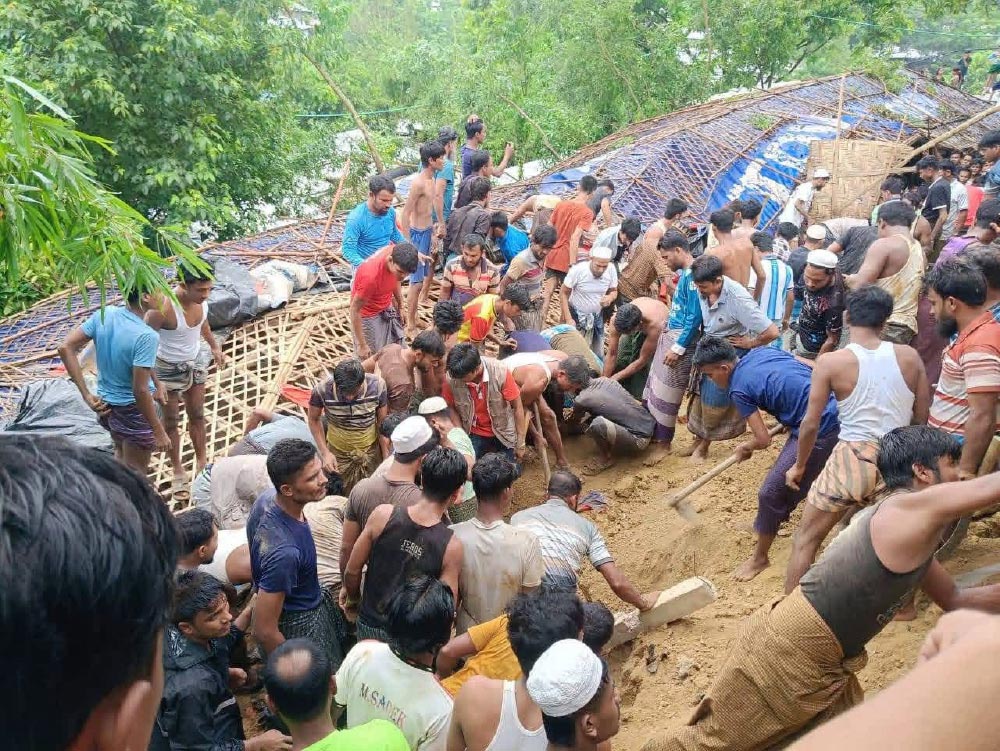
Several days of continuous heavy rains submerged vast areas of Chittagong city and the hilly region. Train services were stopped as the Chittagong-Cox's Bazar railway line was submerged. Hundreds of road connections were cut off, educational institutions were declared closed, business and commerce came to a standstill and thousands of people were forced to go to shelters. 749 millimetres of rainfall in four consecutive days in Cox's Bazar made the situation even more dire. The tragic deaths of children, women and Rohingya students in landslides remind us that the nature of disasters is changing rapidly in the era of climate change.
The question is, were we completely unprepared for this situation? The answer is a resounding “no.” Bangladesh has made remarkable progress in disaster management over the past two decades. Early warning systems, cyclone shelters, community-based volunteer networks and administrative coordination have saved many lives. Even in recent disasters, district administrations have quickly opened shelters, set up emergency control rooms, distributed dry food, rice and relief supplies and tried to evacuate people from vulnerable hilly areas. These initiatives deserve praise.
However, at the same time, this disaster has also brought some harsh realities to our attention.
First, our urban planning is not yet climate-resilient. In a major port city like Chittagong, major roads are submerged in water within a few hours of heavy rain. Due to the filling of many canals, unplanned urbanization, poor drainage system and encroachment of reservoirs, rainwater cannot drain quickly. As a result, natural disasters turn into man-made crises.
Second, the recurrence of landslides is the result of our long-standing mismanagement. Every year, when the monsoon arrives, people living in vulnerable hills are called upon to evacuate. But when the season ends, there is little progress in permanently solving the problem. Poverty, lack of alternative housing and uncontrolled mountain cutting are forcing thousands of families to live under the same risk.
Third, the climate resilience of our critical infrastructure is still not sufficient. The submergence of the Chittagong-Cox's Bazar railway line has cut off communication. This has not only affected passenger transport; it has also affected tourism, business and emergency services. Taking into account the risks of future extreme weather in infrastructure planning is no longer a luxury, but a necessity.
 This disaster reminds us of another thing - disaster management is not just about distributing relief. The internationally recognized disaster management cycle is based on four phases: Mitigation, Preparedness, Response and Recovery. We often give the most importance to Response or relief activities. However, the most investment in reducing losses should be in the Mitigation and Preparedness phases.
If risky settlements in hilly areas could be reduced, if the drainage system of the city was effective, if canals and reservoirs were preserved, if regular disaster drills were conducted in each union, then the losses could be much less even with the same amount of rainfall.
The role of technology in the reality of climate change also needs to be rethought. Today, it is possible to predict flood risks, identify potential landslide areas and quickly assess losses using artificial intelligence (AI), satellite data, drones and GIS technology. Mobile-based early warnings and real-time data analysis can make administrative decision-making faster and more effective.
Another important lesson of this disaster is that climate change is no longer a future crisis; it is a present reality. Bangladesh’s development planning, infrastructure investment, urbanization and local government system must now be reorganized on the basis of climate resilience. It is not enough to just repair the damage after the disaster; investments must be increased to reduce risks before the disaster.
Several issues are now urgent for policymakers. First, an integrated urban drainage and watershed management plan must be implemented in Chittagong and the hilly regions. Second, safe rehabilitation programs must be strengthened in landslide-prone areas. Third, railway lines, roads, bridges, and power infrastructure must be rebuilt in a climate-resilient manner. Fourth, data-based disaster risk assessment and regular drills should be made mandatory at every district and upazila level. Above all, disaster management must be considered not just an administrative responsibility, but an integral part of sustainable development.
The recent disasters in Chittagong and Cox’s Bazar have left us with a clear message. If we only calculate the damage after each disaster, the same mistakes will be repeated again and again. But if we can learn from this experience and make changes in planning, investment, and policymaking, then we will be able to not only reduce the damage in future disasters but also build a more resilient Bangladesh.
We do not have control over nature. But the extent of the damage from disasters depends largely on our preparation, planning, and collective sense of responsibility. Now is the time to establish proactive and climate-resilient disaster management as a national priority, rather than reactive.
The writer is a development professional
Loading...
Loading...
Also read



Editor : Iqbal Sobhan Chowdhury
Published by the Editor on behalf of the Observer Ltd. from Globe Printers, 24/A, New Eskaton Road, Ramna, Dhaka.
Editorial, News and Commercial Offices : Aziz Bhaban (2nd floor), 93, Motijheel C/A, Dhaka-1000.
Phone: PABX- 41053001-06; Advertisement: 41053012; 01793317829, 01550707291, E-mail: [email protected], [email protected] Online: email: [email protected] 41053014; 01550707297 Advertisement: 01550707296
Published by the Editor on behalf of the Observer Ltd. from Globe Printers, 24/A, New Eskaton Road, Ramna, Dhaka.
Editorial, News and Commercial Offices : Aziz Bhaban (2nd floor), 93, Motijheel C/A, Dhaka-1000.
Phone: PABX- 41053001-06; Advertisement: 41053012; 01793317829, 01550707291, E-mail: [email protected], [email protected] Online: email: [email protected] 41053014; 01550707297 Advertisement: 01550707296


