



| HEADLINE |

|

Flood death toll hits 54, over 6 lakh affected
Published : Tuesday, 14 July, 2026 at 12:00 AM
Staff Correspondent


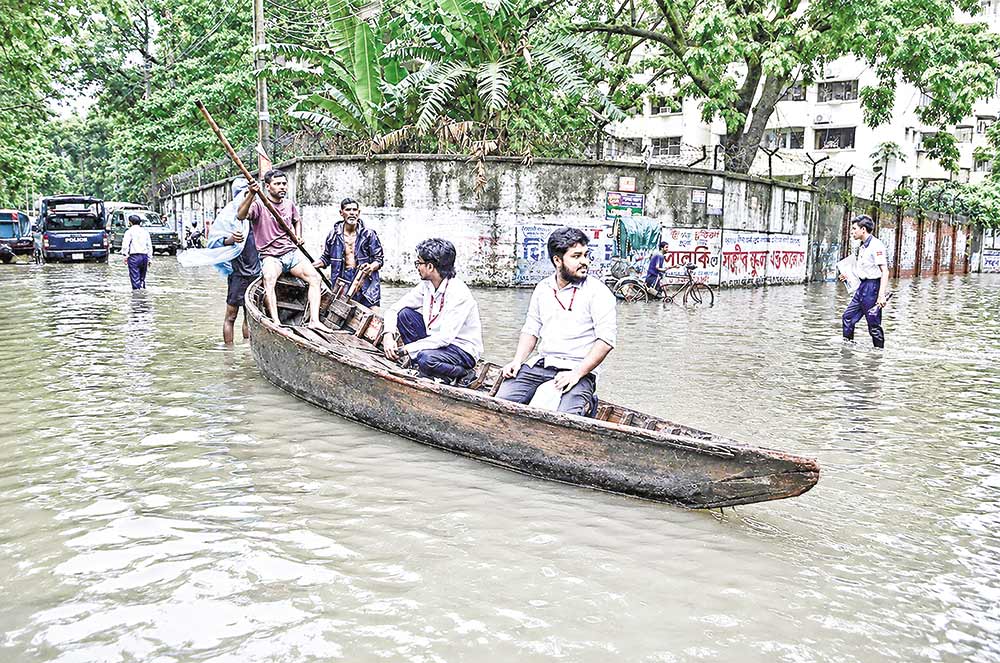 Bangladesh's flood crisis entered a new phase on Monday as the death toll from floods, flash floods and landslides climbed to 54, while authorities warned that the danger is shifting from the southeast to the country's northern and northeastern regions amid forecasts of more heavy rain.
According to the Ministry of Disaster Management and Relief, more than 6.09 lakh people from 1,55,311 families have been affected across 59 upazilas in seven districts. Floodwaters have inundated 334 unions and 12 municipalities, forcing thousands to seek shelter.
The government has opened 1,049 flood shelters, where 38,422 people are currently staying.
Cox's Bazar remains the worst-hit district, accounting for 31 deaths, including 13 Rohingya refugees, followed by Chattogram (13), Bandarban (6), Rangamati (3) and Moulvibazar (1). Authorities also reported 39 injuries, while one person remains missing in Cox's Bazar.
The disaster has damaged nearly 80,000 houses, 344 educational institutions, 3,840 kilometres of roads, and 339 bridges and culverts. Housing losses were most severe in Cox's Bazar, followed by Bandarban and Chattogram.
To support relief efforts, the government has allocated Tk 4.6 crore in cash assistance and 8,950 tonnes of rice across all 64 districts since July 7, with priority given to the worst-affected areas. Relief agencies are distributing cash, dry food, cooked meals, baby food and other emergency supplies.
The floods have also taken a heavy toll on agriculture and livestock. A preliminary assessment by the Department of Livestock Services estimated that more than 1.12 lakh livestock and poultry have died, causing losses of over Tk 30 crore, while damaged animal feed has added another Tk 25 crore in losses.
The humanitarian situation in the Rohingya camps in Cox's Bazar has also deteriorated. Human Rights Watch (HRW) said at least 17 refugees have died and more than 3,000 people have been displaced by landslides triggered by relentless monsoon rain.
The Rohingya Coordination Platform reported 286 weather-related incidents between July 4 and July 9, affecting more than 26,000 refugees, including 95 landslides that damaged shelters and essential facilities. HRW urged Bangladesh, the United Nations and international donors to restore funding for embankments, drainage systems, access roads and emergency relocation sites to reduce further risks.
While conditions improved in Bandarban after the Sangu and Matamuhuri rivers fell below danger level, transport remains disrupted on several routes due to damaged bridges and landslides.
Flood forecasters, meanwhile, warned that the situation could worsen across the north and northeast over the next two days.
The Bangladesh Meteorological Department forecast heavy to very heavy rainfall in Rangpur, Rajshahi, Mymensingh, Dhaka, Chattogram and Sylhet divisions, while the Flood Forecasting and Warning Centre said the Surma, Kushiyara and Someswari rivers remained above danger level.
Rising water levels also threaten low-lying areas of Sylhet, Sunamganj, Netrokona, Sherpur and Mymensingh, while the Teesta and Dudhkumar rivers in Rangpur division may cross danger levels, raising the risk of fresh flooding.
Nearly 7,000 people have already taken shelter in Sylhet as continuous rainfall and upstream flows from India continue to inundate low-lying areas, with residents reporting shortages of food, safe drinking water and cooking facilities.
Loading...
Loading...
Also read



Editor : Iqbal Sobhan Chowdhury
Published by the Editor on behalf of the Observer Ltd. from Globe Printers, 24/A, New Eskaton Road, Ramna, Dhaka.
Editorial, News and Commercial Offices : Aziz Bhaban (2nd floor), 93, Motijheel C/A, Dhaka-1000.
Phone: PABX- 41053001-06; Advertisement: 41053012; 01793317829, 01550707291, E-mail: [email protected], [email protected] Online: email: [email protected] 41053014; 01550707297 Advertisement: 01550707296
Published by the Editor on behalf of the Observer Ltd. from Globe Printers, 24/A, New Eskaton Road, Ramna, Dhaka.
Editorial, News and Commercial Offices : Aziz Bhaban (2nd floor), 93, Motijheel C/A, Dhaka-1000.
Phone: PABX- 41053001-06; Advertisement: 41053012; 01793317829, 01550707291, E-mail: [email protected], [email protected] Online: email: [email protected] 41053014; 01550707297 Advertisement: 01550707296


