



| HEADLINE |

|
HSC candidates’ anguish and state’s accountability
Published : Thursday, 16 July, 2026 at 12:00 AM
Emran Emon


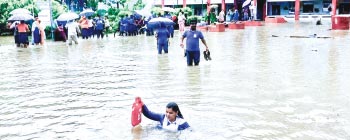
 The current landscape of Bangladesh's education sector is not defined by academic rigor or the pursuit of excellence; it is defined by a profound humanitarian failure. As thousands of students across the country wade through chest-deep floodwaters, battle the psychological trauma of family instability, and face the total collapse of their daily lives, the Ministry of Education has chosen to remain shackled to a rigid, heartless administrative calendar.
The decision to force students into the examination hall during a period of such widespread catastrophe is not merely a bureaucratic blunder�"it is a damning indictment of the current administration's priorities. It sends a chilling message to the nation: that the sanctity of an exam date far outweighs the lives, safety and dignity of the students it claims to serve.
We frequently hear the Ministry of Education speak of evaluating merit. Yet, one must ask: can merit truly blossom in an environment of sheer panic and survival? An examiner can easily grade a paper but no marksheet can ever capture the mental exhaustion, the terror or the trauma of a student who spent the night safeguarding their home from rising floodwaters.
How can a fair competition exist between a student who reached the exam centre by navigating through filthy, waste-ridden floodwaters and a student who, by virtue of geography or privilege, remained largely untouched by the disaster? This is not a test of knowledge; it is a test of resilience in the face of state-sponsored apathy. By ignoring these disparate realities, the Ministry has turned a fundamental human right�"education�"into a crucible of suffering.
The Ministry of Education and the leadership at the helm have demonstrated a disconnect that is as baffling as it is cruel. While the Prime Minister has had to intervene in specific cases�"such as relocating centres in waterlogged districts�"this reactive, patch-work approach is no substitute for a proactive, compassionate policy.
 The Education Minister and the policymakers have repeatedly declared students to be the future of the nation. However, such rhetoric is hollow when not reflected in critical decision-making. By insisting on maintaining the exam schedule in most regions, the Ministry has effectively signalled that it views students not as individuals with aspirations, but as units of production to be processed, regardless of the cost.
What we are witnessing is the commodification of the student. By prioritising a fixed date over the physical and mental well-being of the youth, the state has reduced the examinee to a product on an assembly line. When the state ignores the reality on the ground, it forfeits its moral authority. How can a system demand integrity and discipline from students when it fails to provide the basic safety and empathy that a state owes its citizens?
Education should be a gateway to self-confidence and discovery. Instead, the current regime has turned it into a source of fear and insurmountable pressure. The argument for 'keeping to the schedule' is a lazy administrative defence. Delaying the exams would have had negligible consequences on the broader academic timeline but would have provided thousands of families with much-needed relief and a sense of belonging in a caring society.
A nation that cannot pause for its children in the face of disaster is a nation that has lost its way. True modern education is not just about the curriculum, it is about the civilisation that supports it. If our policymakers continue to prioritise dates on a calendar over the lived realities of their citizens, they are not building a future; they are presiding over the erosion of our collective humanity.
The Ministry of Education may consider the conclusion of these exams a bureaucratic victory, but in the eyes of the nation, it is a defeat of character. By forcing children through the floodwaters of apathy, they have proven that their commitment to a schedule is absolute, even if that commitment comes at the cost of our children's dignity.
The Ministry must realise that a student who is broken by a system that failed to protect them in their time of greatest need will find it difficult to believe in the state's promise of a brighter future. It is time to stop viewing our students as statistics and start recognising them as people. If we fail to do this, the history of this period will not be written in the marks of our students but in the shame of a state that turned its back on them.
We often talk about building a 'Smart Bangladesh,' but true intelligence is measured by empathy, not just data. A system that demands performance without providing protection is not an academic institution; it is a machinery of mechanical compliance. If we persist in this 'business as usual' approach amidst national catastrophe, we are teaching our children that survival of the system is more important than the survival of the individual. If we do not restore humanity to our education system today, we will have nothing left to build upon tomorrow.
The writer is a journalist
Loading...
Loading...
Also read



Editor : Iqbal Sobhan Chowdhury
Published by the Editor on behalf of the Observer Ltd. from Globe Printers, 24/A, New Eskaton Road, Ramna, Dhaka.
Editorial, News and Commercial Offices : Aziz Bhaban (2nd floor), 93, Motijheel C/A, Dhaka-1000.
Phone: PABX- 41053001-06; Advertisement: 41053012; 01793317829, 01550707291, E-mail: [email protected], [email protected] Online: email: [email protected] 41053014; 01550707297 Advertisement: 01550707296
Published by the Editor on behalf of the Observer Ltd. from Globe Printers, 24/A, New Eskaton Road, Ramna, Dhaka.
Editorial, News and Commercial Offices : Aziz Bhaban (2nd floor), 93, Motijheel C/A, Dhaka-1000.
Phone: PABX- 41053001-06; Advertisement: 41053012; 01793317829, 01550707291, E-mail: [email protected], [email protected] Online: email: [email protected] 41053014; 01550707297 Advertisement: 01550707296


