



| HEADLINE |

|
Stoves go cold as gas shortage worsens; CNG queues grow


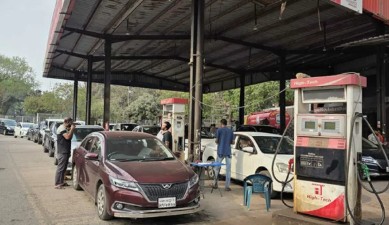
A worsening gas shortage, caused by reduced liquefied natural gas (LNG) supply and ageing infrastructure, has disrupted household cooking, slowed industrial production and created long queues at CNG filling stations across the country.
In many parts of Dhaka, residents reported having no gas, while elsewhere pressure remained too low for cooking. Industry leaders said production in the ceramic, steel and textile sectors has fallen by nearly half due to the prolonged supply crisis.
"There has been no gas in our area for about a week. We are now cooking with electric stoves, which has increased both our costs and suffering," said Masud Hasan, a resident of Sheikhertek in the capital.
Titas Gas Transmission and Distribution PLC General Manager (Operation Division) Engr Kazi Mohammad Saidul Hasan said a delayed LNG cargo had created a supply shortfall of around 90 million cubic feet over the past two days.
"As gas allocation to the power sector remained unchanged, the entire burden of the shortage fell on the industrial, residential and CNG sectors," he said.
He added that heavy rains had allowed water to enter underground pipelines through undetected leaks, further disrupting supply and delaying repairs.
The shortage has also affected CNG filling stations, where reduced gas pressure has forced motorists to wait for hours.
Farhan Noor, secretary general of the Bangladesh CNG Filling Station and Conversion Workshop Owners Association, said low gas pressure had slowed refuelling, while rising electricity costs had made many stations barely profitable.
Bangladesh Chamber of Industries (BCI) President Anwar-ul Alam Chowdhury (Parvez) warned that the prolonged gas crisis was threatening production, exports and investment, urging the government to prioritise uninterrupted energy supply to existing industries.
Meanwhile, hundreds of residents in Savar on Sunday surrounded the local Titas Gas regional office, alleging they had received little or no gas for nearly two months despite paying their bills regularly. They demanded immediate restoration of supply, action against illegal gas connections and suspension of gas bills until normal service resumes.
Loading...
Loading...
Also read








Editor : Iqbal Sobhan Chowdhury
Published by the Editor on behalf of the Observer Ltd. from Globe Printers, 24/A, New Eskaton Road, Ramna, Dhaka.
Editorial, News and Commercial Offices : Aziz Bhaban (2nd floor), 93, Motijheel C/A, Dhaka-1000.
Phone: PABX- 41053001-06; Advertisement: 41053012; 01793317829, 01550707291, E-mail: [email protected], [email protected] Online: email: [email protected] 41053014; 01550707297 Advertisement: 01550707296
Published by the Editor on behalf of the Observer Ltd. from Globe Printers, 24/A, New Eskaton Road, Ramna, Dhaka.
Editorial, News and Commercial Offices : Aziz Bhaban (2nd floor), 93, Motijheel C/A, Dhaka-1000.
Phone: PABX- 41053001-06; Advertisement: 41053012; 01793317829, 01550707291, E-mail: [email protected], [email protected] Online: email: [email protected] 41053014; 01550707297 Advertisement: 01550707296


