



| HEADLINE |

|
Poverty Falls, Inequality Rises
Bangladesh Faces New Development Test
Published : Wednesday, 29 July, 2026 at 12:00 AM
Faruk Ahmed


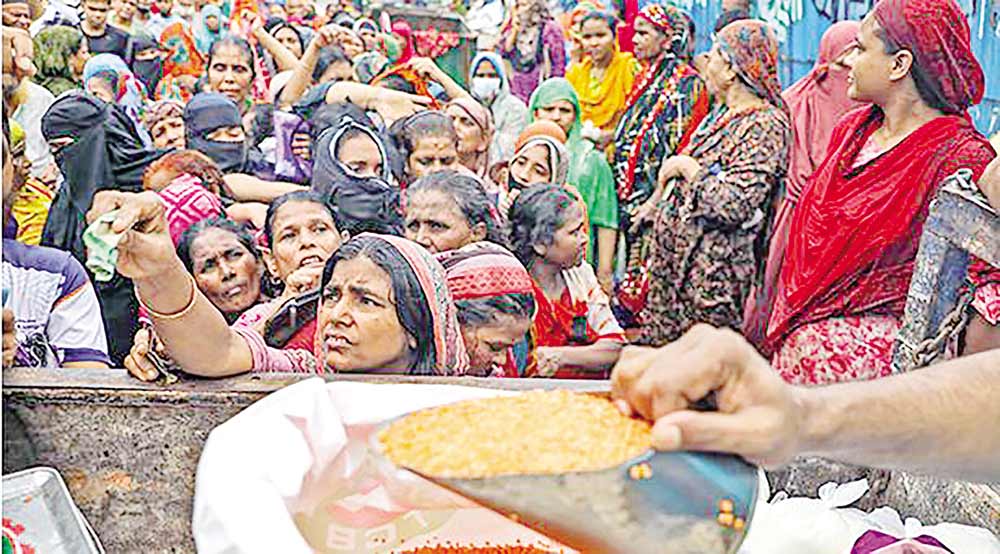 Bangladesh's celebrated economic success story is facing its toughest test yet, with poverty climbing sharply, income inequality widening and millions of vulnerable households slipping closer to hardship despite years of robust economic growth.
In the latest global economic survey released by London-based Global Finance on Monday, Bangladesh slipped deeper into the league of the world's poorest nations, climbing to 58th place in 2026 from 62nd a year earlier, underscoring mounting concerns over the country's deteriorating economic fortunes.
Despite the setback, Bangladesh ranked below Pakistan, which stood 42nd, indicating that its western neighbour remains poorer. However, Bangladesh was placed ahead of India, which ranked 62nd in the latest survey.
Economists warn that reversing the growing divide between the rich and the poor will be one of the greatest challenges for any incoming administration, including a government led by Tarique Rahman.
They argue that Bangladesh's next phase of development will depend not simply on sustaining high GDP growth, but on ensuring that prosperity is shared more equitably through quality employment, stronger institutions and wider economic opportunities.
Fresh poverty estimates paint a disturbing picture of an economy where headline growth is increasingly failing to translate into broad-based improvements in living standards.
According to the latest national assessment by the Power and Participation Research Centre (PPRC), the overall poverty rate has surged to 27.93 per cent, a dramatic increase from 18.7 per cent recorded by the Bangladesh Bureau of Statistics (BBS) in 2022. Even more alarming, extreme poverty has nearly doubled, rising from 5.6 per cent to 9.35 per cent over the same period.
The World Bank's micro-simulation models reinforce the deteriorating outlook, projecting the national poverty rate at more than 21.2 per cent, with at least 1.4 million additional people falling below the poverty line amid prolonged inflation, sluggish job creation and persistent economic pressures.
The reversal marks a sharp departure from Bangladesh's long-standing reputation as one of South Asia's most successful poverty reduction stories.
Over the past decade, the country emerged as one of Asia's fastest-growing economies, powered by the ready-made garments industry, resilient remittance inflows, rising domestic consumption and sustained infrastructure investment. Its graduation from the Least Developed Country (LDC) category further underscored Bangladesh's remarkable economic transformation.
Between 2010 and 2022, around 25 million people escaped poverty, including nine million who emerged from extreme poverty. However, the World Bank says the pace of poverty reduction began slowing after 2016 as job creation weakened, particularly outside Dhaka, while the benefits of economic growth became increasingly concentrated.
Today, nearly 62 million Bangladeshis remain just above the poverty line, leaving them highly vulnerable to being pushed back into poverty by inflation, illness, climate-related disasters or other economic shocks.
The World Bank believes Bangladesh's next development challenge is no longer merely accelerating growth but making that growth genuinely inclusive. It argues that future progress will depend less on GDP expansion alone and more on generating productive employment, strengthening education and workforce skills, expanding economic opportunities beyond the capital and reducing disparities in income and opportunity.
The country's widening inequality is becoming increasingly evident.
Bangladesh's income Gini coefficient has climbed to 0.499, reflecting a steady deterioration in income distribution, with the richest 10 per cent capturing an increasingly dominant share of national income growth.
Although the World Bank's inequality estimates are based on household surveys that often understate the true concentration of wealth, independent studies using tax records and wealth data indicate that inequality is significantly deeper than official surveys suggest.
Regional comparisons also reveal a complex picture. India continues to experience one of the world's highest concentrations of wealth, with the richest 10 per cent accounting for nearly 58 per cent of national income.
Pakistan, meanwhile, has witnessed a sharp rise in inequality amid prolonged economic instability. Bangladesh performs better than both neighbours in long-term poverty reduction but is now confronting a rapidly widening gap between economic growth and income distribution.
Economists and policy analysts say the gains of development have become increasingly concentrated in major urban centres such as Dhaka and Chattogram, where wealth creation has accelerated, while many rural communities continue to struggle with inadequate healthcare, weaker education outcomes, low-productivity employment and limited access to formal financial services.
They attribute the widening divide to structural weaknesses, including uneven regional development, excessive dependence on a narrow export base, slow industrial diversification, weaknesses in governance, unequal access to quality education and healthcare, and gaps in social protection. Rapid urbanisation has also expanded the informal economy, leaving millions of workers without secure employment, social protection or decent wages.
Although successive governments have expanded social safety net programmes, invested in rural infrastructure and accelerated digital inclusion, analysts say these initiatives have not kept pace with the growing structural challenges. They argue that deeper reforms are needed to improve the business environment, strengthen governance, restore confidence in the financial sector, attract investment, diversify industries and create productive jobs capable of absorbing Bangladesh's growing workforce.
For Bangladesh's next government, economists say the policy challenge is both urgent and historic.
"The country has already demonstrated that rapid economic growth can lift millions out of poverty," one economist observed. "The next chapter will be judged not by how fast the economy grows, but by whether that growth creates decent jobs, reduces inequality and delivers prosperity to ordinary citizens rather than concentrating wealth in the hands of a privileged few."
As Bangladesh enters a new phase of development after its LDC graduation, the defining question is no longer whether the economy can continue to grow, but whether its growth model can be transformed into one that is fairer, more resilient and genuinely inclusive. The answer, economists say, will determine whether the country's remarkable economic miracle continues�"or begins to unravel.
Loading...
Loading...
Also read



Editor : Iqbal Sobhan Chowdhury
Published by the Editor on behalf of the Observer Ltd. from Globe Printers, 24/A, New Eskaton Road, Ramna, Dhaka.
Editorial, News and Commercial Offices : Aziz Bhaban (2nd floor), 93, Motijheel C/A, Dhaka-1000.
Phone: PABX- 41053001-06; Advertisement: 41053012; 01793317829, 01550707291, E-mail: [email protected], [email protected] Online: email: [email protected] 41053014; 01550707297 Advertisement: 01550707296
Published by the Editor on behalf of the Observer Ltd. from Globe Printers, 24/A, New Eskaton Road, Ramna, Dhaka.
Editorial, News and Commercial Offices : Aziz Bhaban (2nd floor), 93, Motijheel C/A, Dhaka-1000.
Phone: PABX- 41053001-06; Advertisement: 41053012; 01793317829, 01550707291, E-mail: [email protected], [email protected] Online: email: [email protected] 41053014; 01550707297 Advertisement: 01550707296


