



| HEADLINE |

|
No factory shut due to energy crisis, says BGMEA President
Published : Thursday, 17 September, 2026 at 3:57 PM
Observer Online Report


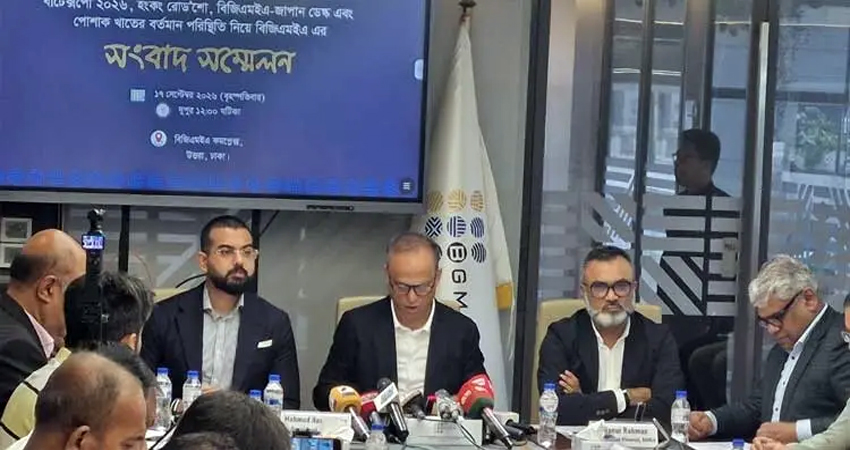
Collected Photo
The Bangladesh Garment Manufacturers and Exporters Association (BGMEA), the apex body of ready-made garment factory owners, reported an improvement in the gas supply situation.
Mahmud Hasan Khan, president of the association, stated that no garment factories have closed so far due to the recent energy crisis. However, he noted that it would take a few more months to fully understand the actual impact of the situation.
He made these remarks on Thursday (September 17) at a press conference held at the BGMEA Complex in Uttara, Dhaka. The event was organized to discuss ‘Batexpo 2026’, an upcoming roadshow in Hong Kong, and the overall state of the garment sector.
BGMEA President Mahmud Hasan Khan said, "The gas situation has improved; supply has increased compared to the last few days. No factories have shut down due to electricity or energy shortages. The full impact of this energy crisis will only become apparent after at least three months."
Relief in Gas Supply
Addressing the energy crisis, Mahmud Hasan Khan noted that backward linkage sectors—such as dyeing and washing—were severely disrupted due to low gas pressure. However, following a recent meeting between the business community and the government, gas supplies to industries were restored to previous levels, a measure that has since been implemented.
He mentioned that garment factories typically operate for 8 to 10 hours under normal conditions. However, due to the energy crisis, many establishments had to spend an additional five hours or so and rely on alternative fuel sources, thereby increasing operational costs.
Despite these challenges, entrepreneurs strove to ensure timely shipment of goods. The BGMEA president stated that short, medium, and long-term plans are essential to stabilize gas supplies. A presentation regarding this matter has been submitted to the Ministry of Energy. They believe that if the plan is implemented, a major resolution to the energy crisis could be achieved within the next two years.
BGMEA seeks land-based storage instead of more FSRUs
To ensure energy security, the BGMEA has called for the installation of two additional Floating Storage and Regasification Units (FSRUs). At the same time, the organization's president emphasized the construction of land-based storage terminals as a long-term solution.
He noted that an agreement has already been signed with China to procure one FSRU on a government-to-government (G2G) basis. However, beyond that, the BGMEA prefers to shift towards land-based storage systems rather than acquiring multiple FSRUs.
He argued that even if three, four, or five FSRUs are installed, the desired benefits will not be realized unless the distribution system is adequate. Therefore, efforts to upgrade gas distribution lines must proceed alongside the installation of FSRUs.
Additionally, the BGMEA demanded top priority for gas connections and rationing in SME factories, priority gas connections for factories operating boilers with 100 to 500 PSI capacity, low-interest green loans for adopting renewable energy, and an accelerated push for gas exploration in coastal areas.
Increasing focus on solar power
Highlighting his own initiatives regarding solar power, Mahmud Hasan Khan mentioned that he has been using rooftop solar power at his facilities since 2019. He stated that his establishments utilize approximately 14 megawatts of solar power.
According to BGMEA data, there is significant potential for large-scale solar power generation within member factories. He also mentioned that discussions have been held with Bangladesh Bank regarding low-interest green financing, as the long return periods and high interest rates associated with investments in this sector pose major challenges.
Hopes for a three-year extension on LDC graduation
Regarding LDC graduation, the BGMEA president stated that the government's initiative to seek a three-year deferral of Bangladesh's graduation timeline at the United Nations is crucial for the business community. He expressed optimism that the matter will be passed by the UN General Assembly this month.
He noted that securing an additional three years would provide more time to prepare for the challenges of the post-LDC era. To this end, the private sector has been included in a committee led by the Economic Relations Division (ERD) under the Ministry of Finance, and progress is being reviewed through regular meetings.
Prioritizing an FTA with the EU
Mahmud Hasan Khan emphasized the importance of a Free Trade Agreement (FTA) with the European Union for Bangladesh's garment exports following LDC graduation.
He stated that securing an FTA with the EU—rather than GSP Plus status—is their most critical objective. He mentioned that the Ministry of Commerce is working on this matter and that discussions have already made significant progress.
Additionally, the BGMEA called for the modernization of company and customs laws to facilitate business, the swift conclusion of FTA/EPA agreements, and the maintenance of special policy support and consistent tariff structures for the export sector for at least five years in the post-LDC period.
Initiatives to boost exports to new markets
Regarding the diversification of export markets, the BGMEA president spoke about the efforts made over the past decade to increase Bangladesh's garment exports to new markets. Efforts are underway to expand market reach; currently, out of approximately 40 billion dollars in garment exports, about 8 billion dollars comes from markets outside the United States, the European Union, and Canada.
He mentioned that new international brands would be invited to set up business in Bangladesh during an upcoming roadshow in Hong Kong, organized by HSBC.
Additionally, the BGMEA is launching a ‘Japan Desk’ to facilitate communication with Japanese buyers, appointing officials proficient in the Japanese language for this purpose. The BGMEA president stated that the aim is to increase exports to Japan—currently valued at around 500 million dollars—to between 2 billion and 2.5 billion dollars in the near future.
At the press conference, he also announced a strategic agreement with the Bangladesh Brand Forum to position Bangladesh's garment industry in the global market not merely as a producer of low-cost goods, but as a modern, innovation-driven sector.
-NS/SA
Loading...
Loading...
Also read







Editor : Iqbal Sobhan Chowdhury
Published by the Editor on behalf of the Observer Ltd. from Globe Printers, 24/A, New Eskaton Road, Ramna, Dhaka.
Editorial, News and Commercial Offices : Aziz Bhaban (2nd floor), 93, Motijheel C/A, Dhaka-1000.
Phone: PABX- 41053001-06; Advertisement: 41053012; 01793317829, 01550707291, E-mail: [email protected], [email protected] Online: email: [email protected] 41053014; 01550707297 Advertisement: 01550707296
Published by the Editor on behalf of the Observer Ltd. from Globe Printers, 24/A, New Eskaton Road, Ramna, Dhaka.
Editorial, News and Commercial Offices : Aziz Bhaban (2nd floor), 93, Motijheel C/A, Dhaka-1000.
Phone: PABX- 41053001-06; Advertisement: 41053012; 01793317829, 01550707291, E-mail: [email protected], [email protected] Online: email: [email protected] 41053014; 01550707297 Advertisement: 01550707296


