



| HEADLINE |

|

The LNG Trap: Costly Transition, Fragile Security



 Bangladesh's transition from domestic natural gas to imported liquefied natural gas (LNG) was meant to ease mounting gas shortages and diversify the country's energy mix. Eight years after LNG entered the national grid, however, the country is paying record import bills, mounting subsidies and sharply higher gas tariffs while industries, power plants, households and CNG filling stations continue to grapple with chronic supply shortages, raising concerns over the sustainability of the country's energy transition.
Introduced in 2018 to compensate for declining domestic gas production and rising energy demand, LNG now supplies around 30 per cent of Bangladesh's daily gas requirement. But the shift has also exposed the country to volatile international energy markets, foreign exchange pressures and geopolitical disruptions, while significantly increasing the cost of supplying natural gas.
According to data from Rupantarita Prakritik Gas Company Ltd (RPGCL), a subsidiary of state-owned Petrobangla, Bangladesh has imported 31.61 million metric tonnes of LNG since 2018 at a cost exceeding $17.6 billion.
Despite the massive expenditure, consumers across all sectors continue to face gas shortages.
Industries are struggling to maintain production, power plants frequently operate below capacity, CNG filling stations experience supply disruptions and many household consumers continue to complain about inadequate gas pressure despite paying higher tariffs.
Since LNG was added to the national grid, the government has increased gas tariffs seven times. Gas prices reached an unprecedented rise of up to 179 per cent in 2023, while industrial gas prices have increased by 415 per cent over the past eight years. The price per unit of gas has increased from $0.063 (Tk7.76) in 2018 to $0.32 (Tk40).
Even with repeated tariff hikes, the financial burden on the government has continued to rise.
The gas sector has received Tk51,366 crore in subsidies over the past eight years. Annual subsidies increased from around Tk2,500 crore in fiscal 2018-19 to around Tk6,000 crore in each of fiscal 2021-22, 2022-23 and 2023-24, before rising further to Tk8,900 crore in fiscal 2024-25 and Tk14,600 crore in fiscal 2025-26.
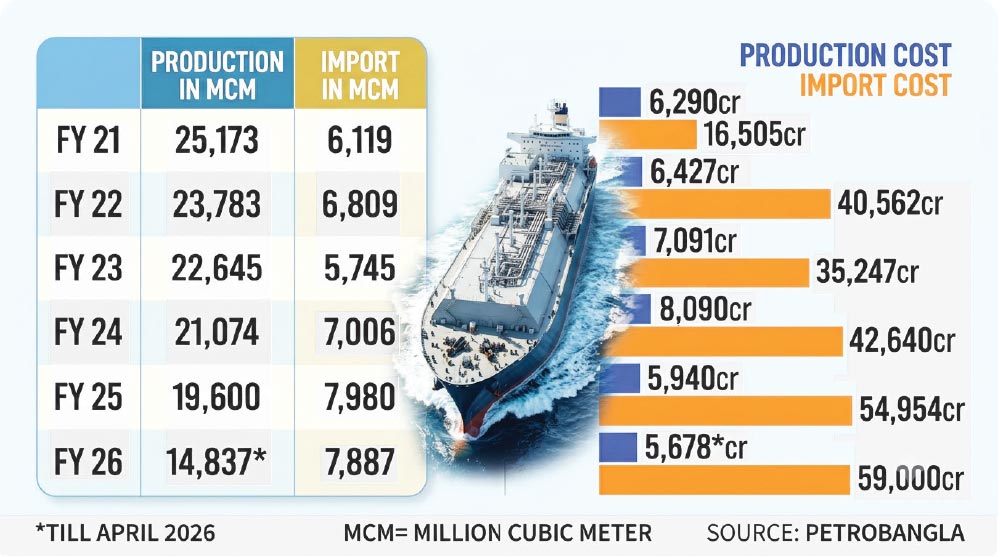
The cost of LNG imports has also increased sharply, rising from Tk16,505 crore in fiscal 2020-21 to around Tk59,000 crore in fiscal 2025-26, according to Petrobangla data.
The contrast between imported LNG and domestic gas has become increasingly apparent.
During fiscal 2024-25, Bangladesh spent $4.38 billion (Tk53,946 crore) on LNG imports and regasification facilities to secure around 30 per cent of total gas supply. By comparison, the remaining 70 per cent supplied from domestic gas fields cost only $565 million (Tk6,956 crore).
Meanwhile, domestic gas production continues to decline.
Petrobangla data show domestic gas production fell by 22.1 per cent over the past five years to 19.60 bcm in fiscal 2024-25, while LNG imports increased from 6.12 bcm to 7.98 bcm over the same period.
During the first 10 months of fiscal 2025-26, domestic production stood at 14.84 bcm, compared with LNG imports of around 7.89 bcm, according to Petrobangla's latest MIS data.
The country's growing dependence on imported LNG has also increased its exposure to global market volatility and geopolitical developments.
Purchasing LNG from the spot market requires substantial foreign currency, particularly US dollars, placing additional pressure on Bangladesh's foreign exchange reserves during periods of high international prices and global inflation.
The vulnerability became evident during the recent disruption of a floating storage and regasification unit (FSRU), which reduced gas supply to the national grid by around 450 mmcfd. Total supply fell to around 2,150 mmcfd against daily demand of nearly 3,800 mmcfd, disrupting industrial production, electricity generation and gas supply to consumers.
Some critics argue that Bangladesh's decision to import LNG was misguided. However, sector data suggest the country had limited options as domestic gas production continued to decline while demand kept increasing.
South Asia is also emerging as an important LNG market.
According to Chong Zhi Xin, Principal Asia LNG Analyst at energy consultancy Wood Mackenzie, Bangladesh and Pakistan are following India in becoming major LNG consumers because existing gas infrastructure and declining domestic production make imported LNG a natural option.
Experts, however, argue that greater dependence on imported LNG should not come at the expense of developing domestic energy resources.
Professor Shamsul Alam said the transition to LNG had often been presented as unavoidable, but other options remained available.
"There are many alternatives to costly LNG, such as domestic gas exploration and the expansion of industrial rooftop solar on a priority basis," he said.
He added that supportive policies and incentives for rooftop solar would help industries reduce electricity costs and lessen dependence on gas-fired captive power generation.
Climate finance expert and Chief Executive of Change Initiative M Zakir Hossain Khan said Bangladesh's long-term energy security would depend on securing its own energy sources rather than relying heavily on imports.
He said the current situation in the Strait of Hormuz demonstrated how geopolitical events could repeatedly disrupt global energy supply chains, whereas renewable energy sources such as solar and wind would remain available over the long term.
Bangladesh had planned to further expand LNG infrastructure through additional FSRUs and an onshore regasification terminal at Kutubdia Island. However, those projects were cancelled by the interim government in 2025.
Energy experts say Bangladesh now faces the challenge of balancing immediate energy needs with long-term energy security.
While LNG has helped offset declining domestic gas production, they argue that reducing dependence on volatile international markets will require faster domestic gas exploration alongside greater investment in renewable energy to create a more affordable, resilient and sustainable energy system.

Loading...
Loading...
Also read




Editor : Iqbal Sobhan Chowdhury
Published by the Editor on behalf of the Observer Ltd. from Globe Printers, 24/A, New Eskaton Road, Ramna, Dhaka.
Editorial, News and Commercial Offices : Aziz Bhaban (2nd floor), 93, Motijheel C/A, Dhaka-1000.
Phone: PABX- 41053001-06; Advertisement: 41053012; 01793317829, 01550707291, E-mail: [email protected], [email protected] Online: email: [email protected] 41053014; 01550707297 Advertisement: 01550707296
Published by the Editor on behalf of the Observer Ltd. from Globe Printers, 24/A, New Eskaton Road, Ramna, Dhaka.
Editorial, News and Commercial Offices : Aziz Bhaban (2nd floor), 93, Motijheel C/A, Dhaka-1000.
Phone: PABX- 41053001-06; Advertisement: 41053012; 01793317829, 01550707291, E-mail: [email protected], [email protected] Online: email: [email protected] 41053014; 01550707297 Advertisement: 01550707296


