



| HEADLINE |

|
Power Crisis Cuts Plastic Output to 30pc as Industry Turns to Solar for Survival
Published : Wednesday, 5 August, 2026 at 12:00 AM
Business Correspondent


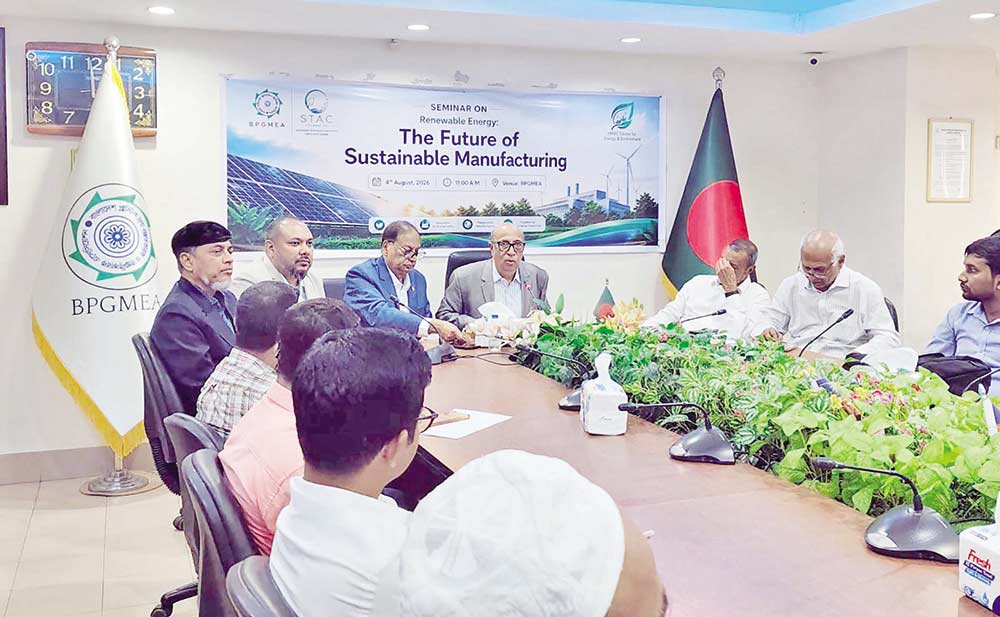 Bangladesh's plastic manufacturing industry has been pushed to the brink by a deepening electricity crisis, with production slumping to just 30 per cent of capacity, prompting manufacturers to accelerate a transition towards renewable energy in a bid to safeguard the sector's future.
Warning that the industry faces an existential threat if the energy crisis continues, Bangladesh Plastic Goods Manufacturers and Exporters Association (BPGMEA) President Shamim Ahmed said there was no viable alternative to embracing solar power and other renewable energy sources to sustain production, reduce costs and remain competitive in global markets.
"The sector cannot survive if the present situation persists," Ahmed said while addressing a workshop titled "Renewable Energy: The Future of Sustainable Manufacturing", jointly organised by the BPGMEA and the STAC Foundation at the association's headquarters in Purana Paltan, Dhaka, on Tuesday.
The event featured a keynote presentation by Engineer Hasan Mahamud Khan, while Ekramul Haque of Akij Plastics Ltd. and other industry experts also shared their views on the future of sustainable manufacturing.
To confront the crisis, he said, the BPGMEA has already launched initiatives to bring the country's plastic industry under renewable or green energy, with solar power emerging as the most practical and cost-effective solution.
"There is no alternative to expanding the use of renewable energy, particularly solar power, if we want to overcome the ongoing power crisis while addressing the challenges of global climate change," he said.
He noted that the shift is no longer driven solely by environmental concerns but has become a strategic business imperative as international buyers increasingly favour products manufactured using clean energy.
Highlighting the environmental cost of conventional fuels, Ahmed said fossil fuels�"including coal, natural gas and petroleum�"account for more than 90 per cent of global carbon emissions, adding that burning just one litre of petrol releases 2.31 kilograms of carbon dioxide into the atmosphere.
He warned that unchecked industrial dependence on fossil fuels is accelerating climate change and damaging ecosystems, making resource efficiency and environmentally sustainable manufacturing essential for long-term economic growth.
Drawing comparisons with global trends, Ahmed said countries such as China are investing in renewable energy on a massive scale, generating solar power in gigawatt and even terawatt capacities to decarbonise their industries. Bangladesh, by contrast, still has solar projects largely limited to around 200 megawatts, leaving substantial room for expansion.
Describing energy as the backbone of manufacturing, he said transitioning to sustainable energy would fundamentally reshape industrial production, particularly in energy-intensive sectors such as plastics.
Industry experts at the workshop noted that rooftop solar systems can reduce factories' dependence on the national grid, lowering electricity bills by 40 to 60 per cent while ensuring stable long-term energy supplies. Solar panels typically have a lifespan of 25 to 30 years, with properly maintained systems capable of generating electricity for at least two decades.
Replacing electricity generated from coal, oil or gas with solar power would also sharply reduce carbon emissions, improving the environmental credentials of Bangladeshi products and enhancing their acceptance in export markets where sustainability standards are becoming increasingly stringent.
Participants also highlighted three practical solar solutions for manufacturing industries, including grid-connected rooftop systems, net-metering arrangements that allow surplus electricity to be fed into the national grid, and battery-backed hybrid systems capable of maintaining production during power outages.
Loading...
Loading...
Also read



Editor : Iqbal Sobhan Chowdhury
Published by the Editor on behalf of the Observer Ltd. from Globe Printers, 24/A, New Eskaton Road, Ramna, Dhaka.
Editorial, News and Commercial Offices : Aziz Bhaban (2nd floor), 93, Motijheel C/A, Dhaka-1000.
Phone: PABX- 41053001-06; Advertisement: 41053012; 01793317829, 01550707291, E-mail: [email protected], [email protected] Online: email: [email protected] 41053014; 01550707297 Advertisement: 01550707296
Published by the Editor on behalf of the Observer Ltd. from Globe Printers, 24/A, New Eskaton Road, Ramna, Dhaka.
Editorial, News and Commercial Offices : Aziz Bhaban (2nd floor), 93, Motijheel C/A, Dhaka-1000.
Phone: PABX- 41053001-06; Advertisement: 41053012; 01793317829, 01550707291, E-mail: [email protected], [email protected] Online: email: [email protected] 41053014; 01550707297 Advertisement: 01550707296


