



| HEADLINE |

|

Middle East Truce Sparks Remittance Boom, War Risk Clouds $36b Goal
Published : Thursday, 6 August, 2026 at 12:00 AM
Faruk Ahmed


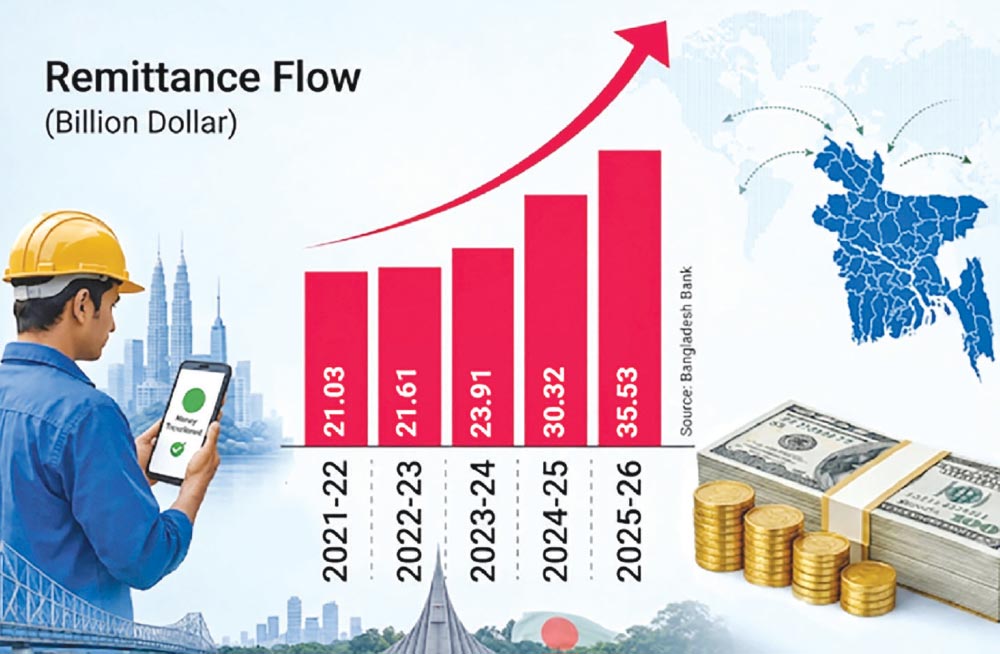 The easing of tensions between Iran and the United States has opened a crucial window of opportunity for Bangladesh to sustain its record-breaking remittance boom, offering fresh hope for stronger foreign exchange reserves and macroeconomic stability.
 Yet economists warn that the fragile peace could unravel quickly, with any renewed conflict in the Gulf threatening one of the country's most vital economic lifelines.
Bangladesh received US$2.85 billion in remittances in July 2026�"the highest inflow for the month in eight years�"marking a strong start to FY2026-27 and reinforcing overseas earnings as the nation's most dependable source of foreign currency after exports.
The impressive performance follows a record US$35.59 billion remitted by expatriate Bangladeshis during FY2025-26, a rise of more than 30 per cent from the previous fiscal year. Encouraged by the strong momentum, Bangladesh Bank expects remittance receipts to climb to around US$36 billion this year, provided geopolitical conditions remain favourable.
The improved outlook comes as international mediation led by Oman and Qatar has helped ease immediate fears of a full-scale Iran-US confrontation. Diplomatic efforts have reduced tensions in the Gulf, temporarily lowering the risk of disruptions to regional economies that employ millions of Bangladeshi migrant workers.
For Bangladesh, the stakes are exceptionally high. More than two-thirds of its overseas workers are employed in the Gulf and wider Middle East, making the country's remittance earnings closely tied to the region's economic and political stability.
Bangladesh Bank, in its latest assessment, said remittance inflows have remained resilient, supported by a large overseas workforce, cash incentives and the growing use of formal banking and digital transfer channels. However, the central bank cautioned that a prolonged regional conflict could weaken labour markets, delay infrastructure and energy projects, reduce fresh recruitment and ultimately curb remittance inflows.
Economists say another outbreak of hostilities would have far-reaching consequences. Higher oil prices, disruptions to shipping through the Strait of Hormuz and slower economic activity across oil-exporting Gulf states could reduce employment opportunities and income for Bangladeshi migrant workers. That, in turn, would put pressure on remittance growth, foreign exchange reserves and the balance of payments.
"Bangladesh's external sector has become increasingly dependent on robust remittance inflows. Any prolonged instability in the Gulf would quickly be reflected in foreign exchange availability, exchange rate stability and domestic economic confidence," said a senior economist.
Higher remittances are already delivering significant macroeconomic benefits. Increased inflows through formal channels have strengthened foreign exchange reserves, eased pressure on the taka, improved the balance of payments and enhanced Bangladesh's capacity to finance imports and meet external debt obligations. They have also boosted liquidity in the banking system and reinforced the market-based exchange rate regime introduced by Bangladesh Bank.
Beyond the macroeconomy, remittances continue to transform household incomes by financing food, education, healthcare, housing and small business investments, providing an essential financial cushion for millions of families.
Analysts attribute the recent surge to a combination of favourable exchange rates, government cash incentives, tighter measures against informal money transfer networks and wider access to digital remittance services.
Despite the encouraging outlook, experts caution against complacency. Although diplomacy has reduced the immediate threat of war, the underlying disputes over Iran's nuclear programme, regional security and economic sanctions remain unresolved. Any collapse of negotiations or escalation involving Iran-backed groups could once again destabilise the Middle East and undermine Bangladesh's remittance outlook.
For now, the Gulf's fragile calm has handed Bangladesh a valuable economic dividend. Whether the country can sustain its march towards US$36 billion in remittance earnings will depend not only on sound domestic policies but also on the durability of peace in one of the world's most strategically important regions.
Loading...
Loading...
Also read



Editor : Iqbal Sobhan Chowdhury
Published by the Editor on behalf of the Observer Ltd. from Globe Printers, 24/A, New Eskaton Road, Ramna, Dhaka.
Editorial, News and Commercial Offices : Aziz Bhaban (2nd floor), 93, Motijheel C/A, Dhaka-1000.
Phone: PABX- 41053001-06; Advertisement: 41053012; 01793317829, 01550707291, E-mail: [email protected], [email protected] Online: email: [email protected] 41053014; 01550707297 Advertisement: 01550707296
Published by the Editor on behalf of the Observer Ltd. from Globe Printers, 24/A, New Eskaton Road, Ramna, Dhaka.
Editorial, News and Commercial Offices : Aziz Bhaban (2nd floor), 93, Motijheel C/A, Dhaka-1000.
Phone: PABX- 41053001-06; Advertisement: 41053012; 01793317829, 01550707291, E-mail: [email protected], [email protected] Online: email: [email protected] 41053014; 01550707297 Advertisement: 01550707296


