



| HEADLINE |

|
President Xi Jinping's Vision for Party Building to Modern Governance
Published : Friday, 7 August, 2026 at 12:00 AM
Nafees Sakhawat


 During a national conference on Party building was held on 15 June 2026, the concept of "Xi Jinping's Thought on Party Building" was hailed as a milestone in the history of Marxist theory on party building and in the history of the Chinese Communist Party building across China. A major report titled ‘Contemporary features and Global significance of Xi Jinping Thought on Party Building’ was released by the Party school of the Communist Party of China (CPC) Central Committee and Xinhua News Agency. The first and second volume of President Xi Jinping’s selected works on party building, which compile 102 major speeches, reports, and articles from November 2012 to February 2026, were published for nationwide distribution.
Since the 18th CPC National Congress in 2012, the CPC Central Committee, with comrade Xi Jinping at its core, has put forward new concepts, new thinking, and new strategies that will serve as the fundamental guidelines for strengthening Party building in the new era. These concepts put forth the 'Fourteen Persistence', which included insistence on 'full and rigorous party self-governance' and insistence on an organizational system that is cohesive across different levels. Fighting corruption is also a major focus. The doctrine demands that coordinated efforts be made to ensure ‘officials do not have the audacity, opportunity or desire to commit corruption’.
In practice, the CPC has built a clear 'chain of responsibility ' where party committees carry the main responsibility, the Party Secretary is the first responsible person, and the leadership team at every level hold 'One position, two responsibilities'. It means that the leading official is accountable for both daily work and Party building. The CPC has built a magnificent system of internal Party rules and regulations, with over 400 currently in force. They cover leadership, cadre management, discipline oversight, and organizational operations. Moreover, the CPC's organizational system provides full play to the Party's political strengths under the centralized and unified leadership of the Party Central Committee. The continuous improvement of Party governance has created favorable conditions for economic growth, social stability, and long-term national development.
This year, 1st July marks the 105th founding anniversary of the CPC, a milestone worth close attention for every politician, policymaker, and ordinary reader across Asia and the wider Global South. However, the anniversary was celebrated as a confident assertion of the way forward. Events were organized to focus on the strong vitality of Marxism and Socialist planning and as a preparation for and warning of future global emersions. The CPC has consistently argued that Western style elections produce ‘chaos’ and ‘division’, leading to political polarization and policy paralysis. In contrast, the CPC presents its model of “whole-process people’s democracy” as a more effective system for reflecting the true will of the people. This re-defines democracy not as electoral competition, but as a form of ‘consultative governance’ led by an enlightened political leadership. Through these narratives, the leadership seeks to reinforce the political legitimacy and global appeal of its governance model.
Chinese President Xi Jinping's address marking the 105th anniversary of the CPC is far more than a ceremonial speech. It serves as a comprehensive political document that unpacks the institutional logic behind China's historic transformation, which is from one of the world's impoverished nations in 1949 to the world's second-largest economy, top manufacturing power, largest trading nation, and global pacesetter in infrastructure, renewable energy, industrial innovation, poverty eradication, and AI development. Today, China's urban residents comprise 83.7% of the country's total population. China's cities are modern, well-planned, and green. China has one of the highest rates of home ownership in the world.
China has established the world’s largest education, social security, and healthcare systems. These systems are freely accessible to all. In China, modernization has the world’s most advanced mass transit and high-speed rail lines and advanced energy systems based on solar, wind, and water energy and electric vehicles. All major financial institutions, industries, natural resources, and communication networks are owned collectively. The enormous profits they generate are used for development, benefiting the whole population. In the 105-years of stormy existence through revolutionary upheavals, wars, invasions, and then determined rebuilding, the CPC has gone through very different stages of national and party development.
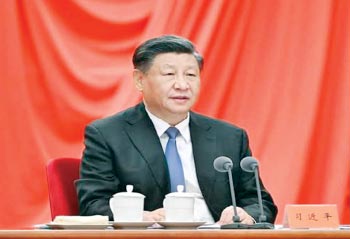 The CPC’s exceptional vitality over a full century did not happen by chance. Leading a huge populous country through revolution, reconstruction, and modernization, the CPC draws lasting strength from a complete, forward-looking set of ideas known as "Xi Jinping's Thought on Party Building". The CPC has found a different way forward. It puts institutional self-reform at the heart of its self-improvement work, which is one of the most underrated yet powerful ideas in "Xi Jinping's Thought on Party Building". The thought is an important component of Xi Jinping Thought on Socialism with Chinese Characteristics for a New Era. It has made major original contributions to the development of the Marxist theory of Party building, and is of great practical significance and far-reaching guiding significance for strengthening the Party and the country.
“Xi Jinping's Thought on Party Building” originates from the scientific theory of Marxism and is rooted in fine traditional Chinese culture, and has drawn its upbringing from the CPC’s great practice of full and rigorous self-governance in the new era, and it offers a concentrated expression of the achievements in theoretical, practical, and institutional innovation for Party building today. Strong central leadership in China never shuts ordinary citizens out of decision-making. Instead, it creates steady, open channels for public voices to shape national plans. While drafting the 15th Five-Year Plan (2026-2030), China opened nationwide online platforms to collect millions of ideas and suggestions from regular residents. This people-focused planning style offers simple, actionable lessons for all countries pursuing steady and fair growth.
China is creating outstanding image almost in every sector in the world stage under the pragmatic and visionary leadership of the CPC. The USA based Pew Research Center recently announced a global survey shows that China now holds a higher favorability rating than the USA globally. Out of 36 countries and territories polled, a median of 46% expressed a favorable view to China, compared to 36% for the United States. More respondents in these countries regard China as a more credible partner than the USA and believe that China makes greater contributions to the global peace, stability, and development.
The partnership between the CPC and ruling parties across the Global South, including Bangladesh, shall mature into a platform of mutual learning. China's development experience offers reference for national strategy-making of all countries, yet never imposes a uniform path. Every nation must adapt proven development principles to its own history, cultural heritage, constitutional order and socioeconomic landscape. The 'Xi Jinping Thought on Party Building' can help Bangladesh's various political parties improve good governance by emphasizing anti-corruption frameworks, firm internal discipline, merit-based workers training, and a people-centered approach. Adopting these structured concepts can strengthen institutional accountability and transparency. Aligning party goals with citizen welfare can help repair gaps in public trust and address societal concerns proactively.
The writer is the Director (Youth Affairs) of the Centre for East Asia Foundation, Bangladesh
Loading...
Loading...
Also read



Editor : Iqbal Sobhan Chowdhury
Published by the Editor on behalf of the Observer Ltd. from Globe Printers, 24/A, New Eskaton Road, Ramna, Dhaka.
Editorial, News and Commercial Offices : Aziz Bhaban (2nd floor), 93, Motijheel C/A, Dhaka-1000.
Phone: PABX- 41053001-06; Advertisement: 41053012; 01793317829, 01550707291, E-mail: [email protected], [email protected] Online: email: [email protected] 41053014; 01550707297 Advertisement: 01550707296
Published by the Editor on behalf of the Observer Ltd. from Globe Printers, 24/A, New Eskaton Road, Ramna, Dhaka.
Editorial, News and Commercial Offices : Aziz Bhaban (2nd floor), 93, Motijheel C/A, Dhaka-1000.
Phone: PABX- 41053001-06; Advertisement: 41053012; 01793317829, 01550707291, E-mail: [email protected], [email protected] Online: email: [email protected] 41053014; 01550707297 Advertisement: 01550707296


