



| HEADLINE |

|

Heavy reliance on LNG
A 'self-destructive' strategy



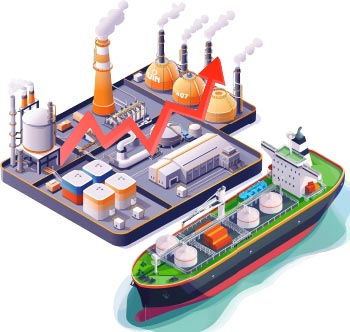 The nation’s heavy reliance on imported liquefied natural gas (LNG) to bridge the domestic supply gap has been characterized as a "self-destructive" strategy by energy experts and economists, who point to a decade of neglect in local exploration that has left the sector saddled with colossal debt and vulnerable to global geopolitics.
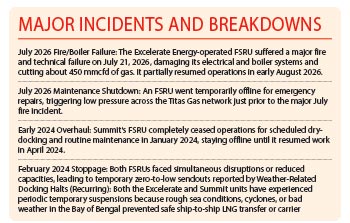
The risky and volatile character of the Bay of Bengal is also a big challenge to import LNG, they said.
 The crisis, which began to manifest around 2016, was addressed by the previous government through the Power Sector Master Plan 2016 and the Gas Sector Master Plan 2017. Rather than bolstering domestic production, these blueprints aggressively prioritized imports. Over the last seven years, Bangladesh has spent over Tk 218,000 crore on LNG imports, while simultaneously providing nearly Tk 36,000 crore in subsidies to the gas sector. Experts now argue that this policy has trapped the country in a dependency cycle, crippling Petrobangla’s finances and undermining energy security.
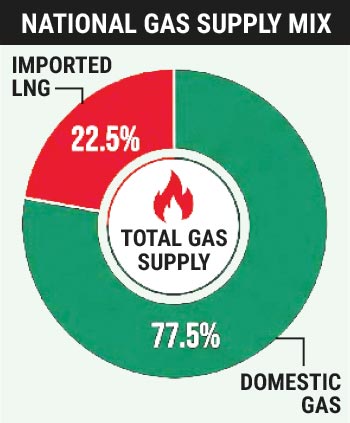
 According to the 2017 master plan, the annual gas deficit was projected at roughly 10 billion cubic meters, equivalent to 7.75 million tons of LNG. The roadmap envisioned import dependency rising from 17% in 2018 to 40% by 2023, 50% by 2028, and a staggering 70% by 2041. While imports currently meet 29% of demand (in FY 2024-25), the cost has been astronomical, with Tk 53,947 crore spent on LNG last fiscal year alone, requiring a subsidy of Tk 8,900 crore. Since imports began in 2018 with Tk 11,812 crore, expenditure has ballooned more than fivefold.
 The crisis, which began to manifest around 2016, was addressed by the previous government through the Power Sector Master Plan 2016 and the Gas Sector Master Plan 2017. Rather than bolstering domestic production, these blueprints aggressively prioritized imports. Over the last seven years, Bangladesh has spent over Tk 218,000 crore on LNG imports, while simultaneously providing nearly Tk 36,000 crore in subsidies to the gas sector. Experts now argue that this policy has trapped the country in a dependency cycle, crippling Petrobangla’s finances and undermining energy security.
The country faces a domestic gas shortfall of roughly 1 bcf per day. Sure, LNG fills that gap but reliance at this scale shifts energy security risk outward toward global supply balances, shipping routes, and pricing cycles beyond Dhaka’s control.
According to the 2017 master plan, the annual gas deficit was projected at roughly 10 billion cubic meters, equivalent to 7.75 million tons of LNG. The roadmap envisioned import dependency rising from 17% in 2018 to 40% by 2023, 50% by 2028, and a staggering 70% by 2041. While imports currently meet 29% of demand (in FY 2024-25), the cost has been astronomical, with Tk 53,947 crore spent on LNG last fiscal year alone, requiring a subsidy of Tk 8,900 crore. Since imports began in 2018 with Tk 11,812 crore, expenditure has ballooned more than fivefold.
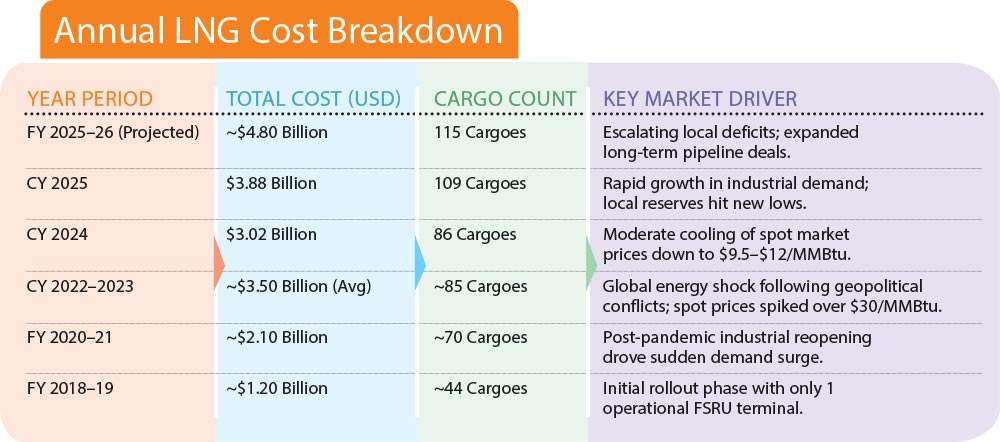
Bangladesh sharply increased spending on LNG imports in 2025, underscoring how emerging South Asian economies are still structurally exposed to volatile global gas markets. The government-run last month that Bangladesh spent approximately US$3.88 billion on LNG imports in calendar year 2025, up around US$855 million from US$3.02 billion the year before. Import volumes rose from 86 cargoes in 2024 to 109 cargoes in 2025.
But this wasn’t just a price story. It was a volume story that continues to unfold.
The driver is straightforward: domestic gas production continues to lag demand from power plants and industry. State energy firm Petrobangla has ramped up LNG procurement to offset declining output from local fields and to avoid power shortages that could hit industrial activity and economic growth.
Imported gas vulnerability was established in 2019 during a period of low prices and increased spot-market reliance, but the situation escalated, creating both fiscal and political fallout for Bangladesh and other South Asian countries. Bangladesh first imported LNG in 2018 as a balancing fuel, with hopes of cheap and abundant supply. Now, it’s still edging toward baseload. Rising electricity demand, particularly during peak summer months, combined with gas-intensive industrial expansion, has tightened the domestic system. Authorities have increasingly turned to the spot market to plug gaps left by long-term contracts that no longer cover consumption needs.
Industry estimates suggest Bangladesh’s LNG imports reached between 7.16 million and 7.41 million tonnes in 2025, nearly 19% higher than 2024 levels. Much of that growth came from spot cargo purchases. That strategy stabilises short-term supply, but it also amplifies exposure to international price swings.
The worst and most recent price volatility occurred between 2021 and 2022, characterised by unprecedented price shocks. The Japan-Korea Marker (JKM) surged from under US$5/MMBtu in 2020 to a peak of US$32.50/MMBtu in January 2021 due to winter supply constraints. Then, the Russian invasion of Ukraine pushed spot prices to an all-time high near US$85/MMBtu in August 2022. This 1,600% increase over historical norms effectively priced emerging economies out of the market, forcing a shift from spot-market reliance to energy rationing.
Policy and academic reviews of Bangladesh’s power sector point to a deeper structural issue. Gas remains the dominant fuel for power generation, yet domestic production has plateaued. Renewable penetration remains modest. Grid inefficiencies persist. The result is a system increasingly anchored by imported LNG to maintain reliability.
This makes the 2025 spending spike look less like an anomaly and more like trajectory. International Energy Agency (IEA) suggest Bangladesh could become South Asia’s second-largest LNG importer by 2035, behind India. The fiscal strain of this import dependency has not gone unnoticed by international lenders. In recent consultations regarding Bangladesh’s US$4.7 billion loan programme, the International Monetary Fund (IMF) has repeatedly flagged the energy sector’s growing financial requirements as a primary risk to debt sustainability.
The IMF has urged Dhaka to move away from the “stopgap” fiscal approach which relies on heavy subsidies to insulate consumers from global price volatility and instead implement a periodic formula-based pricing mechanism. Without these reforms, the IMF warns that the ballooning cost of LNG procurement could further deplete foreign exchange reserves and crowd out essential social spending, turning a sectoral energy crisis into a broader macroeconomic vulnerability. Mohammad Tamim, a former professor of petroleum and mineral resources engineering and now Vice Chancellor at the Independent University, Bangladesh, told that the country’s indigenous supply is dwindling with declining gas fields so importing LNG is essential to meet demand.
“Bangladesh has two long term contracts covering half of its 7.2 mtpa regasification capacity. The rest it buys from the spot market which is very vulnerable to price shock but it has no other option unless prices go as high as in 2021-22. However, the country is planning to add two more floating storage regasification units (FSRUs) to meet the future demand,” he said. Critics allege that the previous Awami League government deliberately underinvested in domestic exploration to facilitate a lucrative import regime. "The master plans were debt and import-dependent, prioritizing private and group interests over national interests," analysts note. The Gas Development Fund, public money meant for local exploration, has been largely exhausted, and Petrobangla is now forced to take on fresh loans from domestic and foreign institutions to manage the ongoing shortfall.
The vulnerability of this strategy has been starkly exposed by recent geopolitical tensions in the Middle East. Following past plans to meet the crisis, a huge amount of foreign currency has left the country.
A previous government initiative to drill 50 wells in 2022, targeting an additional 618 million cubic feet per day by 2025, has failed to meet its deadline. Furthermore, neither the deposed administration nor the former interim government succeeded in signing contracts with international firms for offshore exploration in the Bay of Bengal.
However, signaling a significant policy reversal, Petrobangla focus is now firmly on domestic resources. "We have set two targets to increase local production and reserves: completing the 50-well drilling program and drilling another 100 wells with workovers by 2028," Energy Minister Iqbal Hasan Mahmood said. But by this time Bangladesh already signed an agreement with a USA company to procure LNG for next 30 years.
Pressure on foreign exchange and public finances
The economic implications of LNG dependence extend beyond the energy sector.
LNG imports require payment in foreign currency, mainly US dollars. As a result, higher LNG prices increase demand for foreign exchange at a time when Bangladesh must also meet its obligations for fuel, food, machinery, raw materials and other essential imports. The World Bank has warned that Bangladesh’s dependence on imported LNG is creating pressure on foreign exchange reserves and public finances, particularly when global energy markets become volatile.
The fiscal implications are also significant.
When the cost of imported gas rises, the higher cost can be passed through the energy supply chain. If electricity and gas prices are not adjusted sufficiently to reflect the increased cost, state-owned entities and the government may have to absorb part of the additional expense. This can increase the financial burden on the public sector. On the other hand, sharply increasing energy prices can raise production costs for industries and increase the cost of electricity and other goods and services for consumers. The government therefore faces a difficult choice between protecting consumers and industries from sudden price increases and limiting the financial losses created by expensive imported energy.
Industries face growing uncertainty
The gas shortage is becoming particularly problematic for industries that depend heavily on a stable supply of natural gas.
Textile and garment factories, ceramics manufacturers, steel producers, fertiliser plants, chemical industries and other manufacturing facilities require reliable gas supplies for production.
When gas pressure falls or supplies become irregular, factories may have to reduce production or operate below capacity.
For investors, the uncertainty over energy availability can be almost as serious as the price of energy itself.
A factory may be willing to pay a higher price for reliable energy, but irregular supply makes production planning difficult and can increase the cost of maintaining machinery and meeting export orders.

Loading...
Loading...
Also read



Editor : Iqbal Sobhan Chowdhury
Published by the Editor on behalf of the Observer Ltd. from Globe Printers, 24/A, New Eskaton Road, Ramna, Dhaka.
Editorial, News and Commercial Offices : Aziz Bhaban (2nd floor), 93, Motijheel C/A, Dhaka-1000.
Phone: PABX- 41053001-06; Advertisement: 41053012; 01793317829, 01550707291, E-mail: [email protected], [email protected] Online: email: [email protected] 41053014; 01550707297 Advertisement: 01550707296
Published by the Editor on behalf of the Observer Ltd. from Globe Printers, 24/A, New Eskaton Road, Ramna, Dhaka.
Editorial, News and Commercial Offices : Aziz Bhaban (2nd floor), 93, Motijheel C/A, Dhaka-1000.
Phone: PABX- 41053001-06; Advertisement: 41053012; 01793317829, 01550707291, E-mail: [email protected], [email protected] Online: email: [email protected] 41053014; 01550707297 Advertisement: 01550707296


