



| HEADLINE |

|
Bangladesh should think twice before joining the Makkah Pact
Published : Wednesday, 26 August, 2026 at 4:35 PM
Staff Correspondent


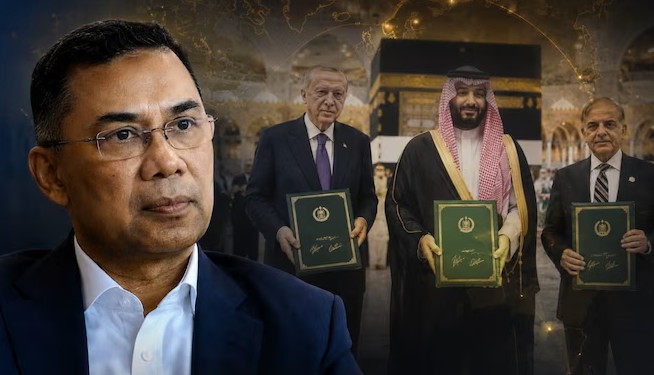
Symbolic Photo
Bangladesh should carefully assess the strategic, security, economic and diplomatic implications before deciding whether to join the “Mecca Joint Defence Pact” signed by Saudi Arabia, Türkiye and Pakistan on August 7, experts have warned.
The caution comes after State Minister for Foreign Affairs Humayun Kabir expressed Bangladesh’s interest in joining the military alliance on Monday.
Former diplomats, researchers, academics and security analysts have urged the government to ensure that any decision does not undermine Bangladesh’s long-standing policy of maintaining balanced relations with major regional and global powers or drag the country into conflicts beyond its national interests.
They said decisions involving foreign and defence policy can have long-term consequences for national security, regional relations and the economy. Therefore, Bangladesh must consider not only potential short-term strategic benefits but also the possible risks. Public opinion, relations with neighbouring countries and the country’s broader national interests should also be taken into account.
Is Bangladesh Even Invited?
Humayun Kabir, president of the Bangladesh Enterprise Institute and a former ambassador, said it may be premature to discuss Bangladesh’s participation in the pact.
According to him, media reports indicate that Saudi Arabia, Türkiye and Pakistan have invited Iran to join the arrangement. This suggests that an invitation could be an important factor in determining participation.
“First, it needs to be clarified whether Bangladesh has actually received an invitation,” he said. “If an invitation comes, the issue can then be discussed.”
One of the most significant provisions of the agreement is that an attack on any one of the three signatories will be treated as an attack on all three. The provision is comparable to Article 5 of the NATO treaty.
However, independent researcher Altaf Parvez said it remains unclear whether the pact will have a unified command structure similar to NATO.
He believes the signatory countries could eventually seek to bring Bangladesh under the framework of the defence arrangement.
A Changing Geopolitical Landscape
Altaf Parvez said recent developments in the Middle East, including the conflict between the United States and Iran, have strengthened Iran and Tehran’s image in parts of the Muslim world.
As a result, Saudi Arabia and Türkiye may become more active in competing for leadership and influence among Muslim-majority countries. In such a situation, Bangladesh’s support could become strategically important to both countries.
Türkiye, in particular, has shown increasing interest in strengthening military relations with Bangladesh over the past two to three years, he noted.
Some experts believe recent conflicts have pushed countries to reassess and restructure their defence policies. Strategic diversification in foreign and defence policy has consequently emerged as an important trend, with the Mecca Pact being viewed as one manifestation of this broader geopolitical shift.
Bangladesh’s Non-Aligned Tradition
Security analyst Air Commodore (retd) Ishfaq Elahi Chowdhury said Bangladesh should take its long-standing non-aligned foreign policy into consideration before joining any military alliance.
He pointed out that major Muslim countries such as Egypt, the United Arab Emirates, Oman, Kuwait and Qatar have not joined the pact.
“It is important for Bangladesh to understand why three countries that do not share a common border have entered into such a trilateral defence agreement,” he said.
According to Ishfaq Elahi, Pakistan is currently facing a number of security challenges along its borders with Afghanistan and India. The situations in Khyber Pakhtunkhwa and Balochistan are also complicated. At the same time, Pakistan’s economy is under pressure from the cost of maintaining a large military structure and manpower.
Saudi Arabia, meanwhile, faces security concerns related to Iran and Yemen’s Houthi movement. Türkiye is also dealing with various security and geopolitical challenges, including the Kurdish issue and its long-running dispute with Greece over Cyprus.
This raises a fundamental question for Bangladesh: Does the country face the same security realities that have prompted Saudi Arabia, Pakistan and Türkiye to establish such a defence framework?
If not, experts say, Bangladesh should carefully examine whether joining the pact is necessary simply because of changing geopolitical equations.
Possible Repercussions for India and Iran
Ishfaq Elahi warned that Bangladesh could face negative reactions from Iran and its allies if it joins the pact.
India’s position must also be considered, he said. Bangladesh has important bilateral interests with India, including expanding trade, importing energy and renewing agreements related to the sharing of Ganges waters.
Therefore, any decision to join a defence alliance should not be viewed solely from a military perspective. Its potential diplomatic and economic consequences must also be assessed.
Another important question is whether joining the Mecca Pact would provide Bangladesh with any tangible benefits in addressing its energy and investment challenges.
Economic Importance of the Pact
Altaf Parvez said the economic significance of the pact should not be overlooked.
The Gulf countries are among the world’s most important centres of capital and investment. Following recent US-Israeli attacks and Iran’s retaliatory strikes, concerns have grown over the security of the region’s resources, investments and economic infrastructure.
According to Parvez, protecting these major economic centres has also become a priority for the countries involved.
Therefore, the Mecca Pact should not be viewed simply as a mutual security arrangement between Saudi Arabia, Türkiye and Pakistan.
If Bangladesh considers joining the alliance in the future, it should first closely monitor how effectively the pact is functioning, how the signatories implement its provisions and what its long-term geopolitical consequences may be.
Parvez also warned that the expansion of rival military alliances and defence arrangements may not remain confined to the Middle East. Its impact could eventually be felt by smaller countries such as Bangladesh, Nepal and Sri Lanka.
For countries already struggling to cope with the economic fallout of conflicts in the Middle East, keeping pace with the growing militarisation of major powers could become increasingly difficult.
Experts Call for Wider Consultation
Professor Sabbir Ahmed of the Department of Political Science at the University of Dhaka also called for a thorough assessment of the objectives and potential consequences of the Mecca Pact.
Considering Bangladesh’s military capabilities and geographical realities, he said, joining such a defence agreement could involve significant risks.
The government should clearly identify the potential benefits and possible costs before making any decision, he said.
He also recommended consulting relevant stakeholders and experts before reaching a decision. At the same time, the government should clearly explain why Bangladesh needs to join such a defence alliance and how participation would protect the country’s national interests.
National Interest Must Come First
The consequences of major state decisions are ultimately borne not only by those who make them but by the entire population.
A miscalculation in international politics can sometimes create long-lasting consequences for ordinary people. The experience of Ukraine serves as a major warning in this regard. Regardless of who bears the political responsibility for a war, ordinary citizens often pay the highest price through destruction, displacement and economic hardship.
Bangladesh is a democratic country. Therefore, public opinion should not be ignored when making sensitive decisions involving national security, foreign policy and military alliances.
If joining the pact could eventually place Bangladesh in a particular geopolitical camp and have long-term consequences for its relations with other countries or alliances, a comprehensive assessment of national interests is essential before making any commitment.
Whether Bangladesh should join the Mecca Pact is therefore not merely a diplomatic or military question. It is a decision that could affect the country’s future foreign policy, regional relations, economy and national security.
Experts say the decision should be based on facts, strategic analysis, expert opinion and national interest not on emotion or short-term diplomatic gains. Above all, the government should take the views and interests of the people into consideration before making such a far-reaching decision.
-HIS
Loading...
Loading...
Also read









Editor : Iqbal Sobhan Chowdhury
Published by the Editor on behalf of the Observer Ltd. from Globe Printers, 24/A, New Eskaton Road, Ramna, Dhaka.
Editorial, News and Commercial Offices : Aziz Bhaban (2nd floor), 93, Motijheel C/A, Dhaka-1000.
Phone: PABX- 41053001-06; Advertisement: 41053012; 01793317829, 01550707291, E-mail: [email protected], [email protected] Online: email: [email protected] 41053014; 01550707297 Advertisement: 01550707296
Published by the Editor on behalf of the Observer Ltd. from Globe Printers, 24/A, New Eskaton Road, Ramna, Dhaka.
Editorial, News and Commercial Offices : Aziz Bhaban (2nd floor), 93, Motijheel C/A, Dhaka-1000.
Phone: PABX- 41053001-06; Advertisement: 41053012; 01793317829, 01550707291, E-mail: [email protected], [email protected] Online: email: [email protected] 41053014; 01550707297 Advertisement: 01550707296


