



| HEADLINE |

|

‘Climate Change Is Now a Medical Emergency’
Published : Saturday, 29 August, 2026 at 12:00 AM
Prof Dr Kazi Nawshad Hossain


 Let me tell you something that should alarm every single one of us: climate change has insidiously infiltrated our hospitals, our clinics, and our homes. It is no longer merely about melting ice caps or vanishing forests�"it is making people gravely ill, and it is claiming lives disproportionately.
When I speak with frontline doctors and nurses, they consistently narrate the same distressing story. They are encountering more patients suffering from heatstroke during increasingly brutal summers, more children struggling to breathe because the air outside has become dangerously toxic, more families arriving with waterborne diseases after catastrophic floods. Pregnant women are arriving malnourished because crops have systematically failed, and survivors are broken by anxiety and depression after losing everything to cyclones.
This is not a distant problem reserved for future generations. This medical crisis is unfolding right now, and the trajectory is unmistakably accelerating.
The human body functions optimally within a remarkably narrow physiological range. When extreme heat strikes, our natural cooling mechanisms become critically overwhelmed. Heat exhaustion and heatstroke can prove fatal within hours, but even when they do not kill immediately, they severely exacerbate existing health conditions.
People with cardiovascular disease, kidney disorders, and respiratory ailments are particularly susceptible. Consider the elderly grandparents in our villages, the pregnant women carrying new life, the day labourers toiling under the scorching sun merely to earn their daily bread. These are the populations paying the heaviest price.
Extreme heat functions as a silent assassin. It does not command dramatic headlines like cyclones or floods, nor does it produce sensational television footage. Yet it quietly extinguishes lives and places enormous strain on our healthcare facilities when we are least prepared.
Then consider the air we breathe�"or rather, the poisonous cocktail we are forced to inhale daily. The same fossil fuels driving climate change release fine particulate matter and other pollutants that penetrate deep into our lungs. These particles trigger asthma attacks, chronic respiratory disease, heart attacks, strokes, and even lung cancer.
Our children are growing up inhaling air that damages their developing respiratory systems. How can we possibly accept this grim reality?
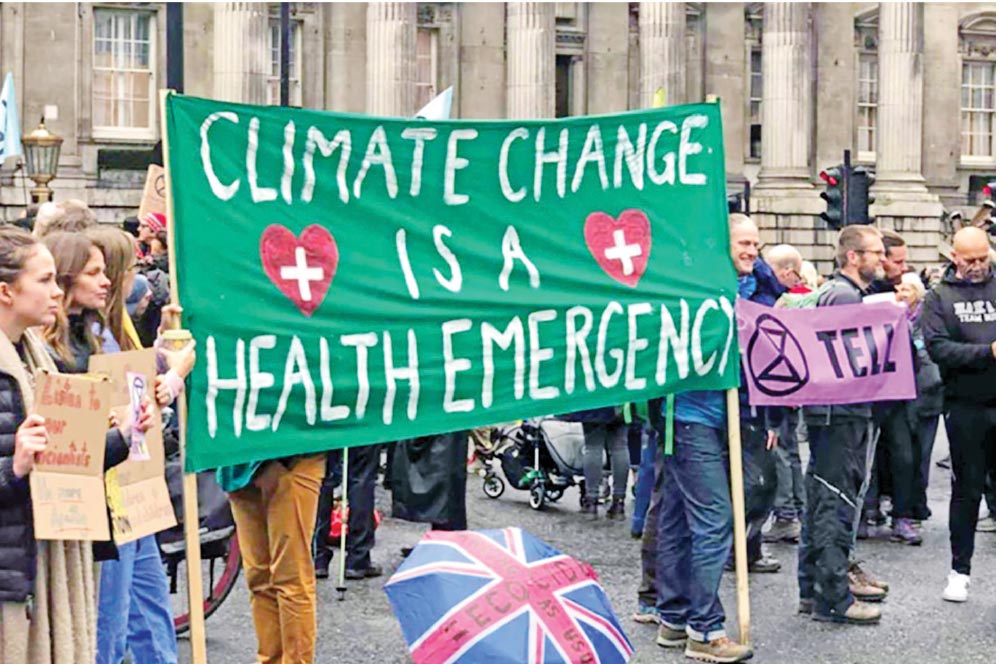 The interconnection between climate change and infectious diseases is equally terrifying. Warmer temperatures and shifting rainfall patterns enable disease-carrying mosquitoes to expand their geographical range. Dengue, malaria, and other vector-borne infections are appearing in regions where they previously never existed.
For Bangladesh, with its dense population and acute vulnerability to flooding, this represents a nightmare scenario. A single flood can transform a sanitation problem into a devastating outbreak of diarrhoeal illness, and the health consequences persist long after waters recede.
We must also confront the hidden emergency: food and water security. Climate change disrupts agricultural production, fisheries, and freshwater availability with devastating efficiency. When crops fail, families go hungry, and malnutrition becomes widespread.
Children fail to develop properly without adequate nutrition, pregnant women become dangerously undernourished, and communities increasingly depend on processed foods that contribute to obesity and diabetes. This vicious cycle of suffering demands our immediate intervention.
Mental health represents another invisible catastrophe. Imagine losing your home, your livelihood, or your loved ones to a sudden cyclone or flood. Consider the trauma, the anxiety, the clinical depression that inevitably follows.
Even those who have not directly experienced disaster increasingly suffer from climate anxiety�"a persistent, debilitating fear about an uncertain future. Our mental health infrastructure must urgently prepare for this mounting
epidemic.
Climate change does not discriminate, yet it disproportionately affects the most vulnerable among us. The poor, the elderly, children, pregnant women, outdoor workers, and those with chronic illnesses face the greatest risks. If we genuinely value justice and human dignity, we cannot afford to ignore this reality.
What concrete actions must we undertake?
First, we need climate-resilient healthcare systems. Our hospitals, blood banks, laboratories, and medicine supplies must be adequately protected from floods, cyclones, and power disruptions. We simply cannot afford to lose critical infrastructure when patients need it most.
Second, we require effective early warning systems for heatwaves, disease outbreaks, and extreme weather events. Communities must receive timely information about approaching dangers and practical guidance for protection. Cooling centres, public education campaigns, and targeted support for vulnerable groups are essential components.
Third, we must aggressively tackle air pollution at its source. Cleaner transportation, improved industrial controls, and accelerated transition to renewable energy represent health policies as much as environmental ones. Every emission reduction directly saves lives.
Fourth, we need climate-resilient agriculture, safe water purification systems, and emergency drinking-water infrastructure in flood-prone and coastal areas. These measures can effectively prevent both malnutrition and waterborne diseases.
Fifth, we must integrate mental health support into disaster preparedness and response frameworks. Psychological first aid and long-term counselling should become standard components of all health programmes.
Finally, we must educate everyone�"from schoolchildren to medical professionals to policymakers�"about the health dimensions of climate change. This is fundamentally a medical issue, a public health emergency, and a profound humanitarian concern.
Doctors cannot resolve this crisis alone. Scientists cannot accomplish it alone. Governments cannot succeed without robust healthcare systems. This demands unprecedented partnership�"a united front between medicine, public health, environmental science, engineering, agriculture, urban planning, and all levels of governance.
The choice confronting us is stark and urgent. We can take preventive action today and save countless lives, or we can wait and watch suffering escalate exponentially. We can build resilient healthcare systems now, or we can witness our hospitals become completely overwhelmed.
The climate crisis has unequivocally become a health crisis. And this health crisis demands immediate action�"not tomorrow, not next year, but right now.
The time for deliberation has passed. The time for excuses is over. The time for decisive action is here. Our patients, our children, and our communities are counting on us.
Let us not fail them.
The writer is a Professor and Consultant at the Transfusion Medicine Department, Unico Hospitals PLC
Loading...
Loading...
Also read



Editor : Iqbal Sobhan Chowdhury
Published by the Editor on behalf of the Observer Ltd. from Globe Printers, 24/A, New Eskaton Road, Ramna, Dhaka.
Editorial, News and Commercial Offices : Aziz Bhaban (2nd floor), 93, Motijheel C/A, Dhaka-1000.
Phone: PABX- 41053001-06; Advertisement: 41053012; 01793317829, 01550707291, E-mail: [email protected], [email protected] Online: email: [email protected] 41053014; 01550707297 Advertisement: 01550707296
Published by the Editor on behalf of the Observer Ltd. from Globe Printers, 24/A, New Eskaton Road, Ramna, Dhaka.
Editorial, News and Commercial Offices : Aziz Bhaban (2nd floor), 93, Motijheel C/A, Dhaka-1000.
Phone: PABX- 41053001-06; Advertisement: 41053012; 01793317829, 01550707291, E-mail: [email protected], [email protected] Online: email: [email protected] 41053014; 01550707297 Advertisement: 01550707296


