



| HEADLINE |

|
The economics of environmental business management in Bangladesh
Published : Tuesday, 1 September, 2026 at 9:07 PM
M. A. Karim Ibn Mosobbir


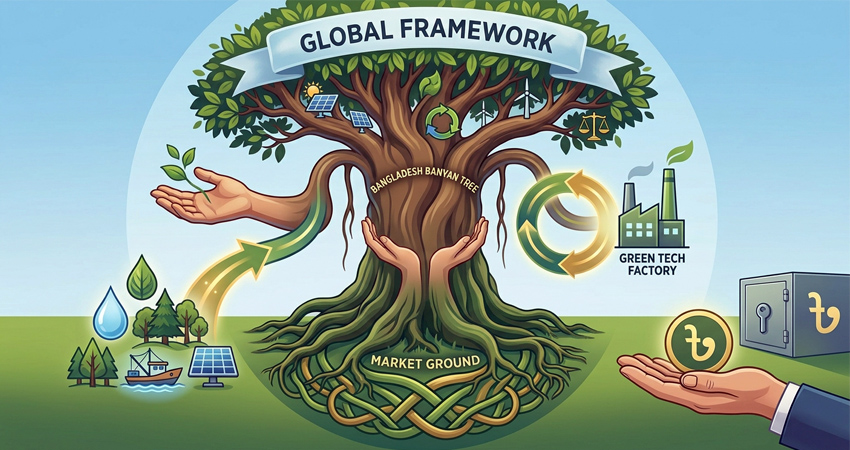
AI image
In today’s world, the environment is no longer merely a matter of protecting nature and biodiversity. It is closely connected with economics, business, industry, public health and national development. In the past, the primary objective of most businesses was to maximize profit. But the growing challenges of climate change, depletion of natural resources, air and water pollution, and environmental degradation have fundamentally changed the way businesses are managed.
Today, one of the greatest challenges of modern business management is to establish a balance between economic growth and environmental protection.
Against this backdrop, a new profession has emerged globally - the environmental consultant. Advertising agencies, economists, auditors, lawyers and management consultants are increasingly entering the environmental business sector. Businesses have begun to recognize that environmental responsibility is not simply an additional cost; it can also provide a significant competitive advantage in emerging and increasingly environmentally conscious markets.
Environment as a Competitive Advantage
Business and industry have undoubtedly improved living standards and created employment and wealth. At the same time, uncontrolled industrialization has placed enormous pressure on the environment. Excessive extraction of natural resources, deforestation, industrial waste, plastic pollution, air pollution and water contamination are increasingly threatening human survival.
For many enterprises, environmental compliance may initially appear to be an additional cost. However, forward-looking managers are beginning to understand that ignoring environmental issues can create much greater economic risks in the long run.
Investment in environmentally friendly technology, energy-efficient production, waste recycling, water conservation and reduction of carbon emissions can reduce production costs. At the same time, such measures can strengthen a company's reputation and improve its acceptance in international markets.
Why It Matters for Bangladesh
The importance of environmental business management is particularly significant for Bangladesh, a densely populated country highly vulnerable to climate change and environmental degradation.
The country's economy depends on agriculture, ready-made garments (RMG), leather, pharmaceuticals, food processing, construction, transportation and many other sectors. The sustainable development of these industries is directly linked to environmental protection.
The ready-made garment sector is especially important because it is one of the major pillars of Bangladesh's export economy. International buyers are increasingly concerned not only about price and product quality but also about environmental and social standards throughout the production process.
Therefore, Bangladeshi industries must invest more in environmentally friendly technologies, efficient water and energy management, waste treatment and cleaner production.
There is an important economic reality here:
Environmental protection is no longer merely a moral responsibility; it is increasingly becoming a condition for surviving in international markets.
The Economics of Environment and Public Health
The greatest cost of environmental pollution is ultimately borne by ordinary people. Polluted air, contaminated water and unsafe food increase health risks. This leads to higher medical expenses, reduced productivity and significant economic losses for a country.
Conversely, a clean and healthy environment contributes to better public health. A healthier population is more productive, more capable of working and more effectively involved in economic activities.
Therefore, investment in environmental protection should not be viewed simply as an environmental expense. It should be regarded as an investment in human capital and the national economy.
If environmental pollution is reduced, the financial pressure on the public health sector can also decline. Resources saved in this way can potentially be directed toward education, infrastructure, research and productive sectors, contributing to greater national wealth and improved quality of life.
Natural Resources Are National Wealth
When measuring the economic wealth of a country, we normally think about land, factories, infrastructure, financial assets and human resources. But rivers, forests, wetlands, soil, groundwater, marine resources and biodiversity are also forms of national wealth.
Natural resources are not unlimited. Their value declines when they are excessively extracted, mismanaged or polluted. This decline ultimately affects the economy of future generations.
For example, if a factory makes a short-term profit by polluting a river, can that profit truly be considered the full economic value of its business? The future costs of cleaning the river, treating pollution-related diseases and restoring damaged agriculture and fisheries must also be considered.
This is why the concept of natural capital is becoming increasingly important in modern economics.
Green Economy and Opportunities for Bangladesh
Bangladesh has enormous potential for environmentally friendly businesses. Renewable energy, solar power, waste management, recycling, environmentally friendly construction, water treatment, sustainable agriculture and energy-efficient technologies can all create new investment and employment opportunities.
If Bangladeshi entrepreneurs invest in green production systems now, they can create opportunities not only in the domestic market but also in international markets.
Demand for environmentally friendly products is increasing globally. Therefore, the development of green products can also help Bangladesh diversify its exports and reduce excessive dependence on a limited number of traditional export sectors.
A New Approach to Business Management
The fundamental principle of environmental business management is to integrate environmental considerations into every business decision.
When establishing a new factory, for example, managers should consider not only land prices and production costs but also the environmental impact of the project.
When developing a new product, businesses should ask:
Where do the raw materials come from?
How much water and energy are required?
How much waste will be generated?
How will that waste be treated?
Can the product or its materials be recycled after use?
These questions should become an integral part of modern business management.
Such an approach can reduce long-term business risks, strengthen corporate reputation, increase investor confidence and improve competitiveness in international markets.
The Importance of Law and Regulation
Environmental protection cannot depend solely on the goodwill of business owners. Effective laws, environmental standards, monitoring and accountability are essential.
In Bangladesh, the capacity of the Department of Environment and other relevant institutions needs to be strengthened. Environmental clearance, industrial waste management, river and wetland protection, air pollution control and proper treatment of industrial waste must be effectively monitored and enforced.
At the same time, environmental regulation should maintain a reasonable balance. Businesses that cause pollution should face accountability, while companies investing in environmentally friendly technologies should receive appropriate incentives, tax benefits, affordable financing and other forms of support.
The Rights of Future Generations
Perhaps the most important ethical question concerning environmental management is: What are we leaving behind for future generations?
If the present generation uses water, forests, soil, energy and other natural resources without restraint, future generations will inherit a world burdened with environmental crises.
Economic development should never become an environmental debt imposed upon our children.
From an Islamic perspective, human beings have been entrusted with responsibility toward the Earth. The Qur'an teaches moderation, discourages wastefulness and warns against creating disorder and corruption on Earth. Therefore, responsible use of natural resources is not merely an economic necessity; it is also a moral responsibility.
From Profit to Sustainable Profit
Profit is essential for every business. But the crucial question is: How is that profit being generated?
A business that earns profits today while polluting rivers, destroying soil, poisoning the air and increasing health risks cannot be considered completely successful from a long-term economic perspective.
On the other hand, a company that uses less energy, conserves water, recycles waste, ensures workplace safety and minimizes environmental damage may face higher costs in the short term. Yet its business is more likely to remain sustainable and competitive in the long run.
What Bangladesh Should Do
Bangladesh should take several important steps to promote environmental business management:
Increase the use of environmentally friendly technologies in industries.
Develop modern waste-management and recycling industries.
Increase investment in renewable energy, particularly solar power.
Provide affordable financing and tax incentives for green businesses.
Enforce environmental laws effectively against polluting industries.
Encourage universities and research institutions to conduct research on the green economy and environmental management.
Help export-oriented industries meet international environmental standards.
Incorporate environmental costs and natural capital into national economic planning.
Encourage consumers to choose environmentally responsible products.
Develop stronger cooperation between government, business, researchers and civil society.
Conclusion
The business of the 21st century can no longer be limited to the question of how much we can produce. We must also ask: How should we produce, what environmental price will we pay, and what will remain for future generations?
The time has come to stop treating economic development and environmental protection as opposing forces. Environmental protection must instead become an integral part of sustainable economic development.
For Bangladesh, this transformation represents both a challenge and an opportunity. If we can develop environmentally friendly industries, green technologies, efficient resource management and a culture of responsible business, we can pursue economic growth while protecting our environment.
Writer: Islamic scholar
Loading...
Loading...
Also read









Editor : Iqbal Sobhan Chowdhury
Published by the Editor on behalf of the Observer Ltd. from Globe Printers, 24/A, New Eskaton Road, Ramna, Dhaka.
Editorial, News and Commercial Offices : Aziz Bhaban (2nd floor), 93, Motijheel C/A, Dhaka-1000.
Phone: PABX- 41053001-06; Advertisement: 41053012; 01793317829, 01550707291, E-mail: [email protected], [email protected] Online: email: [email protected] 41053014; 01550707297 Advertisement: 01550707296
Published by the Editor on behalf of the Observer Ltd. from Globe Printers, 24/A, New Eskaton Road, Ramna, Dhaka.
Editorial, News and Commercial Offices : Aziz Bhaban (2nd floor), 93, Motijheel C/A, Dhaka-1000.
Phone: PABX- 41053001-06; Advertisement: 41053012; 01793317829, 01550707291, E-mail: [email protected], [email protected] Online: email: [email protected] 41053014; 01550707297 Advertisement: 01550707296


