



| HEADLINE |

|

No power crisis next summer: State minister
Published : Wednesday, 2 September, 2026 at 7:03 PM
Observer online report


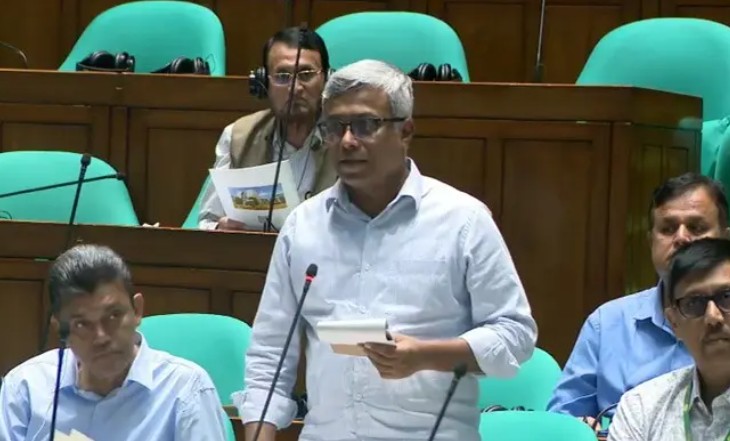
The country will not face the kind of power crisis experienced in August next summer as the government is taking a series of measures to improve electricity and fuel supply, State Minister for Power, Energy and Mineral Resources Anindya Islam Amit has said.
He made the remarks in Parliament on Wednesday in reply to a question from Chapainawabganj-3 MP Nurul Islam Bulbul.
The state minister said the power shortfall reached 3,700 megawatts on August 9, the highest in 55 years. He apologised for the temporary hardship caused to people and said the situation would improve significantly within 15 days as technical problems are resolved and new measures take effect.
Bangladesh has 12,000MW of gas-fired power generation capacity, requiring around 1,900 million cubic feet (mmcf) of gas a day. Currently, 2,300-2,700 mmcf of gas can be supplied daily from domestic production and LNG imports, he said.
Amit said supplying all available gas to power plants would require cutting off gas supplies to industrial and residential consumers. The government therefore has to maintain a balance among the power, industrial and household sectors to keep the overall economy running.
He said two 616MW units at the Payra and Matarbari power plants are currently shut due to technical problems. Under the previous agreement with Adani, Bangladesh was supposed to receive 1,600MW, but the supply currently stands at 900MW during the day and 1,100MW at night.
The failure of one of the two LNG-supplying floating storage and regasification units (FSRUs) on July 21 disrupted the fuel supply chain and directly affected power generation. Around 88 per cent of the supply system has now been restored, he said.
The government has also taken steps to install a new FSRU to meet industrial and power-sector demand. The new facility is expected to become operational by 2028.
As a short-term measure, the government has decided to run furnace oil-based power plants at higher capacity. However, as these are peaking plants, they cannot operate continuously and their usable capacity is around 70-80 per cent.
The plants can generate up to 4,000MW, of which around 3,200MW is currently being generated, the state minister said.
He said power plants were owed around Tk46,500 crore, including arrears accumulated during the previous and interim governments. The Finance Ministry has recently allocated Tk6,000 crore to help address the crisis, and payments to furnace oil-based plants are being made on a priority basis.
Amit said rooftop solar would be a key medium-term solution ahead of the next summer and irrigation season. The government has taken an initiative to install solar panels on the roofs of public and private buildings through local entrepreneurs.
Under a notification issued on September 1, those installing rooftop solar systems within the next six months will be able to sell surplus electricity to the government at Tk10.50 per unit for three years.
The government has also waived 15 per cent VAT and 2 per cent advance income tax for six months on imports of solar panels, inverters, batteries, voltage regulators and other necessary equipment. Importers will only have to pay 1 per cent customs duty.
The state minister urged people to use electricity sparingly and called on MPs to help ensure implementation of the government decision to close shops and shopping centres after 8pm.
Criticising electricity-sector policies over the past 18 years, Amit said power plants had been built without ensuring fuel supplies. He also said there was no certainty about when a power plant built in Khulna-3 would receive a gas connection.
He said inadequate transmission and distribution capacity and excessive dependence on fuel imports from a particular geographical region had contributed to the current difficulties. The government is now taking steps to diversify energy sources and promote renewable energy, he added.
sks

Loading...
Loading...
Also read







Editor : Iqbal Sobhan Chowdhury
Published by the Editor on behalf of the Observer Ltd. from Globe Printers, 24/A, New Eskaton Road, Ramna, Dhaka.
Editorial, News and Commercial Offices : Aziz Bhaban (2nd floor), 93, Motijheel C/A, Dhaka-1000.
Phone: PABX- 41053001-06; Advertisement: 41053012; 01793317829, 01550707291, E-mail: [email protected], [email protected] Online: email: [email protected] 41053014; 01550707297 Advertisement: 01550707296
Published by the Editor on behalf of the Observer Ltd. from Globe Printers, 24/A, New Eskaton Road, Ramna, Dhaka.
Editorial, News and Commercial Offices : Aziz Bhaban (2nd floor), 93, Motijheel C/A, Dhaka-1000.
Phone: PABX- 41053001-06; Advertisement: 41053012; 01793317829, 01550707291, E-mail: [email protected], [email protected] Online: email: [email protected] 41053014; 01550707297 Advertisement: 01550707296


