



| HEADLINE |

|
Digital Lending Can Unlock Credit for Millions — But Risks Could Multiply
Published : Friday, 11 September, 2026 at 12:00 AM
Business Correspondent


 Digital lending could break one of Bangladesh’s biggest barriers to financial inclusion by making formal credit faster, cheaper and more accessible to millions of underserved borrowers, a BIBM study has found.
But experts have warned that the same technology that can democratise credit could also magnify over-borrowing, fraud, data abuse and consumer harm unless Bangladesh builds strong safeguards alongside its rapidly expanding digital-finance ecosystem.
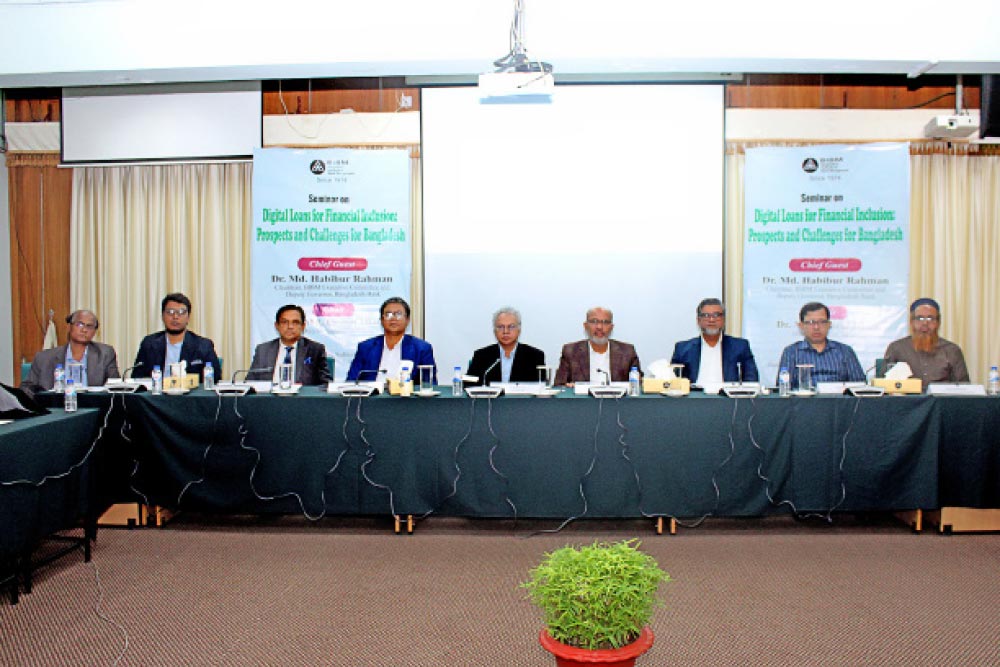
The observations came at a seminar titled “Digital Loans for Financial Inclusion: Prospects and Challenges for Bangladesh”, organised by the Bangladesh Institute of Bank Management (BIBM) at its auditorium in Mirpur, Dhaka, on Wednesday.
A BIBM research team presented a study examining the prospects, challenges and future direction of digital lending in Bangladesh, drawing on international experience, questionnaire-based evidence from banks and interviews with key financial-sector stakeholders.
The keynote study found that digital lending can make small-ticket loans commercially viable by sharply reducing transaction costs, overcoming geographical barriers and using digital and alternative data to assess borrowers without conventional credit histories.
Operating costs for digital lending can be less than 1�"2 per cent of those associated with traditional lending, pointing to major scope for efficiency gains, the study said.
Bangladesh already has much of the infrastructure needed to accelerate digital credit, including mobile financial services (MFS), agent banking, e-KYC and digital payment systems. Yet the digital-loan market remains concentrated mainly in nano-loans and bank-led or bank-MFS partnership models.
The study found that digital lending already represents a significant share of retail loan disbursements and loan accounts, although its contribution to total outstanding loan portfolios remains relatively small.
The reported classification or default rate of digital loans was around 3�"4 per cent, while rural borrowers accounted for approximately 30�"40 per cent of observed digital borrowers.
Repeat borrowers made up around 45�"60 per cent of the borrower base, while female participation varied widely between institutions, ranging from about 3 per cent to 25 per cent, according to the research.
The study identified households traditionally underserved by banks, microentrepreneurs, farmers, women and micro, small and medium-sized enterprises (MSMEs) as major potential beneficiaries of digital credit.
However, it cautioned against judging financial inclusion simply by the volume of loans disbursed or the number of borrowers reached.
“Genuine financial inclusion” must also be measured by the quality, affordability, sustainability and responsible use of credit, the researchers said.
Dr Md Habibur Rahman, Chairman of the BIBM Executive Committee and Deputy Governor of Bangladesh Bank, attended the seminar as chief guest and stressed the ability of digital lending to bring formal financial services to people left behind by conventional banking channels.
He said digital lending could remove major barriers to credit access, particularly for small borrowers and other groups that struggle to obtain traditional bank loans.
At the same time, he stressed that the expansion of digital credit must remain responsible and sustainable to ensure that greater access does not generate new risks for borrowers or financial institutions.
BIBM Director General Dr Md Ezazul Islam, who chaired the seminar, said digital lending could become an important pillar of financial inclusion if the ecosystem develops on a responsible footing.
Technology, he said, could substantially lower lending costs, shorten turnaround times and bring formal credit closer to people historically excluded from the banking system.
But the speed and scale of digital lending could also amplify credit risk, over-borrowing, data misuse, fraud and consumer harm unless robust institutional safeguards are put in place.
“The way forward is not to choose between innovation and regulation, but to make the two reinforce one another,” Dr Islam said.
He called for proportionate regulation, real-time credit-information systems, stronger data infrastructure, sound AI and model governance, transparent pricing, effective consumer protection, robust cybersecurity and targeted digital-literacy programmes.
He also advocated an enabling environment for responsible experimentation through partnerships and regulatory sandboxes, while ensuring clear accountability among banks, MFS providers, fintech firms and other participants in the digital-lending ecosystem.
BIBM Professor (Selection Grade) Md Nehal Ahmed presented the keynote paper. The research team included Dr Md Shahid Ullah, Associate Professor; Rexona Yesmin, Assistant Professor; Md Emon Arefin, Lecturer; and Md Abrar Shahriar, Head of eLending, Products, Acquisitions & Bancassurance, Retail Banking Division, City Bank PLC.
BIBM Professor and Director (Research, Development & Consultancy) Md Shihab Uddin Khan delivered the welcome address.
The keynote presentation was followed by discussions from designated discussants, including BIBM Supernumerary Professor Md Ali Hossain Prodhania; BIBM Senior Faculty (on deputation) and Bangladesh Bank Executive Director Debdulal Roy; BRAC Bank PLC Additional Managing Director and Chief Risk Officer Ahmed Rashid Joy; and City Bank PLC Deputy Managing Director, Chief Economist and Country Business Manager Md Ashanur Rahman.
The discussants focused on responsible credit expansion, risk management, data governance, consumer protection and stronger collaboration among regulators, banks, MFS providers and fintech companies.
The seminar ended with an open-floor discussion involving banking professionals, researchers and other participants on building a more inclusive, efficient and responsible digital-credit ecosystem for Bangladesh.
Loading...
Loading...
Also read



Editor : Iqbal Sobhan Chowdhury
Published by the Editor on behalf of the Observer Ltd. from Globe Printers, 24/A, New Eskaton Road, Ramna, Dhaka.
Editorial, News and Commercial Offices : Aziz Bhaban (2nd floor), 93, Motijheel C/A, Dhaka-1000.
Phone: PABX- 41053001-06; Advertisement: 41053012; 01793317829, 01550707291, E-mail: [email protected], [email protected] Online: email: [email protected] 41053014; 01550707297 Advertisement: 01550707296
Published by the Editor on behalf of the Observer Ltd. from Globe Printers, 24/A, New Eskaton Road, Ramna, Dhaka.
Editorial, News and Commercial Offices : Aziz Bhaban (2nd floor), 93, Motijheel C/A, Dhaka-1000.
Phone: PABX- 41053001-06; Advertisement: 41053012; 01793317829, 01550707291, E-mail: [email protected], [email protected] Online: email: [email protected] 41053014; 01550707297 Advertisement: 01550707296


