



| HEADLINE |

|

Evening markets thrive as Pabna footpaths face encroachment
Published : Sunday, 13 September, 2026 at 12:00 AM
Naresh Madhu


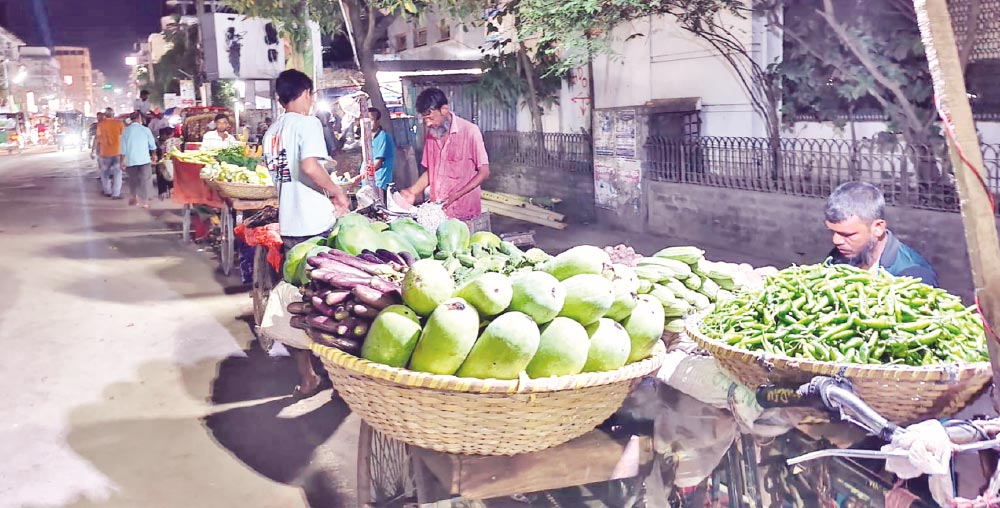 PABNA, Sept 12: Evening kitchen markets are growing increasingly popular in the Pabna town. As the sun sets on Abdul Hamid Road, one of the town's main thoroughfares, it glows with evening lights.
 Local vegetable sellers and other kitchen market traders load their goods onto vans and set up on both sides of the road.
After sunset, various vegetables are arranged on both sides of the road at the entrances, such as red cabbage, spinach, brinjal, gourd, bitter gourd and tomato. Although they look good, buyers are shocked to hear the prices. Compared with last week, the price of almost every vegetable has risen by Tk 10 to Tk 30 per kg. Brinjal is being sold at Tk 80 to Tk 100 per kg, whereas a day earlier its price was around Tk 60. The price of gourd and kankarol is reaching Tk 80 to Tk 90. Cucumber is being sold at Tk 70 per kg. The price of green chilli has increased by another step; it has reached Tk 200 per kg.
A private sector employee who came to the market expressed his anger. He said, "After working all day, I come to the market in the evening to buy some fresh vegetables. Once I enter the market, I can't control my anger. If I enter the market with a Tk 500 note, it runs out after buying two vegetables and some spices. I can't even look at fish and meat. My income hasn't increased by a taka, but the way prices of daily items are rising by leaps and bounds has become a burden for running a family."
When asked about this instability in the vegetable market, the vendors have various excuses ready. Retailer Rahim Mia said, "We don't want to sell at a high price. In the market, goods are scarce and prices are high. We have to buy them from the caravan market or the warehouse at a high price. Transportation costs add up. There is a risk of rotting or spoiling along the way."
"The wholesale price is high because of the rain and supply shortage." A little further beyond the vegetable market is the fish market: rui, katla, pangas, tilapia or small fish. The price of everything is going up. Farmed pangas and tilapia, which are relatively known as the fish of people with modest incomes, are now being sold at Tk 220 to Tk 250 per kg. The price of sized rui and katla is skyrocketing to Tk 350 to Tk 450. The price of fish from rivers or open water bodies is far beyond the reach of the commoner. Even though it is the season, many people cannot afford even medium-sized hilsa because of the high price. One kilogram of hilsa is being sold for Tk 1,600 to Tk 1,800.
Next to the fish market is a meat shop. Cow and mutton meat are hanging there. Beef is being sold at Tk 750 to Tk 800 per kg. Mutton has reached Tk 1,200 per kg. It has almost become a dish for ordinary families. Broiler chicken, a source of protein, is not retreating either. Broiler chicken is being sold at Tk 180 to Tk 190 per kg. Golden chicken has reached Tk 300 to Tk 320. You have to pay Tk 150 to Tk 155 to buy a dozen eggs.
In such a market situation, people with low incomes and labourers are in the most trouble. People who eat every day are cutting back on their dinner list. Many are buying half the required amount and returning home. There is no peace in the rice and dal shops of vegetable sellers. Local onions are being sold at Tk 120 per kg, garlic and ginger at Tk 200 to Tk 240. The price of rice has also increased by Tk 2 to Tk 3 per kg.
Various conscious citizens monitoring the market and working on consumer rights believe it is not possible to hide this price increase by simply citing a "supply shortage."
According to them, a group of traders is destabilising the market by forming syndicates and creating artificial crises. The buyers' main demand this evening is simple: regular market monitoring and strict administrative action against unscrupulous traders.
As the night progresses, the markets' hustle and bustle also increase. However, after shopping, most buyers return home with lighter pockets and heavy hearts. They think perhaps they will have to endure the price shock of a new product again at tomorrow's evening market.

Loading...
Loading...
Also read



Editor : Iqbal Sobhan Chowdhury
Published by the Editor on behalf of the Observer Ltd. from Globe Printers, 24/A, New Eskaton Road, Ramna, Dhaka.
Editorial, News and Commercial Offices : Aziz Bhaban (2nd floor), 93, Motijheel C/A, Dhaka-1000.
Phone: PABX- 41053001-06; Advertisement: 41053012; 01793317829, 01550707291, E-mail: [email protected], [email protected] Online: email: [email protected] 41053014; 01550707297 Advertisement: 01550707296
Published by the Editor on behalf of the Observer Ltd. from Globe Printers, 24/A, New Eskaton Road, Ramna, Dhaka.
Editorial, News and Commercial Offices : Aziz Bhaban (2nd floor), 93, Motijheel C/A, Dhaka-1000.
Phone: PABX- 41053001-06; Advertisement: 41053012; 01793317829, 01550707291, E-mail: [email protected], [email protected] Online: email: [email protected] 41053014; 01550707297 Advertisement: 01550707296


