



| HEADLINE |

|

Bangladesh Moves Towards First Electric Trains On Mainline Railway
Tk 3,822 crore project for N'ganj-Dhaka-Joydebpur route
Published : Monday, 14 September, 2026 at 12:00 AM
Mizanur Rahman


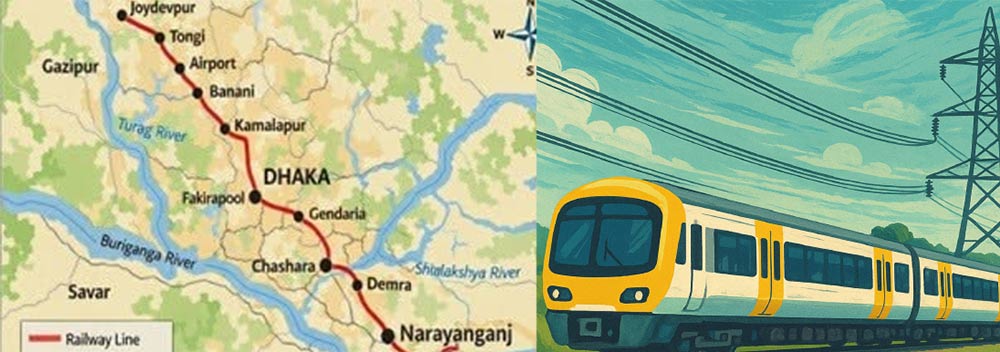 The government is set to take a major step towards modernising its railway system with the introduction of electric trains on the country’s mainline railway network for the first time.
The government has undertaken a Tk 3,822.51 crore project to introduce electric traction on the Narayanganj-Dhaka-Joydebpur railway corridor. The project is scheduled to be placed before the Executive Committee of the National Economic Council (ECNEC) at its meeting on Tuesday for final approval.
Titled “Implementation of Electric Traction Along Narayanganj-Dhaka-Joydebpur Section of Bangladesh Railway,” the project will be implemented by Bangladesh Railway. It aims to establish an electric traction system along the busy 52.32-kilometre railway corridor, marking the beginning of the country’s transition from diesel-powered railway operations to modern electric traction.
According to the project proposal, an Overhead Catenary System (OCS) will be installed over approximately 186 track-kilometres, considering the multiple railway lines along the corridor.
Two traction substations will also be constructed to ensure a reliable power supply for electric train operations. The project includes the installation of a central control system and the construction of a modern workshop for the maintenance of electric trains.
The government also plans to procure 16 sets of Electric Multiple Units (EMUs) under the project. Each EMU set will consist of five coaches.
Officials concerned said the project would lay the foundation for gradually shifting Bangladesh Railway from its heavy dependence on diesel to electric traction. The Narayanganj-Dhaka-Joydebpur corridor is one of the busiest railway routes in the country, carrying a large number of passengers and operating multiple trains every day.
An official of the Planning Commission said, “This is an important project for the modernisation of Bangladesh Railway. The Narayanganj-Dhaka-Joydebpur corridor is extremely busy. Introducing electric traction here will help ensure faster and more reliable railway services while reducing dependence on diesel.”
The total project cost includes Tk 942.09 crore from the government’s own funds and Tk 2,880.42 crore as project loans from foreign sources. The Asian Development Bank (ADB) and the European Investment Bank (EIB) are expected to be involved in financing the project.
According to the project proposal, the introduction of electric traction could reduce travel time along the corridor by up to 18 per cent. At the same time, operating and maintenance costs are expected to decline by around 35 per cent.
Officials said electric trains could accelerate faster than conventional diesel trains and would be particularly suitable for routes with frequent stops. This could create scope for increasing the number of trains and passenger-carrying capacity on the busy corridor.
A Bangladesh Railway official said, “Electric traction is not merely a project to introduce a new type of train; it will bring a major change in the railway’s operating system. Electric trains can accelerate quickly and operate efficiently on routes with frequent stops. This will create opportunities to increase both the number of trains and passenger capacity on busy corridors.”
The project is also expected to reduce the railway’s fuel consumption. As the use of diesel declines, pressure on fuel imports will also ease. At the same time, lower dependence on fossil fuels will help reduce carbon emissions and make railway transportation more environmentally friendly.
According to the latest proposal, the project is scheduled to be implemented from July 2026 to June 2031. Following ECNEC approval, the government plans to complete the construction of infrastructure, installation of the electric traction system, procurement of EMUs and development of maintenance facilities within the project period.
Sources said that successful implementation of the Narayanganj-Dhaka-Joydebpur project could pave the way for expanding electric traction to other major railway corridors across the country.
The project is also being viewed as part of a broader plan to gradually electrify the railway route from Tongi to Chattogram. Therefore, approval of the project by ECNEC would not only pave the way for electric train services on a single corridor but also establish an important foundation for the long-term electrification and modernisation of Bangladesh Railway.

Loading...
Loading...
Also read



Editor : Iqbal Sobhan Chowdhury
Published by the Editor on behalf of the Observer Ltd. from Globe Printers, 24/A, New Eskaton Road, Ramna, Dhaka.
Editorial, News and Commercial Offices : Aziz Bhaban (2nd floor), 93, Motijheel C/A, Dhaka-1000.
Phone: PABX- 41053001-06; Advertisement: 41053012; 01793317829, 01550707291, E-mail: [email protected], [email protected] Online: email: [email protected] 41053014; 01550707297 Advertisement: 01550707296
Published by the Editor on behalf of the Observer Ltd. from Globe Printers, 24/A, New Eskaton Road, Ramna, Dhaka.
Editorial, News and Commercial Offices : Aziz Bhaban (2nd floor), 93, Motijheel C/A, Dhaka-1000.
Phone: PABX- 41053001-06; Advertisement: 41053012; 01793317829, 01550707291, E-mail: [email protected], [email protected] Online: email: [email protected] 41053014; 01550707297 Advertisement: 01550707296


