



| HEADLINE |

|
Public and private actors align on priorities for safe, export-ready vegetables
Published : Wednesday, 16 September, 2026 at 9:32 PM
Press Release


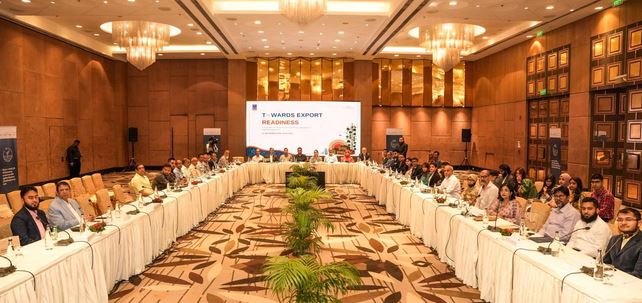
File Photo
Government agencies, regulators, exporters, financial institutions and other sector actors came together in Dhaka today around a shared agenda for strengthening Bangladesh’s position as a reliable supplier of safe, compliant vegetables.
The stakeholder round table, “Towards Export Readiness: Constraints and Commitments in Bangladesh’s Vegetable Export Sector,” was convened by Swisscontact Bangladesh at the Ruposhi Bangla Grand Ballroom, Hotel InterContinental Dhaka. The session was moderated by Dr Selim Raihan, Professor, Department of Economics, University of Dhaka.
Bangladesh produces more than 15 million metric tons of vegetables annually yet exports less than 0.3 per cent of that volume. The barriers extend beyond production to pest and pesticide management, testing and certification accepted by buyers, traceability, logistics, and the ability of institutions across the export system to work together. Gourds continue to face rejection in European markets, with each rejected consignment carrying consequences not only for the exporter concerned but also for buyer confidence in Bangladesh as a sourcing market.
Drawing on findings from a market study conducted by SGS Bangladesh, exporters and sector stakeholders examined where consignments lose competitiveness or encounter compliance barriers. The discussion highlighted high production and export costs, air-freight charges, customs and airport handling delays, inadequate packaging and branding, pesticide-residue risks, weak traceability, costly and lengthy certification processes, fragmented production systems and limited coordination across the value chain.
The discussion pointed to a common direction for action. Stronger farm-level compliance and traceability will be essential to reducing pesticide-residue risks, while improvements in packaging, logistics, testing and certification will be needed to make Bangladeshi vegetables more competitive in international markets. Participants also underscored the importance of better market intelligence, diversified export destinations, stronger institutional coordination and financial services that respond to the operating realities of exporters.
Dr Amirul Baharain, Additional Director, Plant Quarantine Wing, Department of Agricultural Extension, highlighted the continuing challenge of ensuring proper pesticide use at farm level despite the existing toxicity-based colour-coding system. He also stressed that product quality alone is not enough to secure international markets, noting the importance of competitive packaging and presentation.
Md Abdul Majid Pramanik, Director General, Rural Development Academy, identified weak market intelligence, high and unpredictable air-freight costs, inadequate logistics, limited coordination and weak traceability as major constraints. He called for greater market diversification, improved logistics, stronger farm-level traceability, better coordination and export-related tax facilities to strengthen the sector’s competitiveness.
Representing the exporters’ perspective, Mobasserur Rahman Jewel, Acting President, Bangladesh Fruits, Vegetables and Allied Products Exporters Association (BFVAPEA), highlighted the increasing pressure created by rising air-freight costs. He noted that higher freight charges are making it increasingly difficult for Bangladeshi exporters to compete internationally and sustain existing export volumes.
On access to finance, Helal Ahmed, Chief of Branch Business and Head of Operations, IFIC Bank PLC, said that the Bank stands ready to provide financial support to exporters, farmers, advisers and other stakeholders working across the agricultural export sector when financing is required.
The discussion reinforced the need to treat export readiness as a system rather than as a series of isolated interventions. Farm-level production practices, residue compliance, traceability, certification, packaging, logistics, market information and finance all influence whether a consignment ultimately reaches a buyer competitively and reliably.
“Bangladesh has the land, the climate and the growers. What it does not yet have is a compliance system the buyer trusts on arrival,” said Ishrat Fatema, Deputy Country Director, Swisscontact Bangladesh. “Every part of that system exists somewhere in this room. Today was about putting a name against each missing piece.”
The approach reflects how Swisscontact works. Rather than substituting for national institutions, Swisscontact supports the Department of Agricultural Extension, exporters’ association and testing providers to embed compliance within the value chain itself so that safe production practices can continue beyond the life of external support. The same systems that strengthen access to export markets can also contribute to safer vegetables for Bangladeshi consumers and better returns for farmers.
The round table brought together representatives from the Ministry of Commerce, Ministry of Agriculture, Department of Agricultural Extension and its Plant Quarantine Wing, Export Promotion Bureau, Bangladesh Standards and Testing Institution, Commercial banks, and member exporters of BFVAPEA. The event was organised with support from the Standards and Trade Development Facility (STDF), IFIC Bank PLC and the Australian Government, with the Economics Study Center, University of Dhaka, serving as knowledge partner.
The stakeholder round table, “Towards Export Readiness: Constraints and Commitments in Bangladesh’s Vegetable Export Sector,” was convened by Swisscontact Bangladesh at the Ruposhi Bangla Grand Ballroom, Hotel InterContinental Dhaka. The session was moderated by Dr Selim Raihan, Professor, Department of Economics, University of Dhaka.
Bangladesh produces more than 15 million metric tons of vegetables annually yet exports less than 0.3 per cent of that volume. The barriers extend beyond production to pest and pesticide management, testing and certification accepted by buyers, traceability, logistics, and the ability of institutions across the export system to work together. Gourds continue to face rejection in European markets, with each rejected consignment carrying consequences not only for the exporter concerned but also for buyer confidence in Bangladesh as a sourcing market.
Drawing on findings from a market study conducted by SGS Bangladesh, exporters and sector stakeholders examined where consignments lose competitiveness or encounter compliance barriers. The discussion highlighted high production and export costs, air-freight charges, customs and airport handling delays, inadequate packaging and branding, pesticide-residue risks, weak traceability, costly and lengthy certification processes, fragmented production systems and limited coordination across the value chain.
The discussion pointed to a common direction for action. Stronger farm-level compliance and traceability will be essential to reducing pesticide-residue risks, while improvements in packaging, logistics, testing and certification will be needed to make Bangladeshi vegetables more competitive in international markets. Participants also underscored the importance of better market intelligence, diversified export destinations, stronger institutional coordination and financial services that respond to the operating realities of exporters.
Dr Amirul Baharain, Additional Director, Plant Quarantine Wing, Department of Agricultural Extension, highlighted the continuing challenge of ensuring proper pesticide use at farm level despite the existing toxicity-based colour-coding system. He also stressed that product quality alone is not enough to secure international markets, noting the importance of competitive packaging and presentation.
Md Abdul Majid Pramanik, Director General, Rural Development Academy, identified weak market intelligence, high and unpredictable air-freight costs, inadequate logistics, limited coordination and weak traceability as major constraints. He called for greater market diversification, improved logistics, stronger farm-level traceability, better coordination and export-related tax facilities to strengthen the sector’s competitiveness.
Representing the exporters’ perspective, Mobasserur Rahman Jewel, Acting President, Bangladesh Fruits, Vegetables and Allied Products Exporters Association (BFVAPEA), highlighted the increasing pressure created by rising air-freight costs. He noted that higher freight charges are making it increasingly difficult for Bangladeshi exporters to compete internationally and sustain existing export volumes.
On access to finance, Helal Ahmed, Chief of Branch Business and Head of Operations, IFIC Bank PLC, said that the Bank stands ready to provide financial support to exporters, farmers, advisers and other stakeholders working across the agricultural export sector when financing is required.
The discussion reinforced the need to treat export readiness as a system rather than as a series of isolated interventions. Farm-level production practices, residue compliance, traceability, certification, packaging, logistics, market information and finance all influence whether a consignment ultimately reaches a buyer competitively and reliably.
“Bangladesh has the land, the climate and the growers. What it does not yet have is a compliance system the buyer trusts on arrival,” said Ishrat Fatema, Deputy Country Director, Swisscontact Bangladesh. “Every part of that system exists somewhere in this room. Today was about putting a name against each missing piece.”
The approach reflects how Swisscontact works. Rather than substituting for national institutions, Swisscontact supports the Department of Agricultural Extension, exporters’ association and testing providers to embed compliance within the value chain itself so that safe production practices can continue beyond the life of external support. The same systems that strengthen access to export markets can also contribute to safer vegetables for Bangladeshi consumers and better returns for farmers.
The round table brought together representatives from the Ministry of Commerce, Ministry of Agriculture, Department of Agricultural Extension and its Plant Quarantine Wing, Export Promotion Bureau, Bangladesh Standards and Testing Institution, Commercial banks, and member exporters of BFVAPEA. The event was organised with support from the Standards and Trade Development Facility (STDF), IFIC Bank PLC and the Australian Government, with the Economics Study Center, University of Dhaka, serving as knowledge partner.
-AAH
Loading...
Loading...
Also read








Editor : Iqbal Sobhan Chowdhury
Published by the Editor on behalf of the Observer Ltd. from Globe Printers, 24/A, New Eskaton Road, Ramna, Dhaka.
Editorial, News and Commercial Offices : Aziz Bhaban (2nd floor), 93, Motijheel C/A, Dhaka-1000.
Phone: PABX- 41053001-06; Advertisement: 41053012; 01793317829, 01550707291, E-mail: [email protected], [email protected] Online: email: [email protected] 41053014; 01550707297 Advertisement: 01550707296
Published by the Editor on behalf of the Observer Ltd. from Globe Printers, 24/A, New Eskaton Road, Ramna, Dhaka.
Editorial, News and Commercial Offices : Aziz Bhaban (2nd floor), 93, Motijheel C/A, Dhaka-1000.
Phone: PABX- 41053001-06; Advertisement: 41053012; 01793317829, 01550707291, E-mail: [email protected], [email protected] Online: email: [email protected] 41053014; 01550707297 Advertisement: 01550707296


