



| HEADLINE |

|
Human skills remain vital alongside technology: Presidency University seminar
Published : Sunday, 27 September, 2026 at 8:46 PM
Observer Online Report


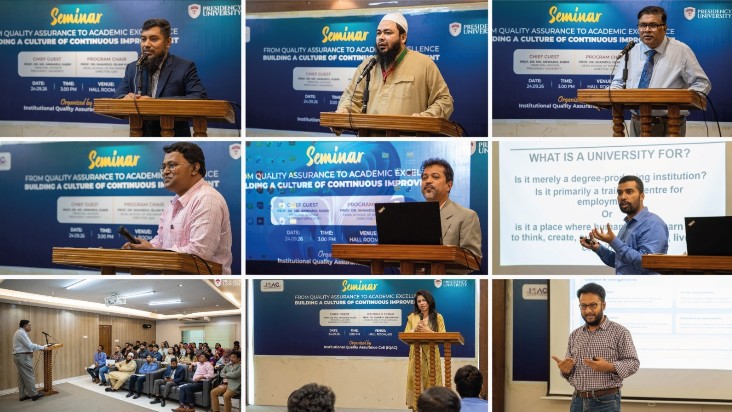
The growing use of artificial intelligence and automation is changing education and the workplace, highlighting the need for universities to develop students’ technical knowledge alongside creativity, problem-solving skills, ethical awareness and human values, speakers said at a seminar at Presidency University.
Titled “From Quality Assurance to Academic Excellence,” the seminar was organised by the university’s Institutional Quality Assurance Cell (IQAC) at Hall Room 401 on Thursday.
Prof Dr Md Anwarul Kabir, Principal Adviser of Presidency University, attended the event as the chief guest, while Prof Dr Shahidul Islam Khan Nayeem, Dean of the School of Engineering and Director of IQAC, chaired the programme.
In his opening remarks, Prof Dr Shahidul Islam Khan Nayeem stressed the importance of maintaining academic quality and promoting continuous improvement across the university.
Prof Dr Md Anwarul Kabir spoke on “Expectations of the Board of Trustees from Faculty Members of Presidency University,” focusing on faculty responsibilities in maintaining academic standards and contributing to institutional development.
Prof Abul Kalam, Dean of the School of Business, discussed teaching as a career, including its opportunities and responsibilities.
Prof Mohammad Azharul Islam, Dean of the School of Law, spoke on the need to reconsider Bangladesh’s university system in light of changing national and global circumstances.
The seminar also addressed academic administration. Md Zahidur Rahman, Controller of Examinations, discussed quality and discipline in the examination system, while Registrar Md Sakir Hossain spoke about the role of academic departments in admission and registration.
Ms Nazla Fatmi, Head of the Department of English, discussed the qualities of an effective teacher, while AKM Ziaul Amin, Head of Human Resources, addressed human resource management and institutional policies.
A session titled “The Fifth Industrial Revolution and Tertiary Education: Prospects and Challenges” focused on the possible impact of emerging technologies on higher education. Prof Dr Shahidul Islam Khan Nayeem discussed how technological changes could reshape tertiary education and create new demands for skills and competencies.
Speakers said artificial intelligence, robotics and automation were increasingly influencing the workplace. They stressed the importance of providing students with opportunities to develop practical and transferable skills alongside academic knowledge.
They also highlighted creativity, critical thinking, ethical responsibility and human values as areas that should remain part of university education amid technological advancement.
The seminar further discussed quality assurance as an ongoing process rather than solely a formal assessment or compliance exercise. Participants exchanged views on improving teaching, examinations, admissions, administration and human resource practices.
The organisers said maintaining academic quality was a shared responsibility of faculty members, officers, staff and students, and stressed the importance of regular evaluation and improvement.
The event ended with an open discussion and question-and-answer session, where faculty members and university officials discussed academic quality, teaching standards, examination and admission management, human resource policies and the future of higher education.
- MaT
Loading...
Loading...
Also read


Editor : Iqbal Sobhan Chowdhury
Published by the Editor on behalf of the Observer Ltd. from Globe Printers, 24/A, New Eskaton Road, Ramna, Dhaka.
Editorial, News and Commercial Offices : Aziz Bhaban (2nd floor), 93, Motijheel C/A, Dhaka-1000.
Phone: PABX- 41053001-06; Advertisement: 41053012; 01793317829, 01550707291, E-mail: [email protected], [email protected] Online: email: [email protected] 41053014; 01550707297 Advertisement: 01550707296
Published by the Editor on behalf of the Observer Ltd. from Globe Printers, 24/A, New Eskaton Road, Ramna, Dhaka.
Editorial, News and Commercial Offices : Aziz Bhaban (2nd floor), 93, Motijheel C/A, Dhaka-1000.
Phone: PABX- 41053001-06; Advertisement: 41053012; 01793317829, 01550707291, E-mail: [email protected], [email protected] Online: email: [email protected] 41053014; 01550707297 Advertisement: 01550707296


