



| HEADLINE |

|
Excessive Pesticide Use Threatens Public Health
Published : Monday, 28 September, 2026 at 12:00 AM
Dr M Abdul Momin


 Over the past three decades, pesticide use in Bangladesh has increased at an alarming rate. While pesticides have contributed to higher agricultural productivity, their excessive and indiscriminate use has emerged as a serious public health and environmental concern. Farmers and rural communities are particularly exposed to the risks, which include acute and chronic health problems, environmental contamination and food-safety threats.
Annual pesticide use in Bangladesh has reportedly risen from around 3,000 metric tonnes in 1990 to more than 41,000 metric tonnes in 2025. According to a recent survey by the Centre for Agriculture and Bioscience International (CABI), pesticide use has increased by more than 81 per cent over the past five years. Rice, vegetables and fruits account for a substantial share of pesticide use. While farmers use pesticides primarily to protect crops and increase yields, the growing dependence on chemicals is imposing significant health and environmental costs.
Government estimates put the country’s pesticide market at around Tk4,000-5,000 crore, much of which is import-dependent. Around 25,000-30,000 metric tonnes of pesticides are reportedly imported annually for crop production. There are approximately 1,300 registered importers and manufacturers, while around 8,000 pesticides are reportedly registered for use. The problem is compounded by the presence of counterfeit and substandard products. According to the study, only about 47 per cent of pesticides are considered genuine, while the remaining 53 per cent are reportedly counterfeit or fabricated. Such products not only fail to control pests effectively but may also increase environmental and food-safety risks.
A recent Research conducted by the Bangladesh Agricultural Research Institute (BARI) has found pesticide residues above permissible levels in around 10 per cent of vegetables and 4 per cent of fruits collected from markets. Lack of awareness among farmers about the risks associated with pesticides is considered one of the contributing factors. At a recent workshop organised by the Bangladesh Agricultural Research Council (BARC), BARI Director Dr Nirmal Kumar Dutta observed that increasing pesticide use is contributing to pesticide resistance among insect pests. As pests become resistant, farmers are compelled to apply pesticides more frequently or at higher doses. Excessive pesticide use also kills beneficial insects, which can ultimately contribute to the resurgence of harmful pests. More than 25 harmful insect pests had newly emerged in Bangladesh by 2016 and stressed the need to promote biological pesticides as an alternative to excessive chemical use.
Field-level observations provide a disturbing picture. Journalists visiting at least ten villages in Sadar, Kamalnagar and Ramgati upazilas of Lakshmipur found that some farmers apply pesticides 10-14 times during a single rice-growing season. Similar patterns are reported in vegetable and fruit cultivation. Mango grower Yakub Ali of Padaganj, Pabna, said that farmers previously needed only two or three sprays for certain mango varieties, whereas they now sometimes apply pesticides 30-35 times, along with additional growth regulators. A major reason is farmers’ dependence on advice from pesticide retailers, many of whom lack adequate technical training. Weak field-level monitoring further aggravates the problem. A survey of 600 farmers found that 12 per cent of farmers in Tangail and 20 per cent in Sirajganj were using pesticides banned in Bangladesh.
The problem does not end in the field. Pesticide residues can move through soil and water and eventually reach consumers through food. One study found pesticide residues above World Health Organization safety limits in 40 per cent of fresh vegetables and 25 per cent of rice samples collected from local markets. Another study identified the continued use in Bangladesh of 17 pesticide active ingredients considered banned or highly hazardous internationally, including six insecticides, five fungicides, four herbicides and two rodenticides. Pesticide exposure can have both immediate and long-term health consequences. Because chronic exposure develops gradually, establishing a direct link with a particular disease can be difficult. Nevertheless, available evidence indicates substantial occupational risks among agricultural workers.
According to the 2025 cancer registry of the National Institute of Cancer Research and Hospital, farmers and agricultural workers accounted for around 33.5 per cent of cancer patients recorded there. Former Director General of the Department of Agricultural Extension Abdul Muyeed has cited an even higher figure, suggesting that farmers constitute 64 per cent of cancer patients, particularly because of direct exposure to pesticides during spraying.
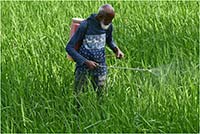
Many farmers spray pesticides without masks, gloves or protective clothing, and some even work barefoot, increasing their exposure. Acute symptoms are also widespread. A 2025 review reported that approximately 27-35 per cent of Bangladeshi farmers experience symptoms such as headache, nausea, dizziness, eye irritation and breathing difficulties each year. A survey in Kotalipara, Gopalganj, found high rates of weakness, skin problems, eye irritation, diarrhoea and headaches among pesticide users. Unsafe storage and disposal were also common, including open storage and disposal of pesticide residues in water.
Long-term pesticide exposure has been associated in international research with neurological disorders, hormonal disruption, asthma, infertility and neurodegenerative diseases. A birth-cohort study published in Environment International found that early-pregnancy exposure to parathion and diazinon in rural Bangladesh was associated with increased risks of preterm birth, while metabolites of diazinon were associated with higher odds of low birth weight.
Bangladesh needs to move from a pesticide-dependent agricultural model towards safer, science-based pest management. Integrated Pest Management (IPM) should be strengthened so that chemical pesticides are used only when necessary and as part of a broader strategy involving biological control, resistant varieties, cultural practices and conservation of natural enemies such as frogs and birds. Pesticide retailers should receive mandatory training and licensing so that farmers receive scientifically sound advice on dosage, timing and application methods. The import, production and marketing of banned, counterfeit and highly hazardous pesticides must be strictly monitored.
Farmers should also have affordable access to protective equipment such as masks, gloves, boots and protective clothing. At the same time, public-health surveillance should be strengthened to establish a population-based database capable of identifying pesticide-related health problems more accurately. Most importantly, agriculture, health and environment authorities must work together.
Pesticides can remain an important tool for protecting crops and sustaining agricultural productivity. But excessive and indiscriminate use can undermine the very system it is intended to support. The time has come to rethink pesticide management in Bangladesh-not merely from the perspective of increasing production, but from the broader perspective of protecting farmers, consumers, the environment and long-term food security.
The writer is Senior Communication Officer, Bangladesh Rice Research Institute (BRRI)
Loading...
Loading...
Also read



Editor : Iqbal Sobhan Chowdhury
Published by the Editor on behalf of the Observer Ltd. from Globe Printers, 24/A, New Eskaton Road, Ramna, Dhaka.
Editorial, News and Commercial Offices : Aziz Bhaban (2nd floor), 93, Motijheel C/A, Dhaka-1000.
Phone: PABX- 41053001-06; Advertisement: 41053012; 01793317829, 01550707291, E-mail: [email protected], [email protected] Online: email: [email protected] 41053014; 01550707297 Advertisement: 01550707296
Published by the Editor on behalf of the Observer Ltd. from Globe Printers, 24/A, New Eskaton Road, Ramna, Dhaka.
Editorial, News and Commercial Offices : Aziz Bhaban (2nd floor), 93, Motijheel C/A, Dhaka-1000.
Phone: PABX- 41053001-06; Advertisement: 41053012; 01793317829, 01550707291, E-mail: [email protected], [email protected] Online: email: [email protected] 41053014; 01550707297 Advertisement: 01550707296


