



| HEADLINE |

|
Solar power must for battery-run rickshaws
Published : Monday, 28 September, 2026 at 12:00 AM
Tanvir Raihan


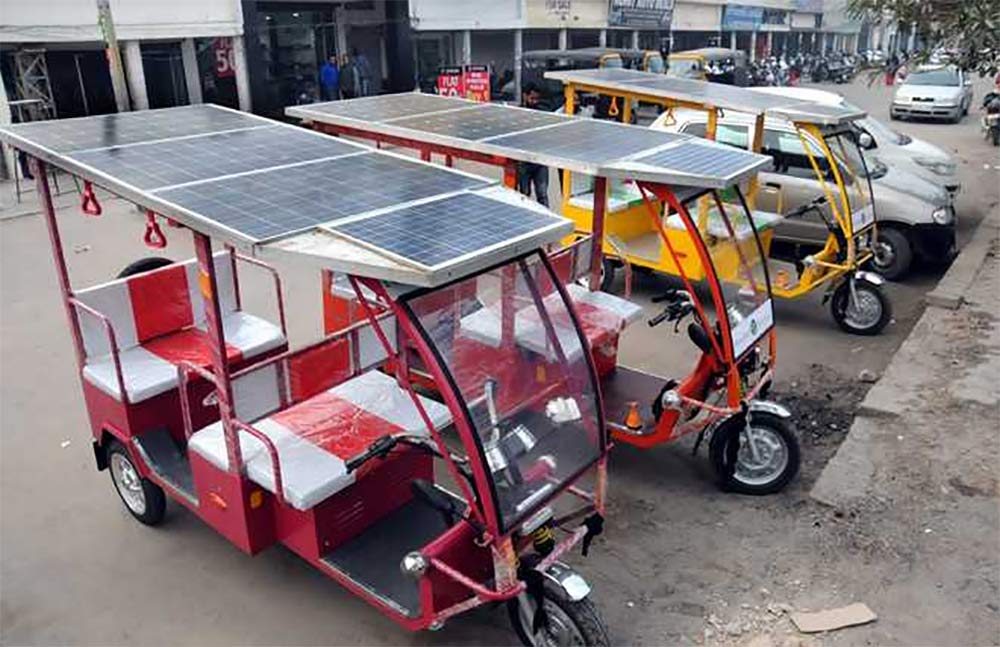 The government is planning major changes to regulate battery-run autorickshaws, with proposed measures including registration, fitness certification, driver licensing, designated routes, zone-based operation, digital tracking and solar-powered charging.
The proposed framework is aimed at bringing the rapidly expanding battery-run vehicle sector under a formal regulatory system in city corporation, municipality, upazila and union parishad areas.
Local Government, Rural Development and Cooperatives State Minister Mir Shahe Alam said a comprehensive policy was being formulated to regulate battery-run rickshaws and e-rickshaws.
Solar-powered charging is one of the key features being considered under the proposed framework.
According to the state minister, battery-run e-rickshaws would have to use solar power for charging their batteries to obtain registration. The government is also considering penalties for charging from sources other than solar power and may refuse registration or renewal in such cases.
The authorities are also considering establishing designated solar charging stations to support the transition.
The government is considering separate categories for two-, four- and six-seater battery-run vehicles based on road conditions, locality and passenger capacity.
In Dhaka, registered e-rickshaws carrying up to four passengers may be allowed to operate on internal roads, while battery-run rickshaws and e-rickshaws would remain barred from major roads.
Six-seater vehicles would face stricter restrictions in the capital.
Mir Shahe Alam has already said the two Dhaka city corporations would not register six-seater e-rickshaws. Such vehicles could, however, be considered for registration outside Dhaka, particularly in rural areas and on rural roads in district towns.
The government is considering glass-covered or enclosed cabins to protect passengers from dust, rain and air pollution. Technical standards could also be introduced for brakes, lights, wheels, batteries, body structures and other safety-related components.
Manufacturers may also be brought under regulatory control. Vehicles would have to be produced at authorised factories according to approved designs and technical specifications.
Officials believe such measures could reduce the production of poorly manufactured vehicles in unregulated local workshops.
Experts have been consulted during the formulation of the proposed regulatory framework.
BUET Mechanical Engineering Department Professor Dr Mohammad Ehsan and Civil Engineering Department Professor Dr Md Hadiuzzaman provided expert opinions during discussions on the issue.
Road Transport and Bridges State Minister Habibur Rashid has also said the government is working to bring battery-run autorickshaws under a regulatory framework.
The government is also planning to introduce digital registration and tracking of battery-run autorickshaws.
Home Affairs Minister Salahuddin Ahmed told Parliament that initiatives had been taken to bring the vehicles under registration and introduce digital tracking.
Authorities are also considering limiting ownership of battery-run autorickshaws. Under the proposal, one person could be allowed to purchase a maximum of five autorickshaws using a single National Identity Card.
The government is also concerned about electricity consumption and unauthorised charging facilities.
The Home Affairs Minister told Parliament that unauthorised charging of battery-run autorickshaws was causing an estimated Tk4,000 crore in annual revenue losses to the government.
Registration and solar-powered charging are therefore being considered as part of efforts to bring the sector under greater regulatory control.
However, millions of drivers and owners depend on battery-run vehicles for their livelihoods. Stakeholders have called for affordable registration fees, adequate charging infrastructure, accessible fitness-testing facilities and a realistic transition plan for existing vehicle owners and drivers.
If implemented, the proposed policy could fundamentally change the operation of battery-run autorickshaws by moving the sector from largely unregulated operation towards a system based on registration, licensing, fitness certification, designated routes and controlled charging.
The final rules on two-, four- and six-seater vehicles, zone-based colours, ownership limits, glass cabins and technical standards will become clear once the government finalises and issues the policy.
Loading...
Loading...
Also read



Editor : Iqbal Sobhan Chowdhury
Published by the Editor on behalf of the Observer Ltd. from Globe Printers, 24/A, New Eskaton Road, Ramna, Dhaka.
Editorial, News and Commercial Offices : Aziz Bhaban (2nd floor), 93, Motijheel C/A, Dhaka-1000.
Phone: PABX- 41053001-06; Advertisement: 41053012; 01793317829, 01550707291, E-mail: [email protected], [email protected] Online: email: [email protected] 41053014; 01550707297 Advertisement: 01550707296
Published by the Editor on behalf of the Observer Ltd. from Globe Printers, 24/A, New Eskaton Road, Ramna, Dhaka.
Editorial, News and Commercial Offices : Aziz Bhaban (2nd floor), 93, Motijheel C/A, Dhaka-1000.
Phone: PABX- 41053001-06; Advertisement: 41053012; 01793317829, 01550707291, E-mail: [email protected], [email protected] Online: email: [email protected] 41053014; 01550707297 Advertisement: 01550707296


