



| HEADLINE |

|

Dengue outbreak engulfs cities and villages
Published : Saturday, 10 October, 2026 at 12:00 AM
Arifur Rahman Rabbi


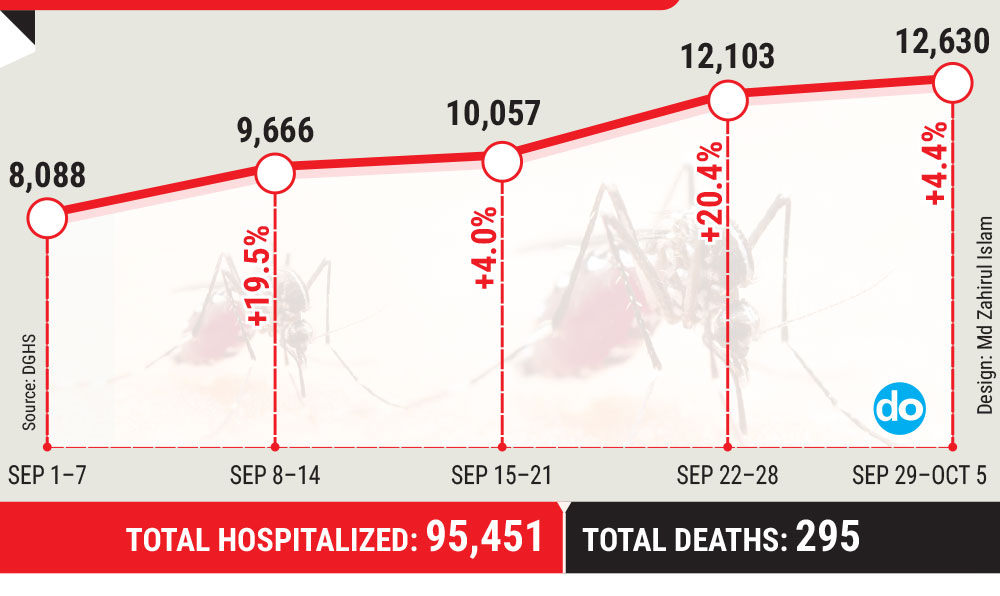 Dengue infections are rising despite a nationwide prevention campaign, with weekly hospital admissions climbing by more than 56 per cent in a month, raising fears of a further deterioration in October and November.
The number of patients admitted to hospitals increased from 8,088 in the first week of September to 12,630 in the first week of October, according to Directorate General of Health Services (DGHS) data.
Experts warn that favourable weather conditions, rising mosquito density and weak mosquito control efforts outside major cities could prolong the outbreak, putting further pressure on hospitals across the country.
The government launched a three-month campaign, titled “Dengue Prevention and Cleanliness Drive”, on September 12 as infections spread in Dhaka and other parts of the country. However, admissions continued to rise in the weeks following its launch.
According to the DGHS dengue dashboard on October 9, a total of 95,451 people had been hospitalised with dengue since the beginning of the year, while 295 had died. In the preceding 24 hours, 1,300 new patients were admitted and one person died.
Nearly 2,000 patients were also being admitted daily over the four days preceding the latest report, adding to concerns about the growing pressure on hospitals.
Health and Family Welfare Minister Sardar Md Sakhawat Hossain said changes in Aedes mosquito variants were among the factors contributing to the risk, despite the use of national and international treatment guidelines.
Speaking to journalists at the Secretariat on October 7, he rejected claims that the government had failed to tackle dengue, saying the disease had not been completely eliminated but that all necessary measures were being taken.
Rural areas face growing burden
Experts and officials said dengue had spread to all districts, with rural areas increasingly affected alongside Dhaka and other major cities. However, large-scale mosquito control activities remain limited in many rural areas, exposing gaps in surveillance and the elimination of breeding sites.
The National Guidelines for the Prevention of Dengue and Other Mosquito-Borne Diseases, published by the Local Government Division in 2019, provide for committees at union, upazila, district, municipality, city corporation and national levels, with defined responsibilities.
Officials concerned said committees outside the national level and city corporations had remained largely inactive.
With local government elections yet to take place following the political change on August 5, activities at union, upazila and district levels remain limited, according to officials. City corporations, however, continue their operations in Dhaka and other major divisional cities.
Entomologist and Jahangirnagar University professor Dr Kabirul Bashar warned that the dengue situation could worsen in October, depending on rainfall, temperature, humidity, Aedes mosquito density and the number of patients.
He said the outbreak could intensify in districts beyond Dhaka. Although infections usually begin to decline in November, that pattern might not hold this year, making it urgent to step up efforts to eliminate mosquito breeding sites.
Breeding grounds need attention
Public health expert Dr Zakia Ferdousi Khanam said city corporations and local administrations were carrying out dengue control activities, but greater emphasis was needed on eliminating breeding grounds.
Aedes mosquitoes breed in clean, stagnant water found in homes, rooftops, balconies, construction sites, discarded containers, flowerpots, drums and coconut shells. Spraying insecticides on roads and open spaces alone would not be sufficient, she said, stressing the need for regular inspections of homes, buildings and construction sites.
As patient numbers increased, hospitals outside Dhaka also faced pressure from the influx. The Health and Family Welfare Ministry recently directed hospitals nationwide to increase bed capacity, with particular priority given to facilities in the capital.
Administrators of Dhaka South City Corporation (DSCC) and Dhaka North City Corporation (DNCC) said special cleanliness drives were being conducted daily in every ward under their supervision.
They said the city corporations could keep public spaces clean, but public awareness and participation were essential to make mosquito control efforts effective.
Rejecting allegations of failure, Minister Sakhawat Hossain said hospitals were providing necessary treatment, including saline, and that the ministry was following established protocols.
Experts, however, stressed that hospital treatment alone would not reverse the rising trend. They called for coordinated nationwide action to eliminate breeding sites, strengthen local surveillance and make prevention efforts more effective before the outbreak worsens further.

Loading...
Loading...
Also read



Editor : Iqbal Sobhan Chowdhury
Published by the Editor on behalf of the Observer Ltd. from Globe Printers, 24/A, New Eskaton Road, Ramna, Dhaka.
Editorial, News and Commercial Offices : Aziz Bhaban (2nd floor), 93, Motijheel C/A, Dhaka-1000.
Phone: PABX- 41053001-06; Advertisement: 41053012; 01793317829, 01550707291, E-mail: [email protected], [email protected] Online: email: [email protected] 41053014; 01550707297 Advertisement: 01550707296
Published by the Editor on behalf of the Observer Ltd. from Globe Printers, 24/A, New Eskaton Road, Ramna, Dhaka.
Editorial, News and Commercial Offices : Aziz Bhaban (2nd floor), 93, Motijheel C/A, Dhaka-1000.
Phone: PABX- 41053001-06; Advertisement: 41053012; 01793317829, 01550707291, E-mail: [email protected], [email protected] Online: email: [email protected] 41053014; 01550707297 Advertisement: 01550707296


