



| HEADLINE |

|

B'desh tourism at a crossroads as closures and roadblocks disrupt travel
Published : Monday, 12 October, 2026 at 8:53 PM
Sakia Kawser Siddique


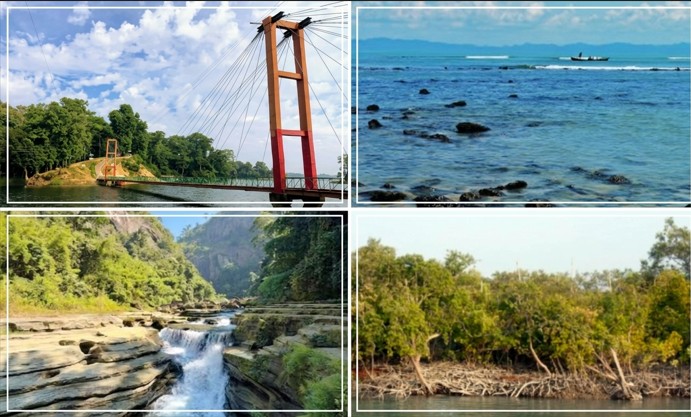
From Sajek’s hills to the Sundarbans’ mangroves, recent restrictions raise questions about safety, environmental protection and the future of local tourism.
Bangladesh’s most attractive tourist destinations are facing a difficult question: how can the country protect its natural beauty, ensure the safety of visitors and sustain the livelihoods of people who depend on tourism?
Recent developments have brought the question into sharp focus. Sajek Valley has been closed to tourists amid security concerns, an indefinite road blockade has disrupted movement along the Sajek tourist route, and the Department of Environment has ordered the closure of unauthorised resorts and eco-cottages near the Sundarbans.
Meanwhile, demands to resume ship services on the Teknaf–Saint Martin’s route have highlighted the importance of transport links to the country’s island tourism economy.
Together, these developments reveal the complicated challenges facing domestic tourism in Bangladesh, where the appeal of a destination depends not only on its scenery but also on safe access, responsible development and effective management.
When a destination becomes inaccessible
Sajek Valley, nestled in the hills of the Chittagong Hill Tracts, is known for its green slopes, cloud-covered landscapes and panoramic views. Its popularity has supported businesses offering accommodation, food, transport and other services to visitors.
However, the destination faced fresh disruption in October. The Rangamati district administration temporarily closed the Sajek tourist centre from the evening of October 11 until further notice and instructed tourists staying there to leave by October 13.
Separately, the Sajek Karbari Association and the Sajek Public Rights Protection Committee announced an indefinite blockade of the tourist road, demanding the withdrawal of armed members of the Parbatya Chattogram Jana Samhati Samiti from the area. The blockade disrupted traffic along the Baghaihat–Sajek road.
The two developments demonstrate how security concerns and interruptions to transport can affect an entire tourism destination. Visitors may have to change their plans, while businesses dependent on a steady flow of tourists can face uncertainty.
For local communities, the consequences extend beyond the loss of a holiday destination. Tourism supports a network of small businesses and service providers, many of whom depend on visitors during particular travel periods.
Ensuring the safety of residents and tourists must remain the priority. At the same time, clear communication about restrictions, safe evacuation arrangements and timely updates can help reduce confusion when travel plans are disrupted.
Tourism versus conservation
A different challenge is emerging around the Sundarbans, the world’s largest mangrove forest and a UNESCO World Heritage Site.
On October 6, the Department of Environment issued final closure notices to 18 unauthorised resorts and eco-cottages near the forest in Khulna’s Dacope upazila. A subsequent report said the department had ordered the closure of 24 unauthorised resorts and eco-cottages across Khulna, Bagerhat and Satkhira for operating in environmentally critical areas without the necessary clearance.
The owners were instructed to stop operations and remove structures within specified deadlines. Authorities warned that failure to comply could lead to legal action, including mobile court operations and disconnection of electricity.
The move raises an important distinction between promoting tourism and allowing tourism infrastructure to expand without adequate environmental oversight.
Accommodation near natural attractions can generate income and create opportunities for local entrepreneurs. But development without the required environmental safeguards can put pressure on fragile ecosystems and undermine the very landscapes that attract visitors.
The Sundarbans is particularly significant because its mangrove ecosystem supports wildlife, coastal communities and natural protection against environmental hazards. Protecting it requires tourism development to operate within environmental laws and conservation priorities.
The closure orders also underline the importance of consistent enforcement. Businesses need clear rules about where construction is permitted, what approvals are required and how environmental standards must be maintained.
Conservation and tourism need not be opposing goals. Responsible tourism can support local economies while encouraging visitors and businesses to value the natural environment. The challenge is ensuring that commercial interests do not override the need to protect ecologically sensitive areas.
The island tourism dilemma
Saint Martin’s Island presents another dimension of the challenge: the relationship between transport access and environmental protection.
The island, known for its coral-associated marine environment and coastal scenery, attracts visitors seeking an escape from crowded urban life. For tourists, transport arrangements can determine whether a trip is possible. For island residents and businesses, passenger movement can be closely tied to income and economic activity.
Calls to resume ship services on the Teknaf–Saint Martin’s route reflect this dependence on reliable connections. However, any decision about passenger vessels must be considered alongside the environmental pressures associated with tourism on a small island.
Increasing visitor numbers can place additional demands on waste management, freshwater supplies, accommodation and coastal ecosystems. Transport decisions therefore require more than a calculation of convenience or commercial demand.
A sustainable approach would balance access with environmental limits, safety requirements and the needs of island communities. Clear information about vessel operations and travel restrictions would also help visitors make informed decisions.
A wider challenge for domestic tourism
The developments in Sajek, the Sundarbans and Saint Martin’s are not identical. One involves security concerns and road disruption, another concerns unauthorised development near a protected ecosystem, while the island route raises questions about transport access and environmental management.
They should not be treated as evidence of a single nationwide tourism crisis. Instead, they illustrate the different pressures that authorities must address when managing destinations with distinct geographical, social and environmental conditions.
A common lesson, however, is that tourism cannot be sustained by natural beauty alone.
Visitors need reliable information, safe transport and confidence that destinations are being managed responsibly. Local businesses need predictable rules and communication from authorities. Communities need to be included in decisions that affect their security, livelihoods and surroundings.
For policymakers, this means coordinating tourism planning with security arrangements, transport management, environmental enforcement and local development. For businesses, it means complying with regulations and recognising that long-term commercial success depends on protecting the attractions that bring visitors in the first place.
Bangladesh has a rich variety of tourism destinations, from its green hills and forests to its rivers, beaches and islands. Preserving their appeal requires a balance between opening places to visitors and protecting the people and ecosystems that make them special.
The future of domestic tourism will depend on whether that balance can be achieved. The goal should not simply be to attract more visitors, but to ensure that tourism remains safe, environmentally responsible and beneficial to local communities.

Loading...
Loading...
Also read









Editor : Iqbal Sobhan Chowdhury
Published by the Editor on behalf of the Observer Ltd. from Globe Printers, 24/A, New Eskaton Road, Ramna, Dhaka.
Editorial, News and Commercial Offices : Aziz Bhaban (2nd floor), 93, Motijheel C/A, Dhaka-1000.
Phone: PABX- 41053001-06; Advertisement: 41053012; 01793317829, 01550707291, E-mail: [email protected], [email protected] Online: email: [email protected] 41053014; 01550707297 Advertisement: 01550707296
Published by the Editor on behalf of the Observer Ltd. from Globe Printers, 24/A, New Eskaton Road, Ramna, Dhaka.
Editorial, News and Commercial Offices : Aziz Bhaban (2nd floor), 93, Motijheel C/A, Dhaka-1000.
Phone: PABX- 41053001-06; Advertisement: 41053012; 01793317829, 01550707291, E-mail: [email protected], [email protected] Online: email: [email protected] 41053014; 01550707297 Advertisement: 01550707296


