



| HEADLINE |

|

Food and Nutrition Security Need Greater Government Attention
Published : Saturday, 17 October, 2026 at 12:00 AM
Dr M Abdul Momin


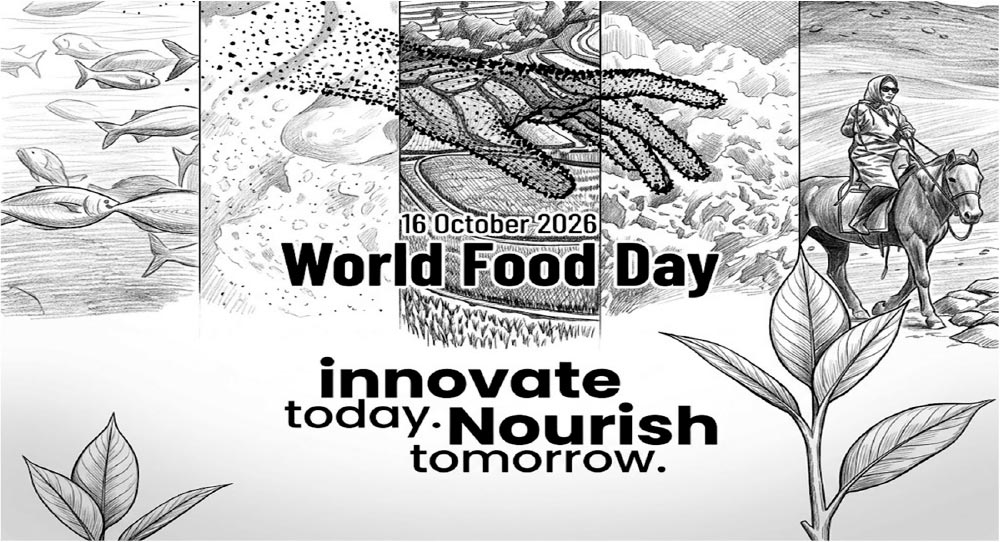
 October 16 marks World Food Day, commemorating the establishment of the Food and Agriculture Organization of the United Nations (FAO) in 1945. This year’s theme, “Innovate Today, Nourish Tomorrow,” calls for combining science, technology and innovation with traditional knowledge to ensure food and nutrition security for present and future generations. The challenge is not merely to produce enough food but also to make nutritious diets affordable and accessible.
According to the State of Food Security and Nutrition in the World (SOFI) 2026 report, published in July, approximately 645 million people, or 7.8 per cent of the global population, faced hunger in 2025. Although this was 14 million fewer than in 2024 and 43 million below the 2022 peak, progress remains insufficient. At the current rate, around 520 million people could still face hunger in 2030, jeopardising the United Nations Sustainable Development Goal 2 (SDG 2), or Zero Hunger. Africa now accounts for 309 million hungry people, surpassing Asia.
Affordability remains another major concern. In 2025, the average daily per capita cost of a healthy diet reached US$4.28 in purchasing power parity (PPP) terms, up from US$3.44 in 2021. Consequently, approximately 2.69 billion people, or 32.7 per cent of the global population, could not afford a healthy diet. Child stunting declined from 26.4 per cent in 2012 to 23.2 per cent in 2024, but remains above the 2030 target of 16.8 per cent. Clearly, food availability alone cannot guarantee nutrition security.
Bangladesh has made progress in reducing hunger, yet nutritional challenges persist. SOFI 2026 estimates that 8.2 per cent of the population, or 14.3 million people, suffered from undernourishment during 2023�"2025, down from 15.1 per cent, or 21.9 million, in 2004�"2006. However, 26.2 per cent, equivalent to 45.4 million people, experienced moderate or severe food insecurity. In 2025, an estimated 38.6 per cent, or 67.8 million people, could not afford a healthy diet, despite an improvement from 62.8 per cent in 2017. Its estimated daily per capita cost also rose from US$3.09 in 2017 to US$4.59 in 2025 in PPP terms, equivalent to an increase from approximately Tk 108 to Tk 160.
Children face a double burden of malnutrition. Around 25.1 per cent of children under five, or 4.2 million, are stunted, while 10.7 per cent, or 1.7 million, are wasted. Another 5.8 per cent are overweight. These figures highlight the need to improve dietary diversity alongside food production.
 Agricultural research offers a way forward. The Bangladesh Rice Research Institute (BRRI) has developed 127 modern, high-yielding rice varieties, including those tolerant to salinity, drought, floods, cold and waterlogging. Others are enriched with zinc, protein and vitamin E, while low-glycaemic-index varieties are suitable for people with diabetes. During the 2024�"25 Boro season, modern varieties covered 99.75 per cent of the country’s cultivated area, with BRRI varieties accounting for approximately 75 per cent.
Zinc-enriched rice is particularly significant in a country where rice is the staple food. BRRI dhan62 is the world’s first zinc-enriched rice variety, and BRRI has developed seven such varieties, each containing at least 24 milligrams of zinc per kilogram. Wider access to these varieties could help address micronutrient deficiencies, especially among low-income households unable to afford a diverse diet. Meanwhile, varieties developed for hilly and remote areas, saline coastal regions, haor wetlands vulnerable to early flash floods and drought-prone Barind areas can help farmers cope with climate change.
However, innovation matters only when it reaches farmers and consumers. First, the government must increase productivity in vegetable, pulse, fisheries and livestock sectors to make healthy diets more affordable. SOFI indicates that animal-source foods, fruits and vegetables account for approximately 70 per cent of the global cost of a healthy diet, while staple carbohydrate-rich foods account for about one-sixth. Reducing post-harvest losses during storage and transportation is therefore essential.
Second, agricultural extension services, seed distribution networks and information systems must be strengthened so smallholder farmers can benefit from improved technologies. Public awareness of zinc-enriched rice should also be increased. Third, investment in domestic research and fertiliser-saving technologies must grow to reduce dependence on imported agricultural inputs. SOFI 2026 warns that instability in food, fertiliser and energy markets arising from conflicts in the Middle East could undermine progress against hunger.
Finally, digital and inclusive innovation deserves priority. Early weather warnings, mobile-based agricultural advice, improved access to technology for women farmers and opportunities for young agricultural entrepreneurs can strengthen resilience. These advances must reach vulnerable communities rather than remain accessible only to those with greater resources.
The message of World Food Day 2026 is clear: food security depends not only on production but also on nutritional quality, affordability and equitable access. Bangladesh has made considerable progress through agricultural research, but its next challenge is to translate food production gains into nutrition security for the 67.8 million people unable to afford a healthy diet. “Innovate Today, Nourish Tomorrow” must become a national commitment supported by sound policies, sustained investment and effective implementation.
The writer is Senior Communication Officer at the Bangladesh Rice Research Institute (BRRI)

Loading...
Loading...
Also read



Editor : Iqbal Sobhan Chowdhury
Published by the Editor on behalf of the Observer Ltd. from Globe Printers, 24/A, New Eskaton Road, Ramna, Dhaka.
Editorial, News and Commercial Offices : Aziz Bhaban (2nd floor), 93, Motijheel C/A, Dhaka-1000.
Phone: PABX- 41053001-06; Advertisement: 41053012; 01793317829, 01550707291, E-mail: [email protected], [email protected] Online: email: [email protected] 41053014; 01550707297 Advertisement: 01550707296
Published by the Editor on behalf of the Observer Ltd. from Globe Printers, 24/A, New Eskaton Road, Ramna, Dhaka.
Editorial, News and Commercial Offices : Aziz Bhaban (2nd floor), 93, Motijheel C/A, Dhaka-1000.
Phone: PABX- 41053001-06; Advertisement: 41053012; 01793317829, 01550707291, E-mail: [email protected], [email protected] Online: email: [email protected] 41053014; 01550707297 Advertisement: 01550707296


