



| HEADLINE |

|

Freedom on Social Media Is Not a Licence to Abuse
Published : Sunday, 18 October, 2026 at 12:00 AM
Abu Md Masani


 It is not in my nature to comment on individuals or their behaviour towards others. Such conduct does not align with my background or lifestyle. However, I am increasingly disturbed by the way innocent people are trolled and bullied on social media. Why has this become so rampant? Are we, as a society, becoming increasingly intolerant? These questions often bother me. It is high time we addressed this issue. In raising awareness, no one should be spared scrutiny, whether a head of state or an ordinary citizen.
The time has come to realise that remaining silent in the face of wrongdoing can amount to supporting it. When I see someone being unfairly attacked, my conscience tells me to speak up. Whether that person is close to me or whether I might gain a favour by supporting them should not matter.
I often wonder where we have gone wrong. In the age of social media, our behaviour often seems irrational and intolerant. Are we becoming a nation of narrow-minded people? A culture of distrust appears to be taking root in our society. When someone achieves something significant, others often respond with envy or suspicion, regardless of the circumstances. Political opponents, too, seem ever ready to seize an opportunity to discredit one another.
Perhaps our greatest challenge lies in overcoming this narrow-mindedness. Can a society truly progress if it refuses to rise above such attitudes?
Social media has made communication easier than ever. Within seconds, we can exchange messages, share photographs and videos, and express our opinions. However, this convenience has also brought serious challenges, particularly the growing misuse of online platforms to damage personal reputations and invade privacy.
Criticism is essential to a democratic society. It can expose wrongdoing, encourage accountability, and help bring about reform. However, criticism should not be driven by hatred or take the form of character assassination, harassment, or the use of abusive language. Sadly, insulting and humiliating others online has almost become an art of destruction. Such behaviour is a serious obstacle to building a civilised society.
Today, it takes very little time to create and circulate false information, manipulated photographs, or objectionable videos about someone. With the help of modern technology, even convincing content can be produced that has no connection to reality. Once such material spreads online, the consequences for the person concerned can be severe.
What is even more disturbing is that we often share such content without checking whether it is true. A single click may seem insignificant to us, but for the person whose name, photograph, or identity has been misused, it can lead to prolonged distress, insult, trauma, social humiliation, and emotional suffering.
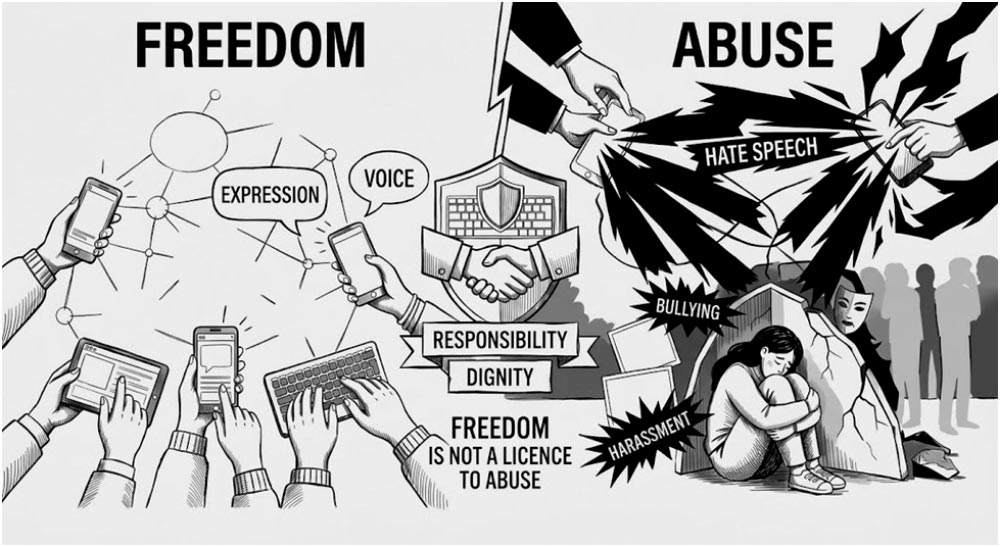 The solution, therefore, cannot lie in technology alone. We must also learn to use it responsibly. Otherwise, the same harm we inflict on others today may one day affect us or someone close to us.
First, appropriate age restrictions on social media platforms are necessary. Parents and guardians must pay greater attention to teenagers' online activities. Government-supported initiatives should also be introduced to regulate online content accessible to children and protect them from harmful material. Parents should be equipped with appropriate cybersecurity knowledge and remain attentive to their children's online activities. Identity verification may also help improve accountability, but it must be designed carefully to protect ordinary users' privacy and prevent the unnecessary exposure of personal information.
Second, reporting mechanisms must be simple, accessible, and effective. If someone's identity is misused or false and offensive content is circulated about them, they should be able to report it easily and receive a timely and fair review. Removing harmful content is important, but affected individuals should also have access to appropriate support and clear information about the steps available to them.
Third, we must change our own online behaviour. Before sharing a photograph or video, we should pause and ask ourselves a few simple questions: Is this genuine? Could sharing it harm someone's dignity? How would I feel if I were the person concerned? What if it involved a member of my own family? How might that person feel?
Freedom of expression is a fundamental right, and the freedom to criticise must be protected. However, freedom does not mean having the right to destroy another person's dignity or violate their privacy. Disagreements are inevitable in a diverse society, but they should never become an excuse for personal humiliation or character assassination.
The state, technology companies, and individual users all have distinct responsibilities. Effective regulations, accessible reporting systems, appropriate technological safeguards, and greater public awareness must work together to create a safer digital environment in our country.
Above all, we must remember that there is a human being behind every screen. That person has a family, relationships, a reputation, and feelings. Online abuse can affect not only the individual but also their family and social life, sometimes with lasting consequences.
A photograph can spread within seconds, and a false allegation can reach thousands of people almost instantly. Repairing the damage, however, may take years. For some, the emotional trauma can be extremely difficult to overcome, and the consequences may be devastating.
So, let us think twice before sharing, reconsider before commenting, and respond responsibly when we witness wrongdoing. Instead of remaining silent spectators or joining online attacks, we should use appropriate reporting channels to identify and address cybercrime.
Technology has given us tremendous power. Now, we must learn to exercise that power responsibly; because freedom is at its best when it goes hand in hand with responsibility.
The writer is a senior journalist

Loading...
Loading...
Also read



Editor : Iqbal Sobhan Chowdhury
Published by the Editor on behalf of the Observer Ltd. from Globe Printers, 24/A, New Eskaton Road, Ramna, Dhaka.
Editorial, News and Commercial Offices : Aziz Bhaban (2nd floor), 93, Motijheel C/A, Dhaka-1000.
Phone: PABX- 41053001-06; Advertisement: 41053012; 01793317829, 01550707291, E-mail: [email protected], [email protected] Online: email: [email protected] 41053014; 01550707297 Advertisement: 01550707296
Published by the Editor on behalf of the Observer Ltd. from Globe Printers, 24/A, New Eskaton Road, Ramna, Dhaka.
Editorial, News and Commercial Offices : Aziz Bhaban (2nd floor), 93, Motijheel C/A, Dhaka-1000.
Phone: PABX- 41053001-06; Advertisement: 41053012; 01793317829, 01550707291, E-mail: [email protected], [email protected] Online: email: [email protected] 41053014; 01550707297 Advertisement: 01550707296


